Marketing and Trust
The advertiser owns the disclosure.
Written by Kaito Yoshizumi
- Published
- Last checked
- Reading time
- 9 minutes

Direct answer
Japan's stealth-marketing rule places the regulatory burden on the business whose product or service is being promoted, not on the influencer who uploads the post. Since 1 October 2023, an advertisement that ordinary consumers cannot recognize as an advertiser's representation can violate the Act against Unjustifiable Premiums and Misleading Representations. The commercial lesson is plain: disclosure cannot be outsourced with the caption.
A foreign brand can still work with creators, affiliates, reviewers, experts, and employees. The rule does not turn every mention into advertising. It does require the advertiser to understand when it has participated in deciding the representation and to make the commercial character clear in context.
This article is operational guidance, not legal advice. A real campaign needs review against its facts, platform, creative format, relationship, and current Consumer Affairs Agency guidance.
The hashtag handoff fails at the first edge case
Many campaign briefs reduce disclosure to one instruction: add PR or ad to the post. That can be a useful visible signal. It is not a complete control.
The Consumer Affairs Agency explains that the designation concerns advertising that consumers cannot identify as advertising. It can include content created at a company's request or direction by an influencer or another third party. It can appear in social posts, reviews, television, newspapers, radio, or magazines. The regulated party is the supplier business involved in deciding the representation—commonly the advertiser. The influencer is generally outside the designation's direct scope unless, exceptionally, the influencer jointly supplies the product or service.
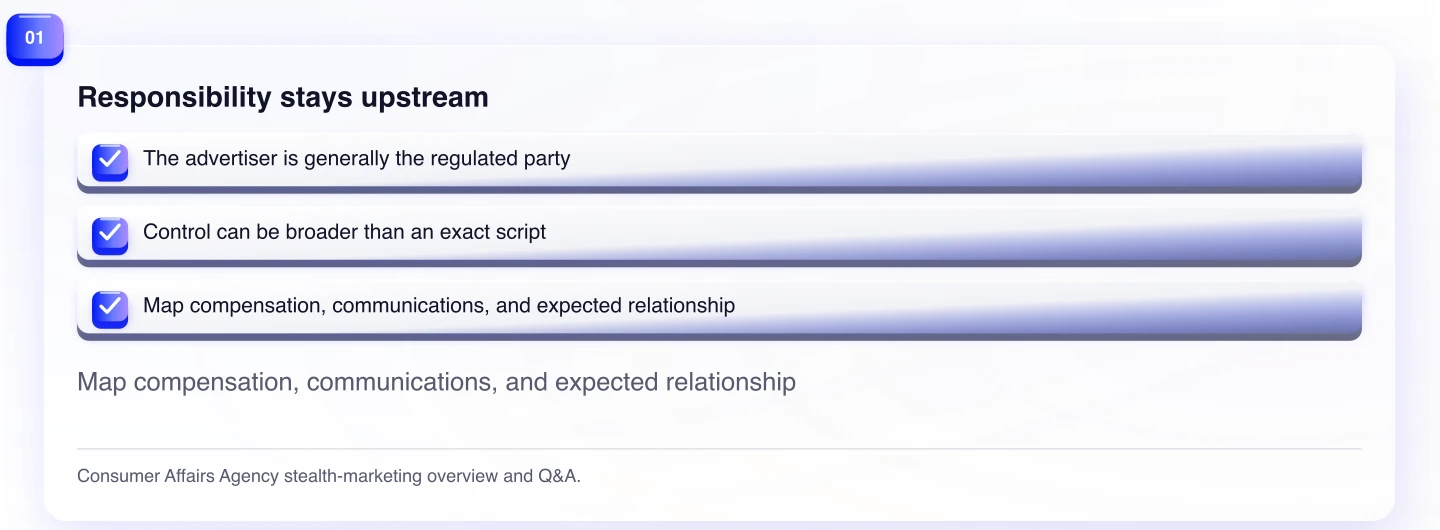
Responsibility therefore stays with the advertiser even when production moves outside the company. A creator can misunderstand the brief, remove a label, edit a video, or place the disclosure where a viewer will not notice it. If the advertiser's process ends at sending a policy PDF, the party with the regulatory responsibility has no reliable view of the output.
Control is broader than scripted words
The difficult question is often whether the post is the advertiser's representation at all. The CAA's Q&A says this does not depend only on an explicit instruction about exact words. The assessment can consider communications, compensation, the reason for providing it, and the past or expected relationship between the business and the third party.
In one Q&A example, a creator is paid to post impressions without receiving detailed content instructions. The Agency says the post is highly likely to be the advertiser's representation because the request and remuneration can show a relationship in which the content is not purely the creator's independent choice.
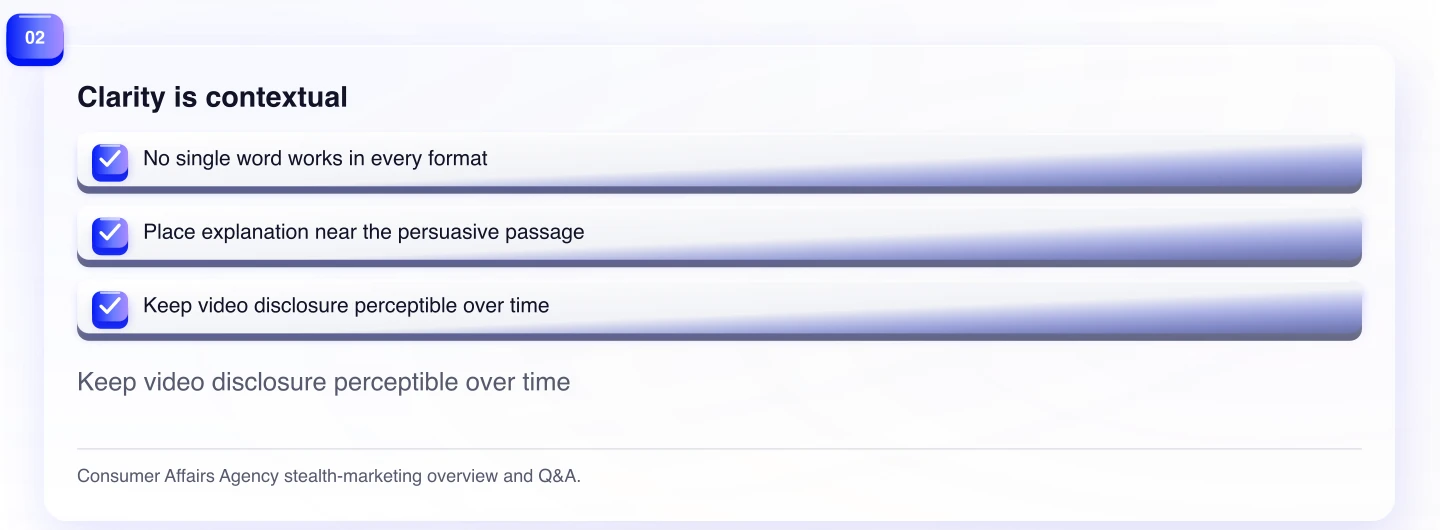
That makes a campaign relationship map more useful than a binary field labelled paid or unpaid. Record what the brand provided, what it requested, what approval rights it retained, what future relationship the creator might reasonably anticipate, and how the content is reused. A gifted product with no meaningful pressure can differ from a paid posting request. A spontaneous customer review can differ from a review required for a discount. The facts decide the classification.
The operator action is to classify before publication. For each asset, name the advertiser, creator, value exchanged, requested action, review rights, intended placement, reuse plan, and disclosure treatment. Escalate ambiguous cases to qualified Japanese counsel or a specialist reviewer.
Clarity is evaluated in context
The CAA does not prescribe one magic word for every format. Its Q&A says terms other than advertising, promotion, or PR can work if the overall representation clearly tells ordinary consumers that it is the business's representation. A sentence explaining that a company supplied the product can be appropriate.
Context also makes some technically present disclosures weak. For an affiliate page, a general statement at the top does not necessarily make every paid expert comment clear. The Agency says a paid and edited expert comment may need an explanation near that passage so a person viewing the passage alone understands its commercial origin.
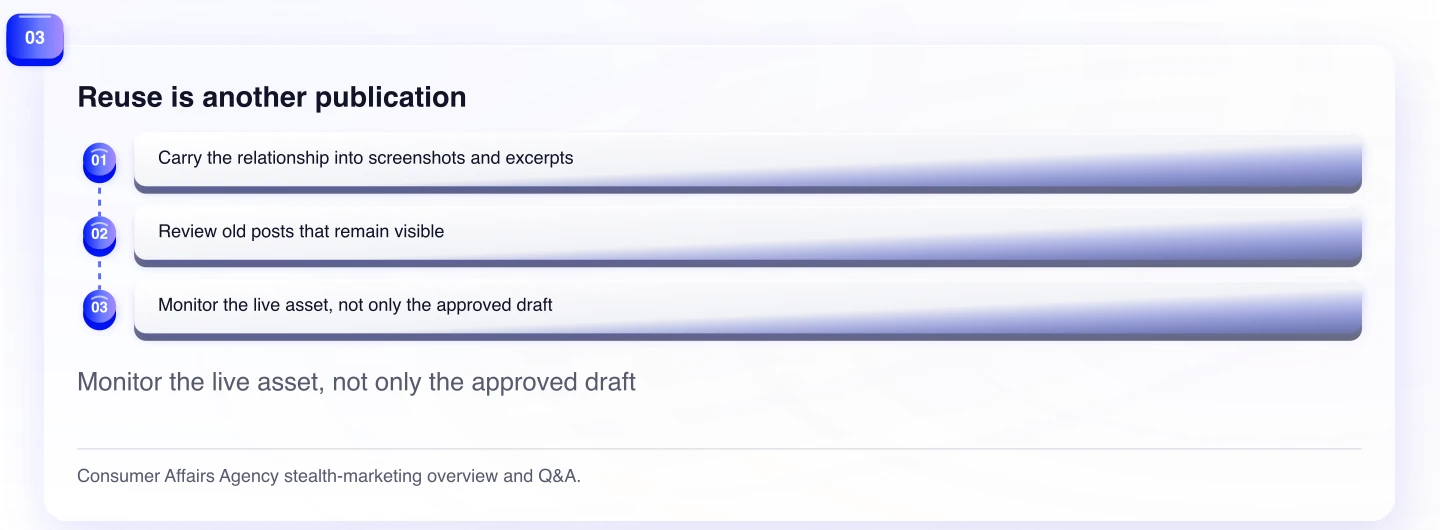
A disclosure placed only in a social-media reply will often be missed. The Q&A says such a placement may frequently fail to be clear because ordinary consumers may not notice the reply. For video, an opening disclosure can also be insufficient when people join later; the Agency says making the advertising character clear throughout the video is desirable.
The shared principle is perceptibility at the moment of persuasion. Ask whether a person encountering the claim, clip, testimonial, or recommendation can recognize the commercial relationship without hunting for another screen. The answer may differ by feed layout, caption truncation, video length, embed, repost, or device.
Reuse creates a second publication decision
Creator content does not remain in one post. A brand may quote it on a product page, turn it into a paid ad, place it in an email, or label it as a customer voice. Each reuse changes the context in which a person interprets the statement.
The CAA warns that an influencer post which is the advertiser's representation should not be presented as a customer voice in a way that suggests an independent consumer opinion. The advertiser's role must remain clear on the brand's own website. A disclosure attached to the original social post does not automatically travel with a screenshot or excerpt.
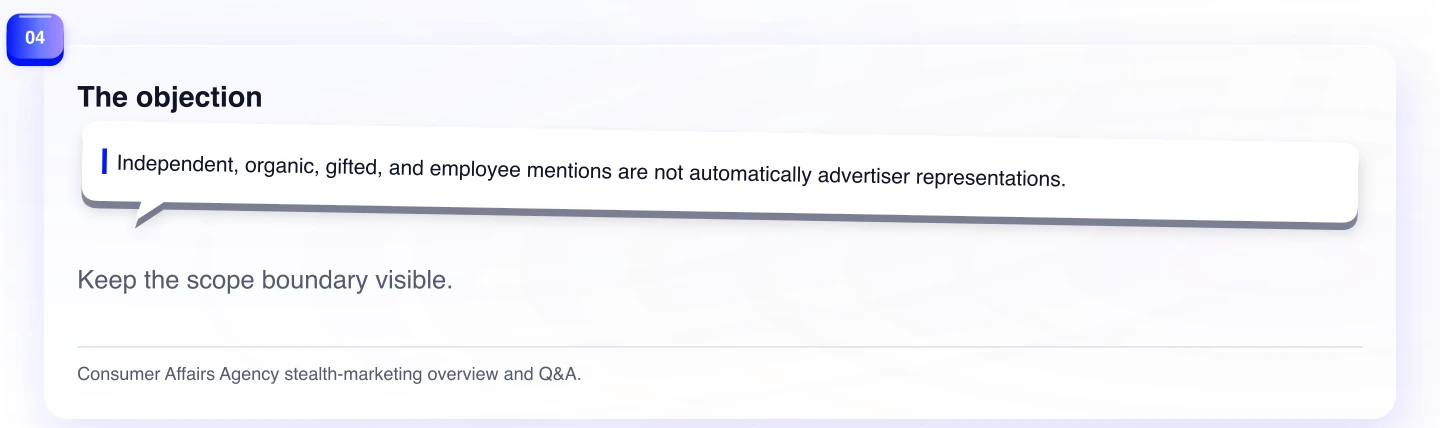
This is why a creator asset needs provenance. Keep the original brief, relationship classification, approved disclosure, final post, capture date, reuse rights, claim evidence, and every destination where the asset is republished. When a team crops the image or extracts a quote, the release workflow should ask whether the disclosure still works in the new format.
Old content also deserves attention. The Q&A says a representation posted before 1 October 2023 can still be subject to the designation if it remains visible after the effective date and its advertiser character is not clear. A campaign archive is not operationally dead merely because the media spend ended.
The objection: not every mention is an advertisement
There is a strong counterargument to compliance systems that become too broad. A creator may genuinely buy and recommend a product without a current arrangement. An employee's personal comment is not automatically the advertiser's representation merely because the person works for the company. A product gift can involve facts that still leave the creator acting independently.
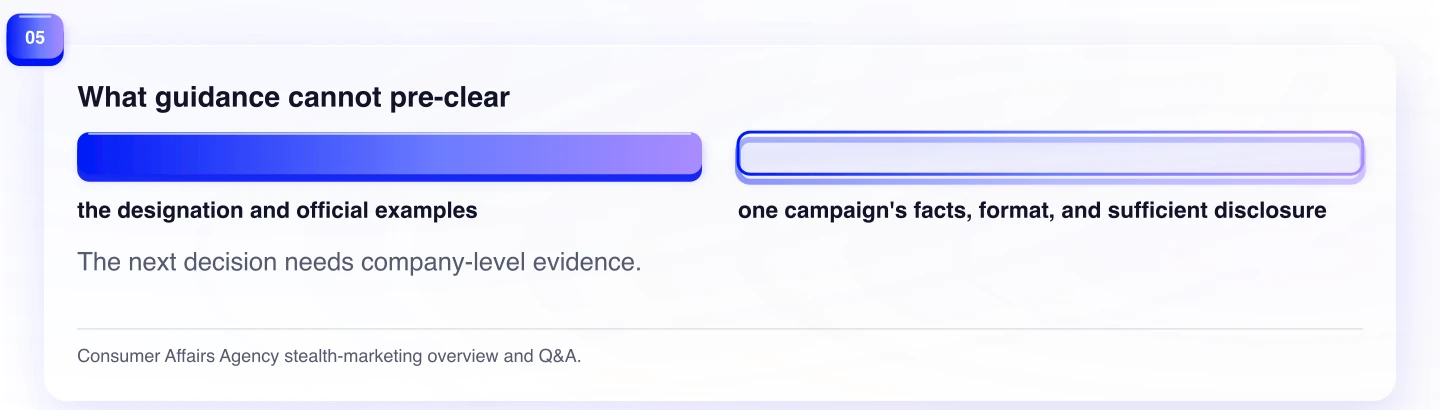
The Agency's Q&A recognizes those distinctions. Past paid work for one product does not automatically make a later independent post about another product advertising. The legal assessment is fact-specific. A rule that labels every organic mention as paid would reduce clarity and could distort the very distinction the designation seeks to protect.
The answer is not to disclose everything indiscriminately. It is to preserve evidence of why the team classified the representation as commercial, independent, or uncertain. An uncertain case should not be pushed through because the posting window is closing.
Enforcement risk is not the only business risk
Where a violation is found, the CAA's Q&A says the Agency may issue a corrective order requiring removal of consumer misunderstanding, prevention measures, and no repetition. The stealth-marketing designation itself is not subject to a surcharge order, although a representation that also includes a misleading quality or price claim may be subject to surcharge rules on that separate basis. The Agency may also issue guidance where it sees a risk of violation without establishing a violation.
Those outcomes matter. But a campaign can damage trust before formal enforcement. A customer who discovers an undisclosed relationship may reassess not only one post but the brand's reviews, ambassadors, and expert claims. The repair cost crosses teams: marketing edits assets, legal reviews claims, customer support answers complaints, and commerce removes reused testimonials.
The advertiser therefore needs a small operating loop. Marketing classifies the relationship. A reviewer checks the disclosure in the final format. Publishing captures evidence. Asset management preserves provenance. Monitoring looks for edits, reposts, and reuse. A named owner can pause an asset when the context changes.
Build a disclosure system, not a creator warning
Start with the next ten creator assets, not a theoretical policy. Create one row for each. Record the advertiser, creator, exchange of value, request, degree of control, current relationship, placement, disclosure wording, reviewer, final URL, capture, and reuse destinations.
Then perform three tests. View the content on the smallest supported screen and after caption truncation. Enter a video at the midpoint. Open a reused quote without the surrounding page. If the commercial relationship becomes difficult to identify, redesign the disclosure or the asset.
The operating principle is not that creators are untrustworthy. It is that the advertiser owns the conditions under which the campaign exists. The brand selects the relationship, supplies the value, shapes the distribution, and often reuses the result. Japan's rule aligns the responsibility with that control. The disclosure belongs in the campaign system from brief to archive, because the advertiser still owns it after the creator presses publish.
Evidence
Sources
The works below support the article's factual claims and were rechecked on .
- Stealth marketing under the Act against Unjustifiable Premiums and Misleading RepresentationsConsumer Affairs Agency · October 1, 2023 · Accessed August 10, 2026
- Stealth marketing Q&AConsumer Affairs Agency · Accessed August 10, 2026