Culture and Commerce
Japanese employees can name the gap. It is 1.05 million yen, and it is not mainly about money.
Written by Kaito Yoshizumi
- Published
- Last checked
- Reading time
- 11 minutes

Direct answer
Japanese employees can state one gap in money: 4.23 million yen is their average current annual income, while 5.28 million yen is the average income they consider commensurate with their work. The difference is 1.05 million yen. But the clearer deficit is elsewhere. The largest gaps in desired autonomy concern when work happens, while the gaps around how the work is done are close to zero.
That combination changes the employer's question. A company entering Japan may look first at salary budgets, then treat flexibility as a secondary benefit. The evidence suggests that control over the calendar is a distinct part of the offer. It may be cheaper to change than pay, but it cannot be presented as if it settles the pay question.
The familiar pitch: Japanese workers do not negotiate
The familiar pitch says Japanese workers accept the conditions placed in front of them. The story usually ends with a cultural explanation: employees value stability, avoid direct conflict, or do not ask for a different arrangement.
That account turns a measurable expectation into a personality trait. It also misses the precision of the dissatisfaction. The Hakuhodo survey did not ask only whether people were happy at work. It asked employed men and women aged 20 to 69 about the gap between their working conditions and what they considered appropriate.
The harder question is what kind of control employees want. If the answer were simply “more money,” the employer's response would be expensive but clear. If the answer is partly control over time, an overseas employer has another lever. The danger is assuming that lever can substitute for the first one.
A gap they can state to the yen
Hakuhodo ran the survey online across Japan between 31 October and 5 November 2024. It collected 5,000 responses from employed men and women aged 20 to 69. The result is an attitude measure: respondents' current income and the income they considered commensurate with their work. It is not an official wage statistic.
Average current annual income among respondents was 4.23 million yen. Average income they considered commensurate with their work was 5.28 million yen. The difference was 1.05 million yen.
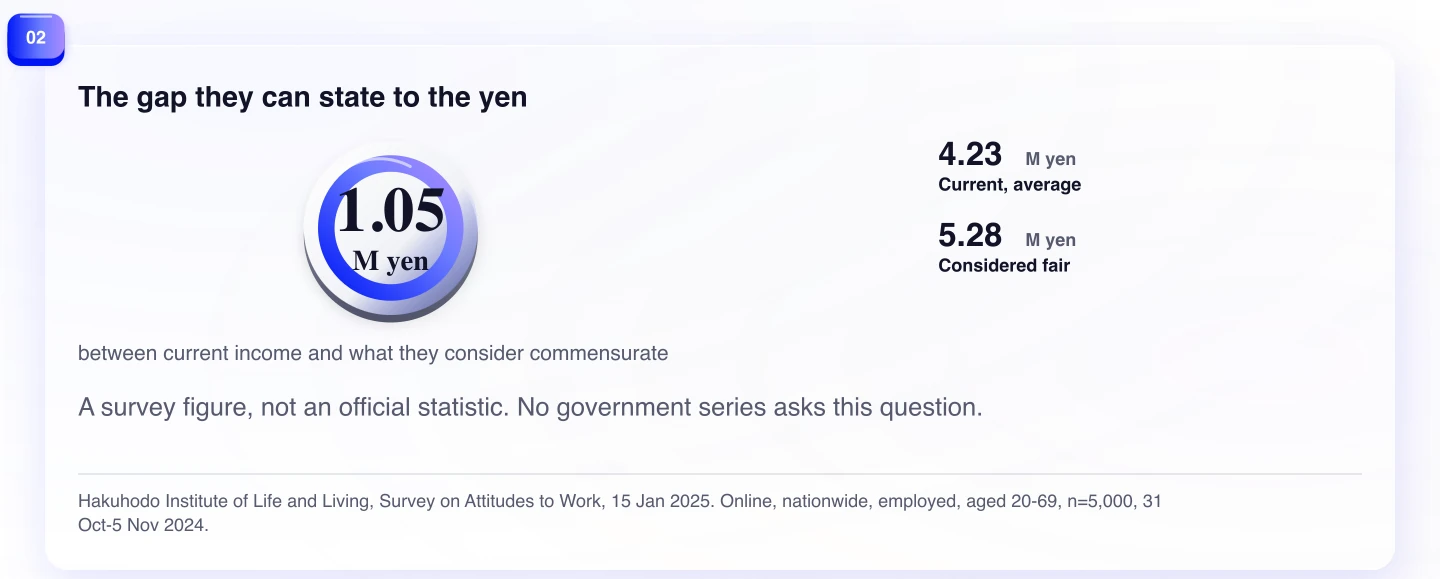
The precision of the figure can tempt an employer to treat it like a market clearing price. It is not one. The survey reports an average expectation across its respondents, not the amount every employee would require to move jobs. Still, a precise expectation gap is operationally different from a vague complaint. It tells a team that compensation is being compared against an internal standard, even when the employer cannot see the calculation.
Twenty-three years of scheduled earnings
The official wage series supplies context, not corroboration. The Basic Survey on Wage Structure covers private establishments with five or more regular employees across sixteen major industries. It approached 78,679 establishments and received 58,375 valid replies, a 74.2 percent response rate. It tabulated 50,682 private establishments with ten or more employees, recorded June wages, surveyed the following month, and weighted the results by prefecture, industry, and establishment size.
This is an establishment survey of wages paid. It does not ask employees what they think they are worth. That boundary is essential because the 1.05 million yen figure exists in only the Hakuhodo survey and cannot be corroborated by the official wage source.
What the official series does show is a long period in which scheduled cash earnings did not move far. Monthly scheduled cash earnings for general workers were 305.8 thousand yen in 2001, 299.6 thousand in 2014, and 330.4 thousand in 2024. The nominal series rose across twenty-three years, but it also fell in the middle.
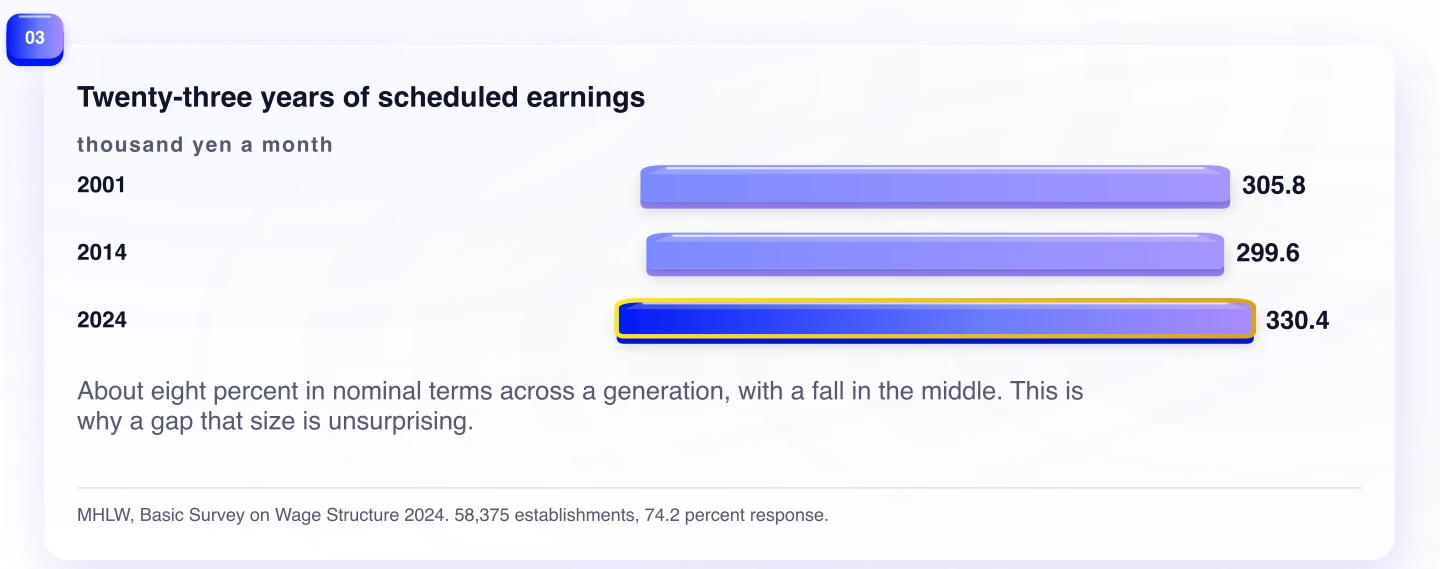
That history helps explain why an expectation gap of 1.05 million yen is plausible. It does not prove that flat scheduled earnings caused the expectation. The interpretation belongs to the relationship between the two sources, not to the official statistic by itself.
The same official dataset records other inequalities. Wages for workers other than permanent staff were 66.9 percent of permanent staff wages in 2024, a gap of 33.1 points. Women's wages rose from 65.3 percent of men's in 2001 to 75.8 percent in 2024. Men's wages peaked at 444.1 thousand yen a month in the 55 to 59 age band.
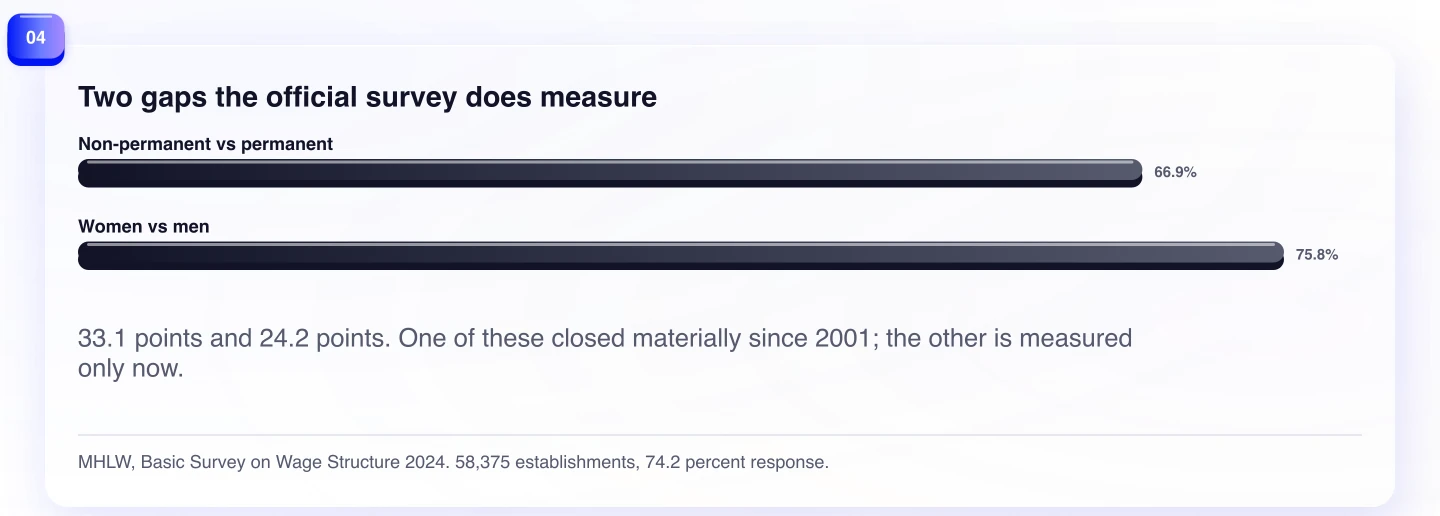
These figures widen the context without answering the survey's central question. They describe what establishments paid across defined groups. They do not say what any one worker believes the payment should be.
The comparison is therefore not a verdict on whether the official wage is fair. It is a way to keep two conversations from being confused. One conversation concerns the level and distribution of pay recorded at establishments. The other concerns the distance between a worker's current condition and the condition they consider appropriate. An employer needs both conversations, but neither source can stand in for the other.
The comparison is therefore not a verdict on whether the official wage is fair. It is a way to keep two conversations from being confused. One conversation concerns the level and distribution of pay recorded at establishments. The other concerns the distance between a worker's current condition and the condition they consider appropriate. An employer needs both conversations, but neither source can stand in for the other.
The gap that is not about pay
The autonomy questions are more revealing than the headline income figure. The largest gaps in desired autonomy concerned when work happens: number of days by 17.2 points, time of day by 15.4 points, number of hours by 14.1 points, and days of the week by 13.3 points.
The smallest gaps concerned how the work itself is done. The gap on method of working was 0.2 points, and the gap on break times was 0.3 points. Content of work sat at 12.2 points, while place of work sat at 11.5 points.
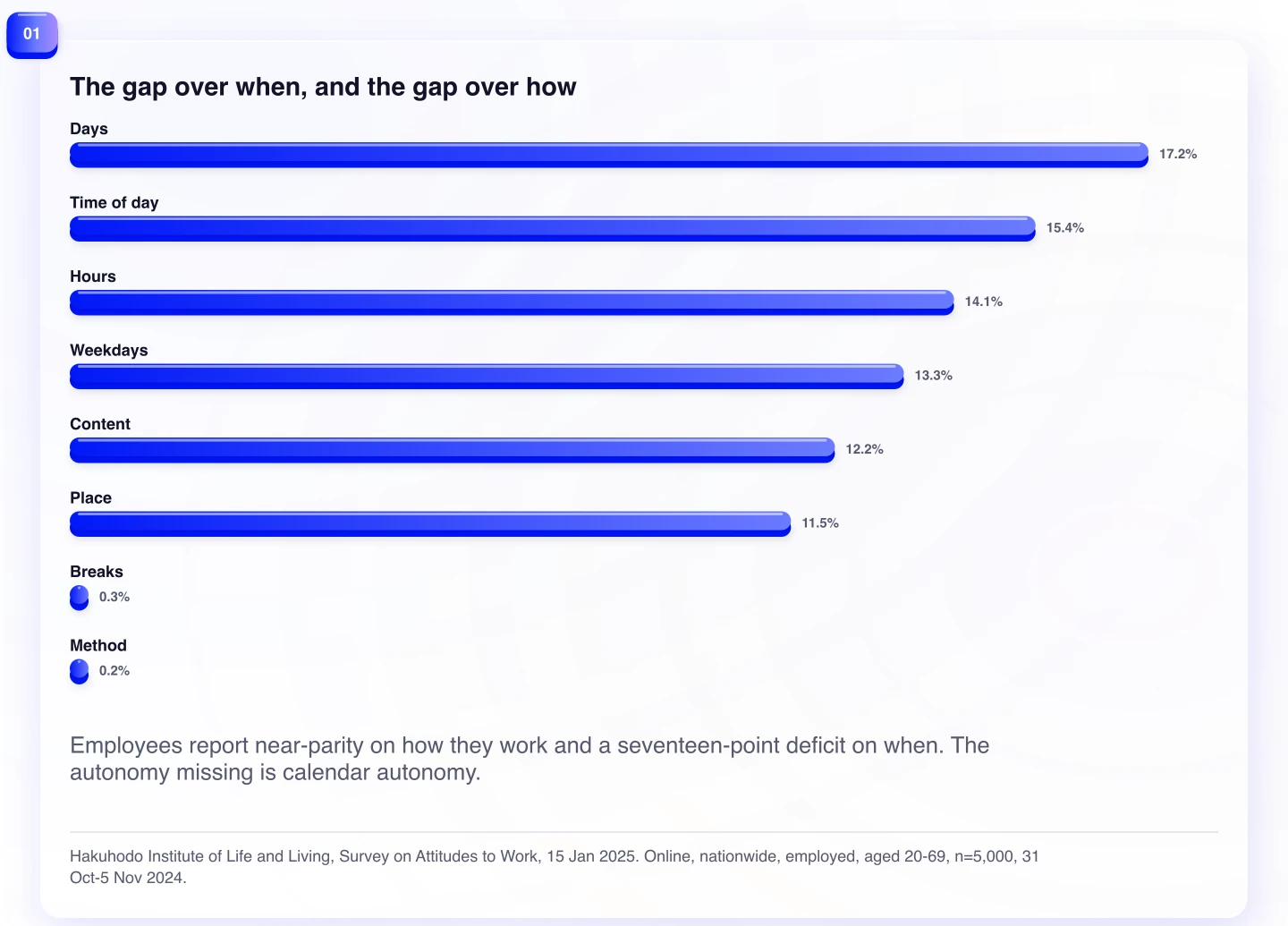
The distinction is easy to flatten into “employees want flexibility.” The data is more specific. Respondents reported near-parity on how they work and a much larger deficit on when they work. The autonomy they are missing is calendar autonomy, not task autonomy.
That changes the design of an offer. A team can give someone discretion over methods and still control the week so tightly that the benefit is not felt. Conversely, a role can keep a clear method while allowing the employee more say over days or hours. The available evidence does not say which arrangement will produce the best retention. It says what to measure separately.
What the official statistic cannot say
The official wage survey measures what is paid. It never asks what workers think they are worth. The attitude survey measures what employed respondents consider appropriate. It does not establish that their desired income matches a sustainable wage for every role, industry, or establishment.
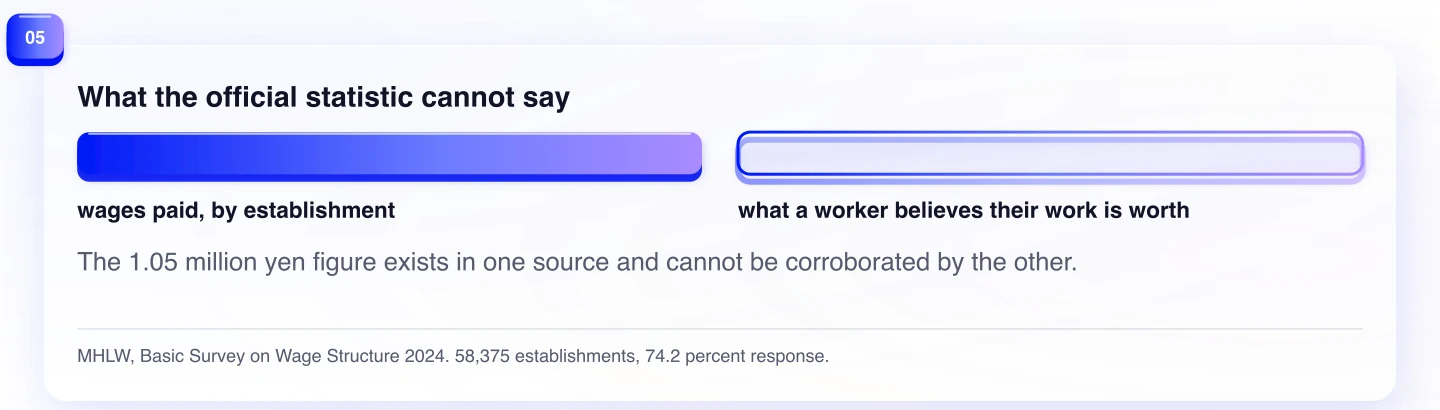
This is not a weakness to hide. It is the reason to use both sources carefully. The official series explains why a generation of relatively flat nominal earnings could leave employees with a large sense of distance from an appropriate income. The attitude survey shows the size of that reported distance and the different shape of the autonomy gap.
The two sources also have different units. Hakuhodo asked 5,000 people. The wage survey approached establishments and tabulated private establishments with ten or more employees. A respondent's expectation and an establishment's recorded wage are not interchangeable observations.
When flexibility reads as an evasion
The strongest objection is that schedule flexibility is not a substitute for pay. Offering the cheaper concession while the pay gap stands may read as an evasion rather than a benefit. An employer can point to control over days and hours while quietly avoiding a compensation problem that employees have already named.
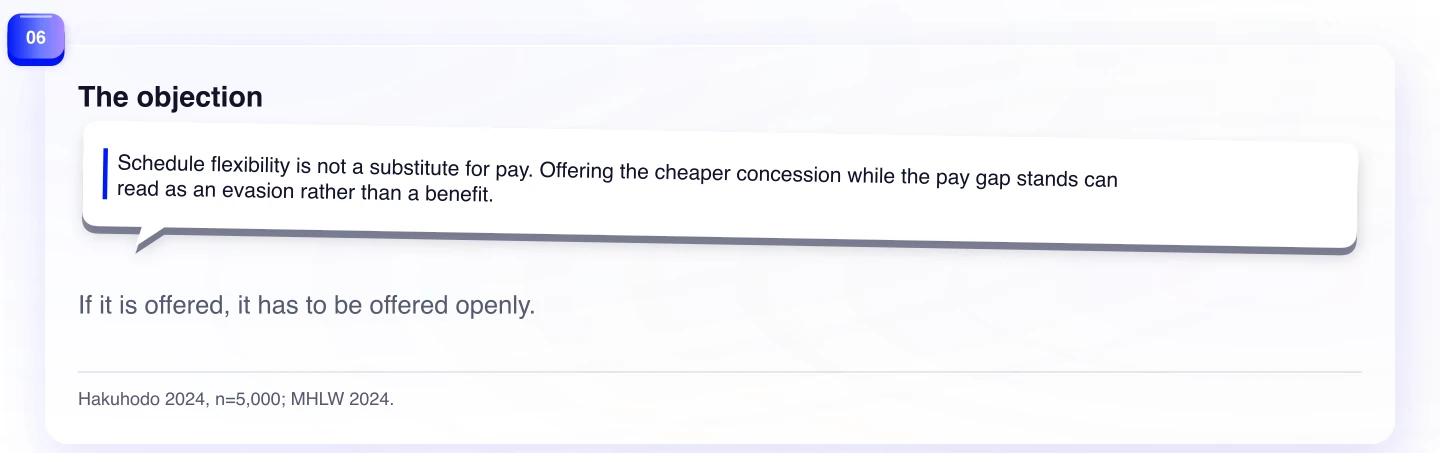
That objection is right to resist substitution. The evidence does not say that a 17.2-point schedule gap cancels a 1.05 million yen expectation gap. It says the two gaps are different and may require different responses.
The practical answer is to make the trade visible. If the role cannot meet the expected salary, say what it can and cannot offer. If schedule autonomy is part of the package, define the days, hours, and decision rights rather than using “flexible” as a decorative word. The cheaper gap can be worth closing only when it is offered as an additional condition, not as a disguise for the first one.
What remains unknown
Whether closing the schedule gap changes retention or acceptance rates in Japan is not measured by either source. The data does not establish that employees who receive more calendar control will stay longer, accept offers more quickly, or value the arrangement equally across roles.
That unknown should keep the employer from making a national promise. It should also keep the employer from dismissing schedule autonomy as a soft preference. The next test is local: define the schedule choice, offer it alongside a transparent pay position, and measure acceptance and retention rather than assuming either.
What an overseas employer should test
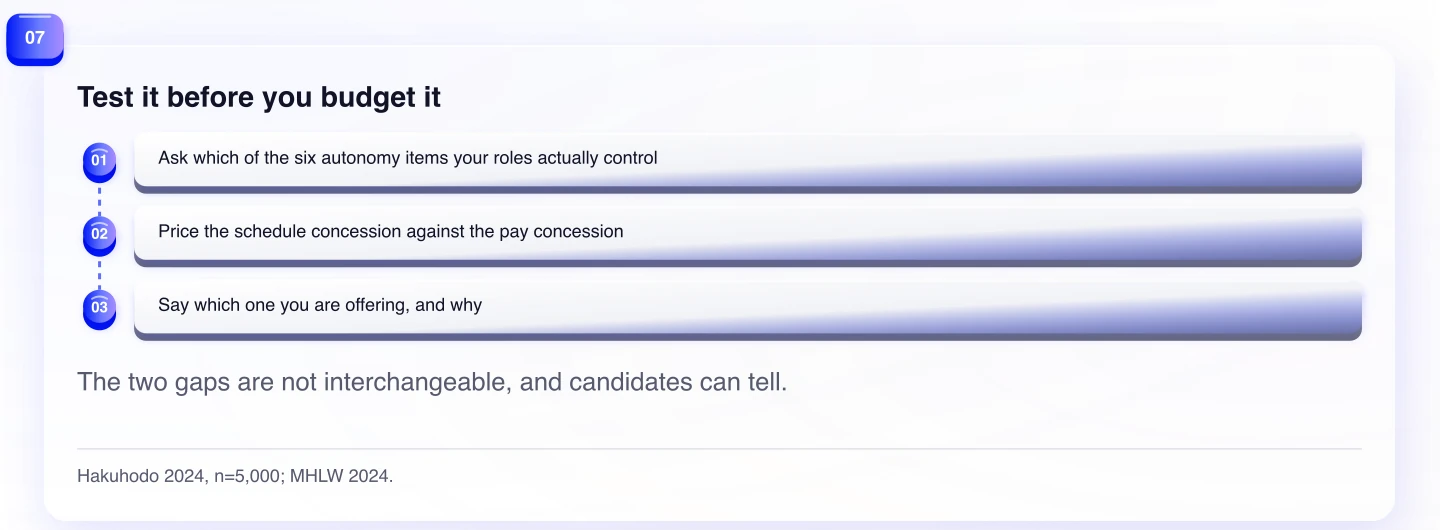
Start by separating compensation from control. Record the salary range, then record exactly which days, hours, and place-of-work decisions the employee can make. Do not put both under one heading called “work-life balance.” The survey's largest autonomy gaps are about time.
Next, test the offer with the people who would actually accept the role. Ask whether control over number of days, time of day, number of hours, or days of the week changes the decision. The national attitude survey identifies the dimensions; it does not rank their commercial value for every employer.
The test should also record what flexibility costs the organization. A schedule choice that depends on one manager's informal permission is not the same as a published rule that a worker can use without negotiation. The survey measures desired autonomy, not the reliability of an employer's process. That process is where a promise becomes real.
Make that process legible in the offer. State who approves a schedule change, how far ahead the request must be made, and what the employee can decide without asking. These details are not measured by the survey, but without them the word “autonomy” describes an aspiration rather than a working condition.
Use the official wage series as context when setting the conversation, not as a rebuttal to the expectation survey. It can show that scheduled cash earnings for general workers were 305.8 thousand yen a month in 2001, 299.6 thousand in 2014, and 330.4 thousand in 2024. It cannot tell an employee that 5.28 million yen is an invalid expectation.
The cheaper gap to close is measured in days rather than yen. That does not make it a substitute for pay. It makes it a separate promise that an overseas employer can test honestly, with the calendar visible and the compensation gap named rather than concealed.
Evidence
Sources
The works below support the article's factual claims and were rechecked on .
- 博報堂生活総合研究所「働くことに関する意識調査」Hakuhodo Institute of Life and Living · January 15, 2025 · Accessed August 8, 2026
- 厚生労働省 賃金構造基本統計調査 2024年Ministry of Health, Labour and Welfare · June 30, 2024 · Accessed August 8, 2026