Property and Place
Nine million vacant homes are not nine million available homes.
Written by Kaito Yoshizumi
- Published
- Last checked
- Reading time
- 9 minutes

Direct answer
Japan counted 9.002 million vacant dwellings in the 2023 Housing and Land Survey, equal to 13.8 percent of the housing stock. That does not mean nine million properties were listed, safe, financeable, legally simple, or located where a buyer needs them. The number is a classification of physical stock. A usable market begins after the classification.
For investors, hospitality operators, relocation services, renovation companies, and regional projects, the distinction is not semantic. A national count can make supply look abundant and cheap. The operating reality depends on category, owner intent, condition, title, access, local rules, infrastructure, and demand.
This article is not property, investment, tax, or legal advice. A specific building requires professional inspection, title and planning review, and local verification.
The headline is true and incomplete
The Statistics Bureau's final 2023 Housing and Land Survey counted 65.047 million dwellings in Japan. Of those, 9.002 million were vacant, the highest recorded number, and the vacancy rate reached 13.8 percent. Compared with 2018, the vacant count increased by 513,000 and the rate by 0.2 percentage points.
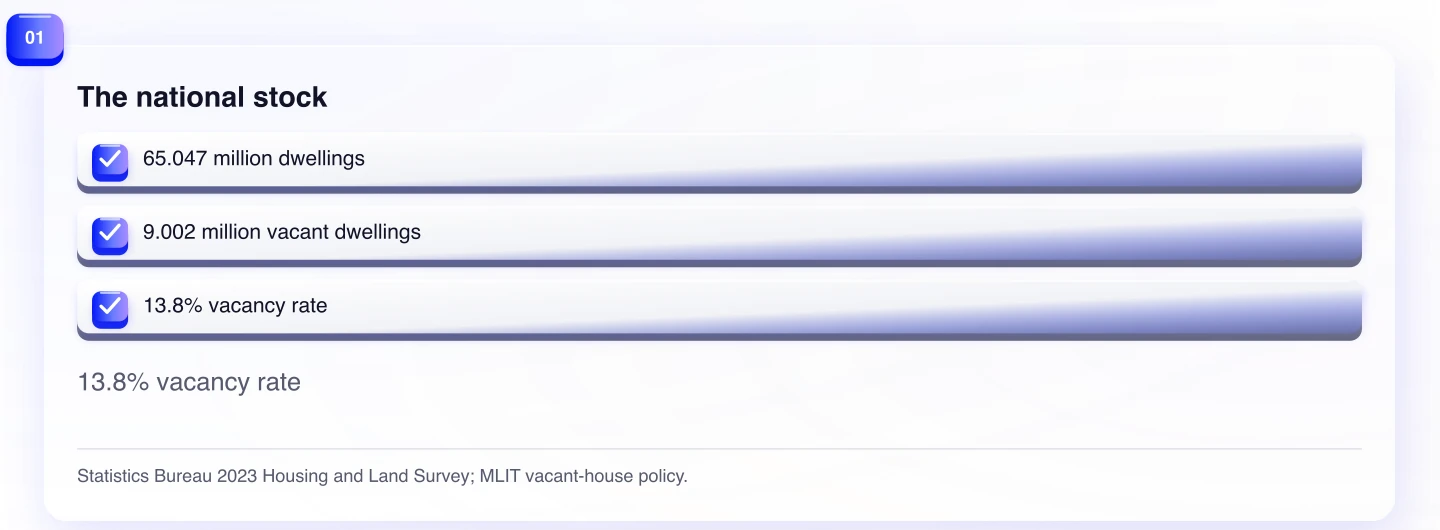
Those are serious figures. They show a growing mismatch between housing stock and continuous occupancy at a national level. They do not show a single pool of properties waiting for one kind of buyer.
The survey itself prevents that interpretation. It divides vacant dwellings into categories based on observed use: rental vacancy, for-sale vacancy, secondary residences, and vacancies outside those groups. Each category reflects a different reason the dwelling was empty on the survey date.
More than half of the stock was already in a market category
Of the 9.002 million vacant dwellings, 4.436 million were vacant rental units and 326,000 were for sale. Another 384,000 were secondary residences, including holiday homes and dwellings used occasionally. The remaining 3.856 million were vacant dwellings excluding rental, sale, and secondary-residence categories.
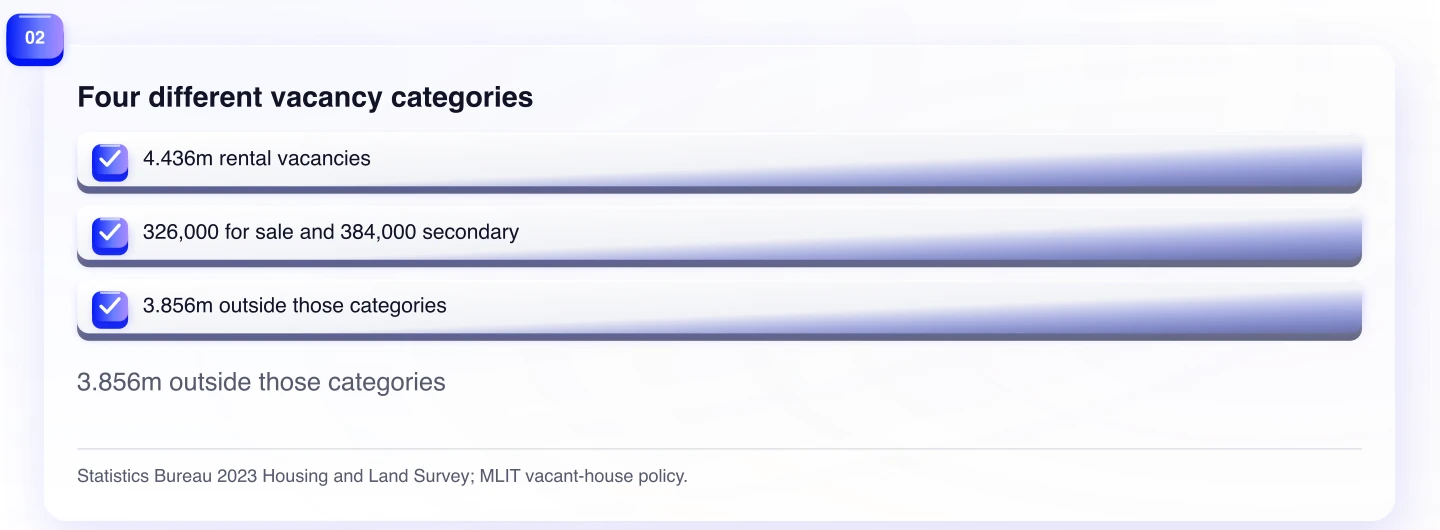
This breakdown changes the market story. A vacant rental unit is already part of a rental supply system, even if its location, quality, price, or timing has not attracted an occupant. A for-sale unit is already offered through some sales route. A secondary residence may be intentionally held for occasional use. The residual category includes dwellings vacant for reasons such as a long absence, impending demolition, or difficulty determining the category.
The four categories add to the national vacant total, subject to the Bureau's rounding convention. They do not have the same conversion path. Turning an empty rental into an occupied rental is different from acquiring an inherited house whose owner has not decided to sell.
The residual category is not a ready inventory
The 3.856 million dwellings outside rental, sale, and secondary use attract the most commercial imagination. The category grew by 369,000 from 2018 and represented 5.9 percent of the total housing stock in 2023. It can look like the closest official measure of abandoned homes.
The definition is broader. It includes housing without residents other than the rental, sale, and secondary categories—for example, homes left empty by a transfer or hospitalization and homes scheduled for demolition. It also includes cases where classification is difficult. The survey does not label every dwelling abandoned, purchasable, or structurally recoverable.
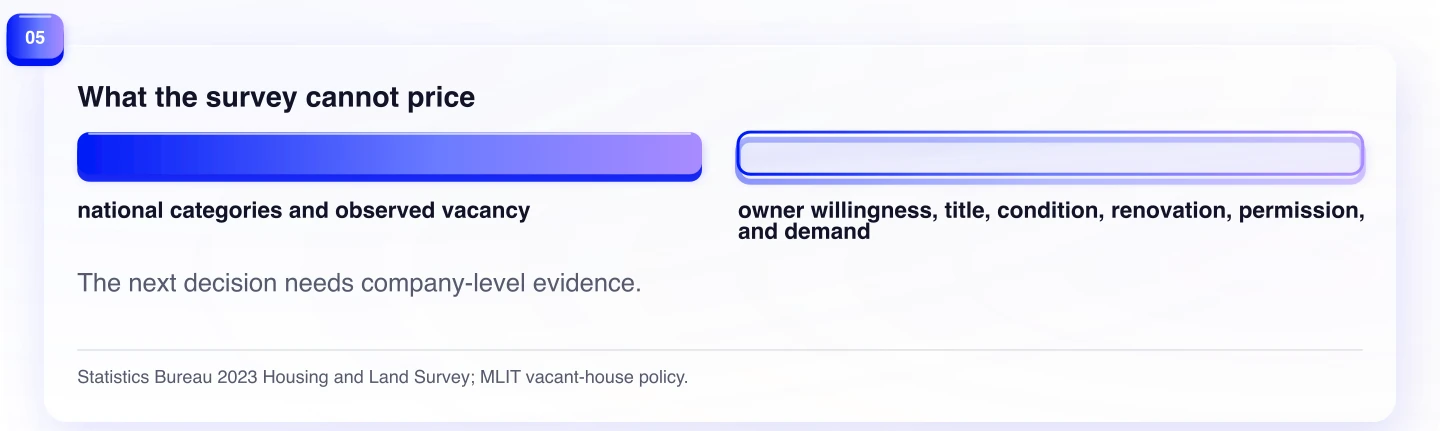
That boundary should change a business model. A marketplace cannot turn the residual count into listings by importing the statistic. A renovation company cannot infer the repairable share. A hotel operator cannot infer planning permission or visitor demand. A regional fund cannot infer ownership willingness or clean title.
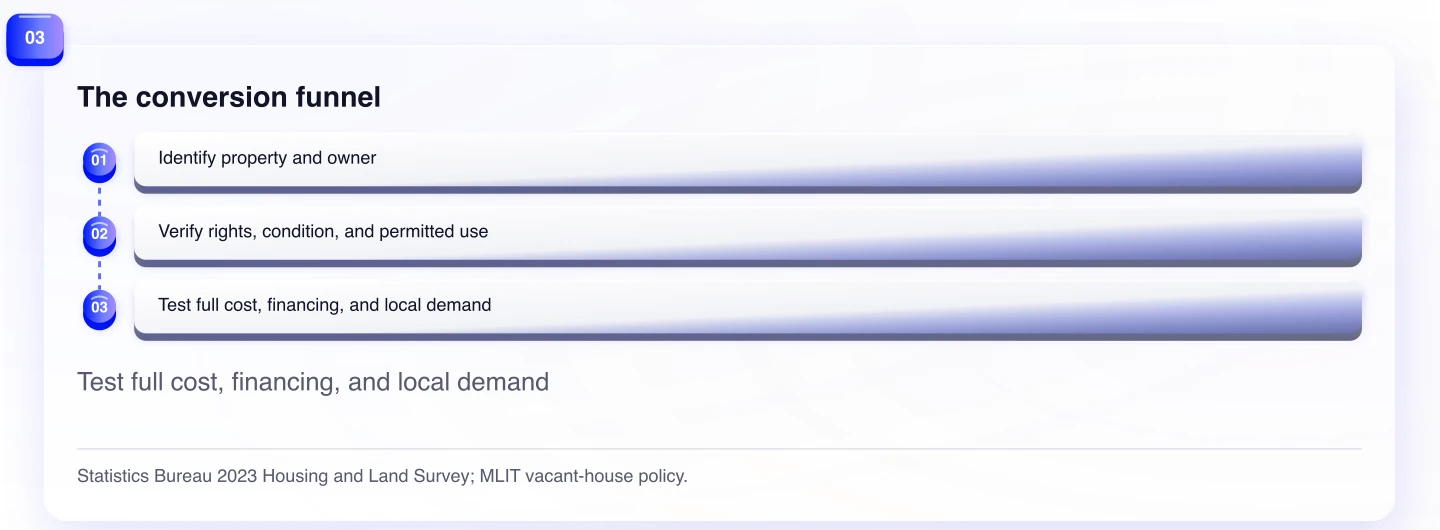
The operator needs a conversion funnel: counted vacancy, identifiable property, reachable owner, willing counterparty, clear rights, feasible use, acceptable condition, fundable project, and demand at the intended price. Each stage removes properties from the apparent stock.
The funnel also clarifies where a business can create value. One operator may specialize in owner outreach and inheritance coordination. Another may underwrite structural rehabilitation. A third may aggregate demand for a defined use. Treating all three as “vacant-home businesses” hides their different risks, partners, time horizons, and unit economics. The strongest opportunity may sit in one conversion stage rather than in owning the final property.
National abundance can coexist with local scarcity
The survey publishes results by prefecture and, for municipalities meeting the publication threshold, by municipality. That is important because a national dwelling is not portable. A vacant house in a remote settlement cannot satisfy demand beside a Tokyo office or a factory hiring cluster.
Even inside one municipality, location can change the economics. Road width, slope, snow, flood or seismic risk, utilities, transport, schools, medical access, and neighborhood rules affect use. A low acquisition price can be outweighed by demolition, seismic work, access repair, taxes, brokerage, registration, furniture removal, and the time required to coordinate owners.
The official national survey does not price those tasks. It frames the scale and category of the stock. A business has to build a local dataset that adds condition, ownership, legal access, target use, and demand.
Policy is moving from dangerous vacancy to managed vacancy
Japan's 2023 amendment to the Act on Special Measures concerning Vacant Houses added measures intended to promote use, strengthen management, and support removal of dangerous properties. The government materials describe mechanisms including municipal utilization-promotion areas and a category for properties at risk of becoming poorly managed.
The framework also allows municipal recommendations concerning a management-failure vacant house to affect the residential-land property-tax measure described in the official material. This does not make a given property available for sale. It changes the incentive and administrative context in which an owner may decide what to do.
For an operator, the local government is therefore not only a source of listings or subsidy information. It can be an essential source for policy zones, management status, demolition programs, community priorities, and the practical route to contact or coordinate owners.
The objection: the headline still describes a real problem
There is a fair objection to emphasizing classification. Nine million vacant dwellings and a record 13.8 percent vacancy rate remain evidence of a substantial housing-stock problem. Explaining that many units are rentals, for sale, or secondary residences should not minimize deterioration, demographic change, regional imbalance, or the burden on communities.
The objection is correct. The classification makes the problem more actionable; it does not make it smaller. A vacant rental can still indicate weak local demand or obsolete stock. A secondary residence can still be poorly managed. The residual category's growth is itself meaningful.
The article's narrower claim is that the national total cannot be used as the denominator for a commercial acquisition pipeline. The same number can be valid for a public-policy discussion and invalid for a forecast of properties a business can transact.
What the official count cannot tell you
The survey does not identify a property's owner or willingness to sell. It does not certify title, inheritance status, boundaries, structural condition, repair budget, insurance, financing, zoning, lodging permission, tenant history, or market demand. It also excludes so-called ruins that do not meet the survey's definition of a dwelling.
Those unknowns should be visible in the investment memo. Do not hide them inside a discount rate derived from a national headline. Separate evidence that exists from evidence to be acquired.
A useful memo should also state the exit condition for the investigation. If an owner cannot be identified, the intended use is not permitted, access makes construction impractical, or demand evidence fails, stop spending because the asset looked inexpensive. A low acquisition price does not compensate for a project that cannot reach lawful, safe, demanded use.
Start with one municipality and one intended use. Obtain the local vacant-property sources available to you. Sample 100 properties rather than extrapolating from nine million. For each, record category, address quality, owner contactability, stated intent, title status, physical inspection, use feasibility, all-in cost, time to control, and evidence of demand.
Then calculate conversion at every stage. If only a small share reaches a signed and feasible project, that is not a failure of the national statistic. It is the actual market the operator needed to discover.
Japan's vacant-home count is a valuable warning and a valuable map of categories. It is not a catalogue. The commercial opportunity begins when a team stops treating empty space as available supply and builds the local ownership, condition, permission, and demand system that can convert a dwelling into a usable place.
Evidence
Sources
The works below support the article's factual claims and were rechecked on .
- 2023 Housing and Land Survey final resultsStatistics Bureau of Japan · September 25, 2024 · Accessed August 10, 2026
- English news bulletin on the 2023 Housing and Land SurveyStatistics Bureau of Japan · October 30, 2024 · Accessed August 10, 2026
- 2023 amendment to the Vacant Houses ActMinistry of Land, Infrastructure, Transport and Tourism · March 3, 2023 · Accessed August 10, 2026