Culture and Commerce
Kaiwai is how Japan decides you are allowed in. It is not how Japan spends.
Written by Kaito Yoshizumi
- Published
- Last checked
- Reading time
- 12 minutes

Direct answer
Kaiwai is usually translated as “community.” The translation is useful, but too neat. Hakuhodo’s report defines the term as a loose cluster formed around a shared liking or interest, mainly on social platforms, while noting that the word originally described a physical vicinity such as the Shibuya area. A vicinity is something you can approach, pass through, or be recognized within. It does not promise a membership list, a captive audience, or a media plan. That distinction matters when an overseas team is deciding whether “kaiwai marketing” deserves a line in its Japan budget.
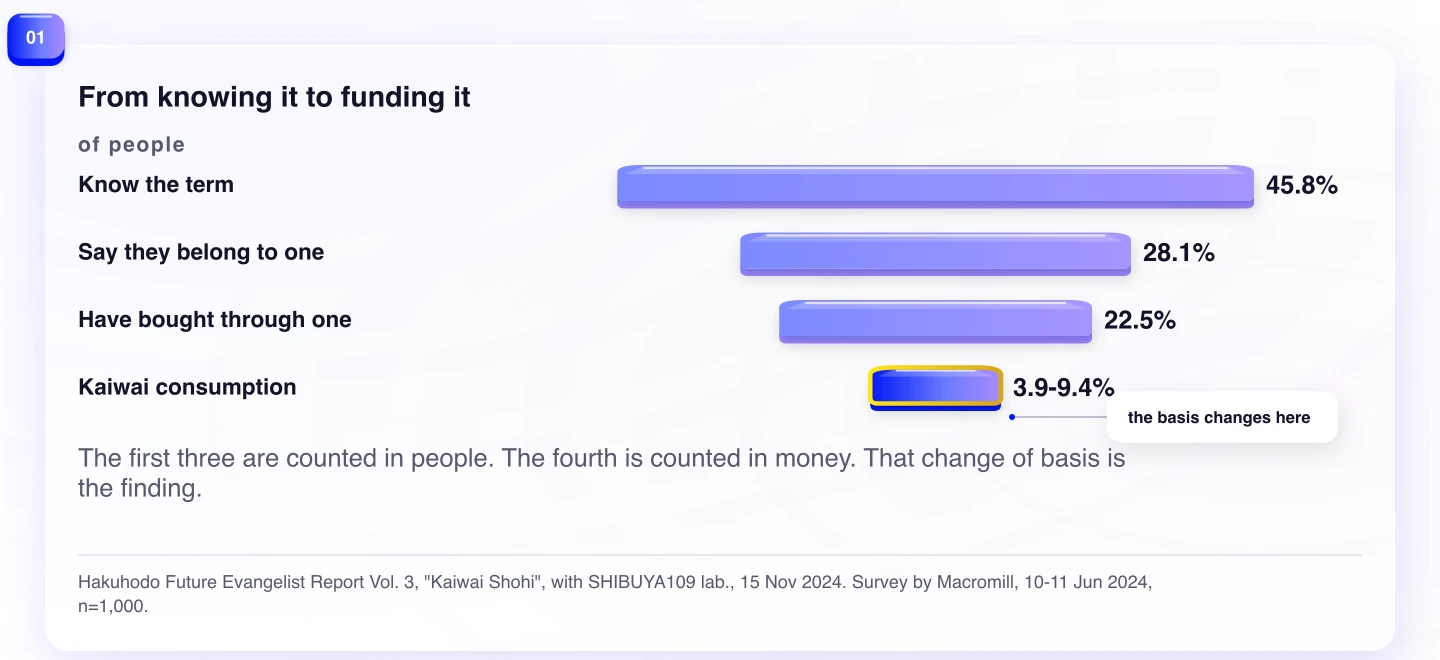
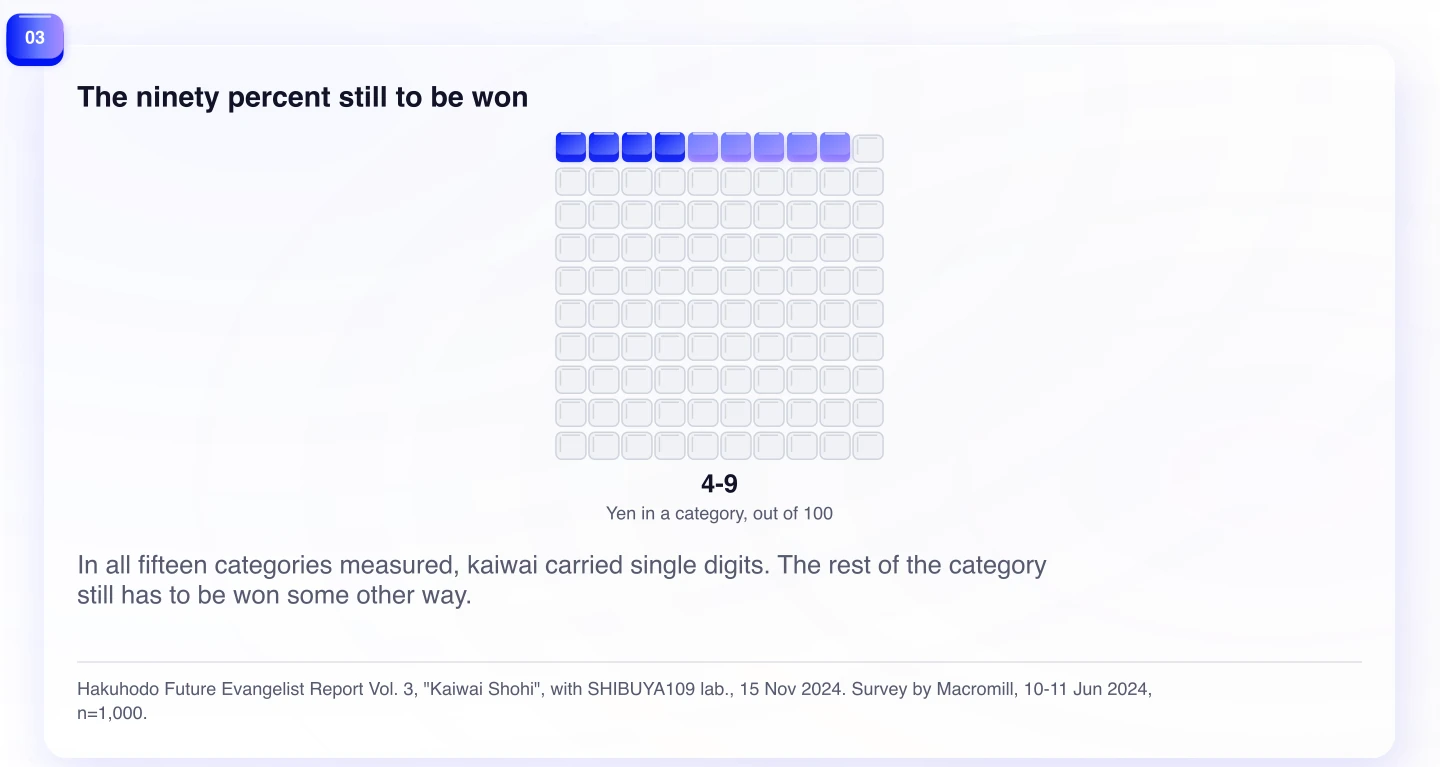
The research behind the term found substantial awareness, participation, and purchasing. It also found that kaiwai consumption accounted for only 3.9 to 9.4 percent of spending in every category measured. Read together, those results point to a narrower and more useful conclusion: kaiwai can determine whether a product is taken seriously inside a group, but it does not distribute most of that group’s spending.
The familiar pitch
The familiar explanation goes like this. Consumers have fragmented into interest-based micro-communities. Broad messages no longer travel as they once did, while people notice products through shared tastes, platform conversations, and the people they already regard as credible. Find the right group, approach it in its own language, and interest can move from one social sphere into another.
That account is not foolish. The report itself describes two ways buying can spread: within one kaiwai and across several of them. Nor is the measured reach trivial. More than one in five respondents said they had bought something after encountering information in a kaiwai.
The problem begins when a mechanism of influence is sold as a channel of scale. Reach, membership, and share of spending are different measures. A plan that treats them as interchangeable may buy visible attention without answering how the rest of the category moves.
What the research actually did
Hakuhodo’s Future Evangelist team and SHIBUYA109 lab. published Future Evangelist Report Vol. 3, “Kaiwai Shohi” on November 15, 2024. The quantitative work is a genuine strength of the report. Macromill surveyed 1,000 men and women in their teens through fifties across Japan on June 10 and 11, 2024. The sample used 100 respondents in each age-by-gender cell, then weighted the results to the composition of Japan’s 2022 national census.
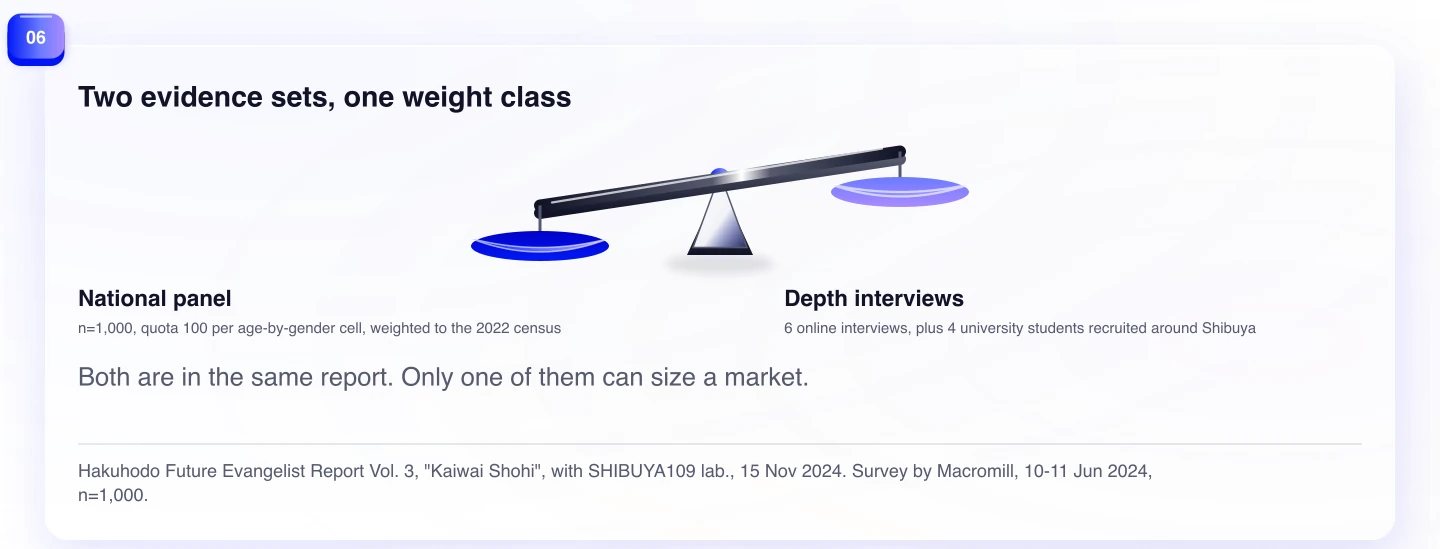
Two smaller qualitative strands supplied texture. Hakuhodo conducted six 60-minute online interviews on July 9 and 10 with people in their thirties and forties. SHIBUYA109 lab. separately interviewed four female university students in July who were deeply involved in a kaiwai.
Those interviews should not carry the weight of national findings. SHIBUYA109 lab. has met roughly 200 people aged 15 to 24 in person each month since 2018, but its interview pool is largely drawn from visitors to the SHIBUYA109 building. Around 80 percent are female, and most come from the greater Tokyo area. That access gives the lab a close view of young consumers around Shibuya; it does not make four students representative of the market.
The distinction between the two evidence sets is essential. A national panel can tell us how widely respondents recognized the term or reported a behavior. Interviews can show how that behavior felt to a few participants. They cannot tell an overseas company how its own category will perform.
Reach is real, but uneven
The national results explain why the idea traveled. Before the survey, 45.8 percent of respondents already knew kaiwai in its online sense. Awareness reached 80.6 percent among women in their teens and 68.9 percent among men in their teens.
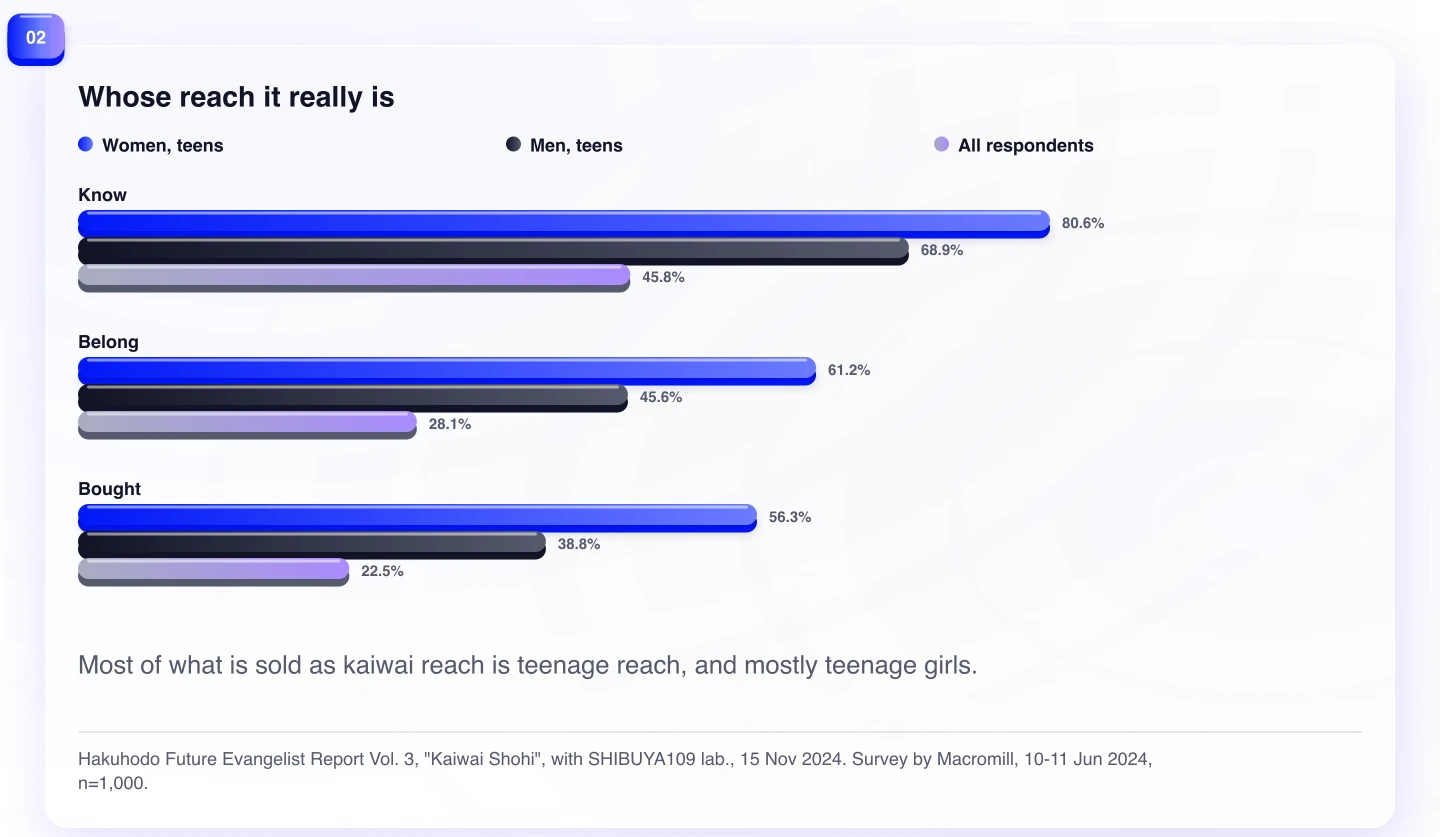
Recognition did not always mean self-identification. Across the sample, 28.1 percent said they considered themselves part of some kaiwai. The rate was 61.2 percent among women in their teens and 45.6 percent among men in their teens.
Purchase behavior sat lower again, although it extended beyond the youngest respondents. Overall, 22.5 percent said they had bought a product or service based on information encountered in a kaiwai. The figure was 56.3 percent among women in their teens and 38.8 percent among men in their teens; the report also says it remained just under 20 percent among people in their thirties and forties.
These figures support a meaningful claim: the behavior is neither an obscure youth-only label nor a market-wide default. It is visible across age groups, with a much stronger concentration among teenagers, and reported purchasing remains narrower than awareness.
The number that changes the picture
The report also asked a harder question: what share of total spending in each category counted as kaiwai consumption? Across all 15 categories, the estimates ranged from 3.9 to 9.4 percent. No category reached one tenth.
The report’s summary puts visually expressive categories such as interiors, sweets, fashion, and beauty near the top of the ranking. Categories that reward information gathering, including gadgets and beauty, also rank highly. That pattern makes intuitive room for products people can show, discuss, compare, or learn about together.
But the ceiling matters more than the ordering. A group may strongly shape which products become discussable while still accounting for a small share of everything its participants buy. The remaining spending does not become community-led simply because a kaiwai influenced one purchase.
For a budget decision, this is the essential distinction. A survey respondent can know the term, identify with a group, and occasionally buy through it without routing most category spending through that group. The report measured all three stages. Only the last one tells a team how much economic weight the mechanism might carry.
The ceiling is part of the design
The single-digit share could look like an early-stage limitation that better targeting will overcome. The report suggests something more structural.
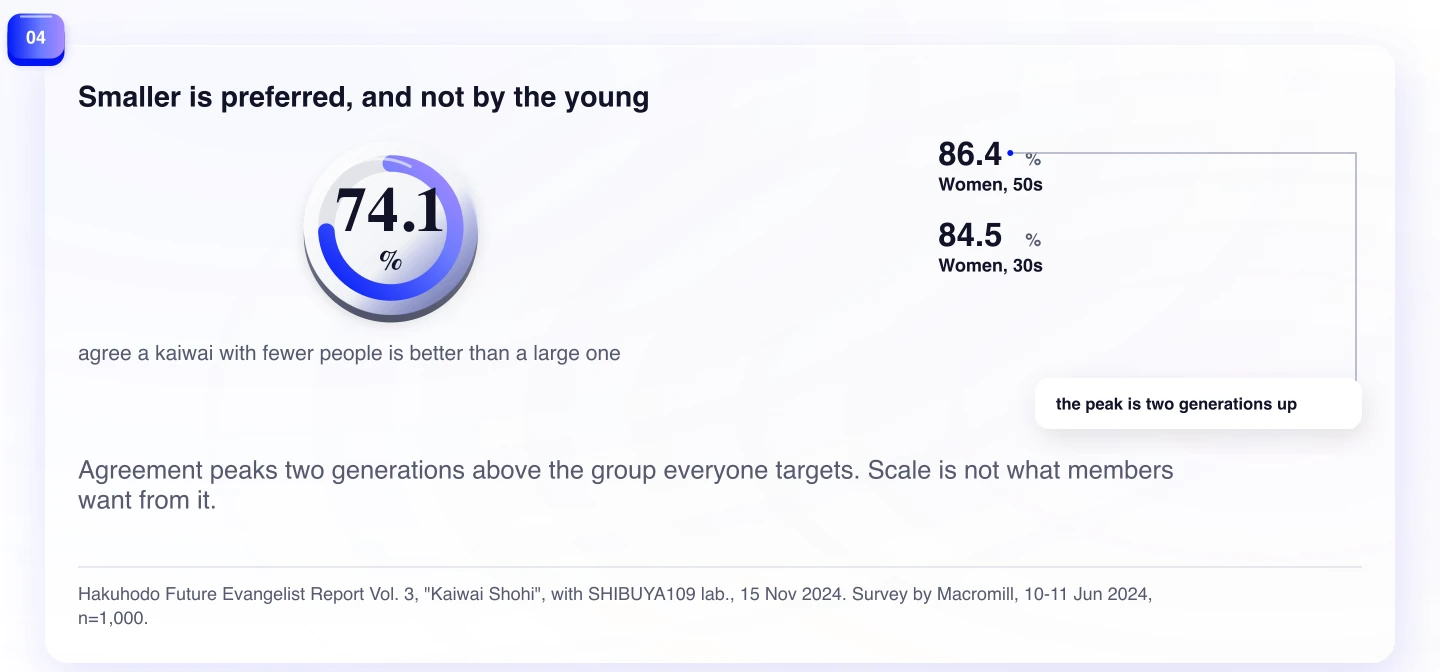
Almost three quarters of respondents, 74.1 percent, agreed that a kaiwai with fewer people is preferable to a large one. The strongest agreement did not come from teenagers: it reached 86.4 percent among women in their fifties and 84.5 percent among women in their thirties. Smallness was not merely a youthful fashion within this sample.
The report describes these groups as having no clear central figure and no firm boundary. One person can belong to several at once and move between them. Members are also sensitive to whether an outsider understands and respects the group; marketing that skips the research can backfire.
The four student interviews add a limited but revealing texture. Participants disliked the idea of an outsider assigning them to a named kaiwai. They did not want to add more groups because their time and money were finite, and they did not welcome sudden arrivals who ignored existing manners. These are four voices, not national estimates. Still, they show why “entering a community” is the wrong mental model: the clearer a company makes the target segment, the more artificial its approach may look to the people being targeted.
A kaiwai is therefore difficult to scale for the same reason it can be persuasive. Its value comes from loose boundaries, overlapping affiliations, and recognition earned within the group. Turning it into a large, clearly labeled audience can remove the conditions that made its signals credible.
How influence crosses the boundary
The report names two mechanisms of spread. Within a kaiwai, a post circulates until buying reaches much of the group. Across kaiwai, a person who belongs to more than one group carries a trend from one into another. That second movement depends on whether the originating group is regarded as credible.
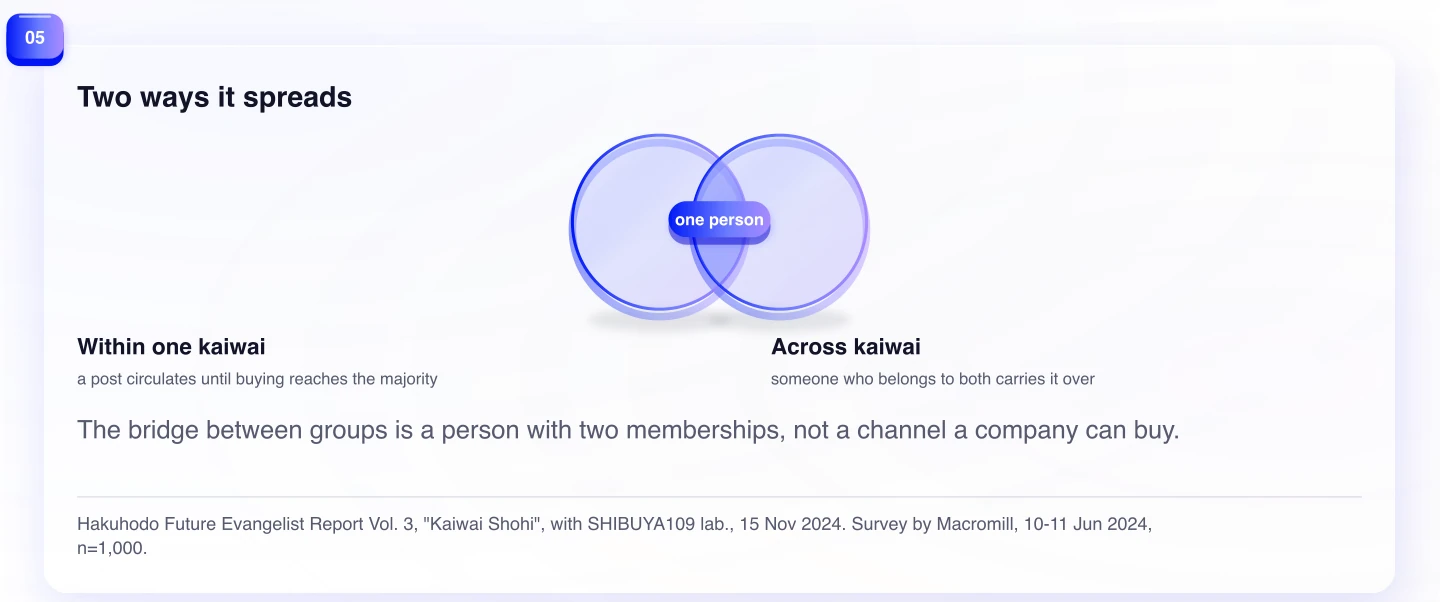
This is not a pipeline a company owns. The bridge is a person with overlapping affiliations, and the signal travels with borrowed credibility. A brand can make the movement easier by offering something worth discussing and by understanding the scene in which it is used. It cannot simply declare itself native to the group.
The mechanism also explains why a mass-reach plan can work against itself. If credibility rests partly on where an idea came from, stripping away that context and pushing the same message everywhere may increase impressions while weakening the reason anyone paid attention.
When nine percent is enough
There is a serious objection to the argument so far. A single-digit share of national category spending can still represent a substantial opportunity. An overseas entrant has no installed base to protect, and a category in which kaiwai accounts for 9 percent of spending may offer the cheapest realistic route to its first thousand customers in Japan.
That objection should change the recommendation. It does not change the mechanism.
For a new, visually expressive, or information-intensive product, earning credibility in one relevant group may be more useful than buying broad awareness. The attainable slice can matter more than the theoretical whole when the immediate task is finding an initial foothold. Treating kaiwai as unimportant because it is small would be as careless as treating it as the whole market because it is visible.
The better boundary is strategic. Kaiwai may be a strong starting point for an entrant seeking its first credible users. It is a weak substitute for a distribution plan expected to carry category-wide volume.
Admission, not distribution
Taken together, the numbers describe a mechanism of admission. Kaiwai can decide whether a product is allowed to be taken seriously inside a group. It does not carry most of the group’s spending, offer a stable membership boundary, or welcome unlimited expansion.
That reading also fits a newer directional signal from SHIBUYA109 lab. Its 2026 trend prediction centers on “attention detox”: deliberately stepping away from social platforms to avoid other people’s attention, with small-group and offline experiences prominent among the nominated trends. The prediction publishes no sample size or percentages, so it cannot establish a market shift. It does, however, reinforce the need to test the premise that more reach is always the desired outcome.
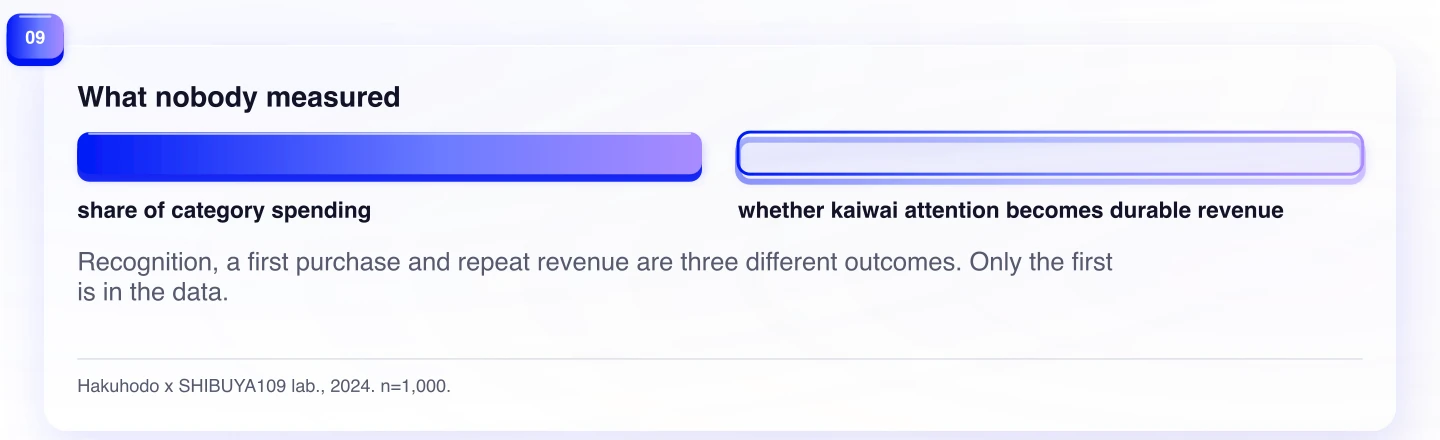
One crucial question remains unanswered. The 2024 report estimates spending share, not retention, and public evidence does not show whether kaiwai-driven attention turns into durable revenue for any specific overseas product category. A burst of recognized interest, a first purchase, and repeated revenue are separate outcomes.
What an overseas team should test
The practical response is not to avoid kaiwai. It is to budget the work accurately: as a cost of earning credibility, not as a customer-acquisition channel guaranteed to scale.
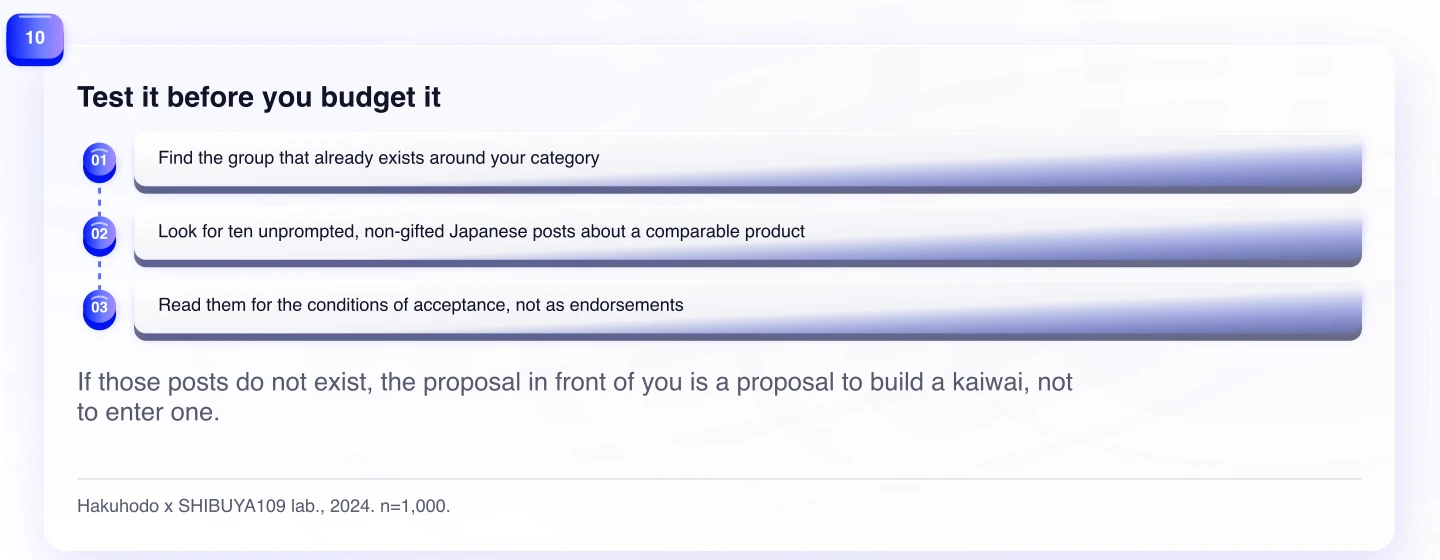
Before committing money, identify the group that already exists around the category and the platform on which its signals travel. Then look for ten unprompted, non-gifted Japanese-language posts about a comparable product. This is a diagnostic, not proof of demand. If those posts do not exist, there may be no relevant kaiwai to enter yet; the proposal in front of you is really a proposal to build one.
If the posts do exist, read them for the conditions of acceptance rather than collecting them as endorsements. What use scene keeps recurring? Which product details attract questions? What language signals that a recommendation came from someone the group trusts? The purpose is to understand the standard a product must meet before it becomes discussable. A count alone cannot supply that context.
Any agency proposal should make the same distinctions visible. Ask it to name the relevant kaiwai without pretending the boundary is fixed, show the platform and observable behavior behind that choice, and separate a credibility objective from a reach objective. Then ask what result would disprove the plan. If every mention is treated as progress and every adjacent audience is treated as expansion, the proposal has no useful stopping condition.
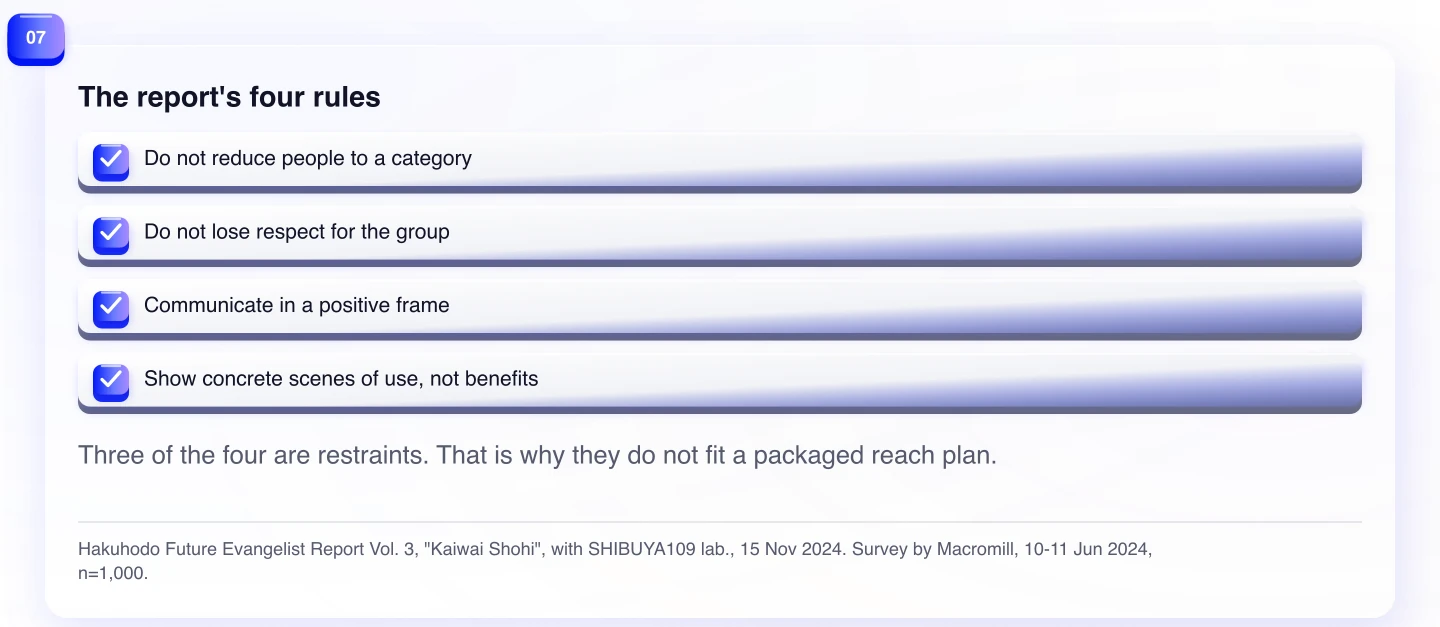
The report’s four rules offer a useful check on the approach. Do not reduce people to a category. Do not lose respect for the group. Communicate in a positive frame. Show concrete scenes of use instead of repeating product benefits. These are mostly rules of restraint, which is precisely why they do not fit neatly into a packaged reach plan.
Finally, separate the first foothold from the full market plan. Ask what the other roughly 90 percent of category spending responds to, and whether the team has a way to learn about that too. The answer may involve a different route entirely; the report does not measure it.
Set the measurement to match the job. Early signals might tell the team whether credible discussion exists and whether the product is described in the intended scene of use. They should not be relabeled as evidence of repeat purchase. Until durable revenue is measured for the product and category in question, the honest result is narrower: the product has, or has not, earned consideration in a particular social sphere.
Kaiwai can remove one uncertainty: whether a product has earned enough contextual credibility to be considered within a group. Before buying access, ask which uncertainty your budget is actually meant to remove.
Evidence
Sources
The works below support the article's factual claims and were rechecked on .
- Hakuhodo, Future Evangelist Report Vol. 3 (15 November 2024), "Kaiwai Shohi", co-authored with SHIBUYA109 lab.Hakuhodo Inc. / SHIBUYA109 lab. · November 15, 2024 · Accessed August 7, 2026
- Student reporters interview SHIBUYA109 lab. on kaiwai consumptionSendenkaigi / AdverTimes · June 5, 2025 · Accessed August 7, 2026
- SHIBUYA109 lab. Trend Prediction 2026 / Attention DetoxSHIBUYA109 Entertainment · June 1, 2026 · Accessed August 7, 2026