Commerce and Infrastructure
Cross-border demand is not symmetric.
Written by Kaito Yoshizumi
- Published
- Last checked
- Reading time
- 9 minutes

Direct answer
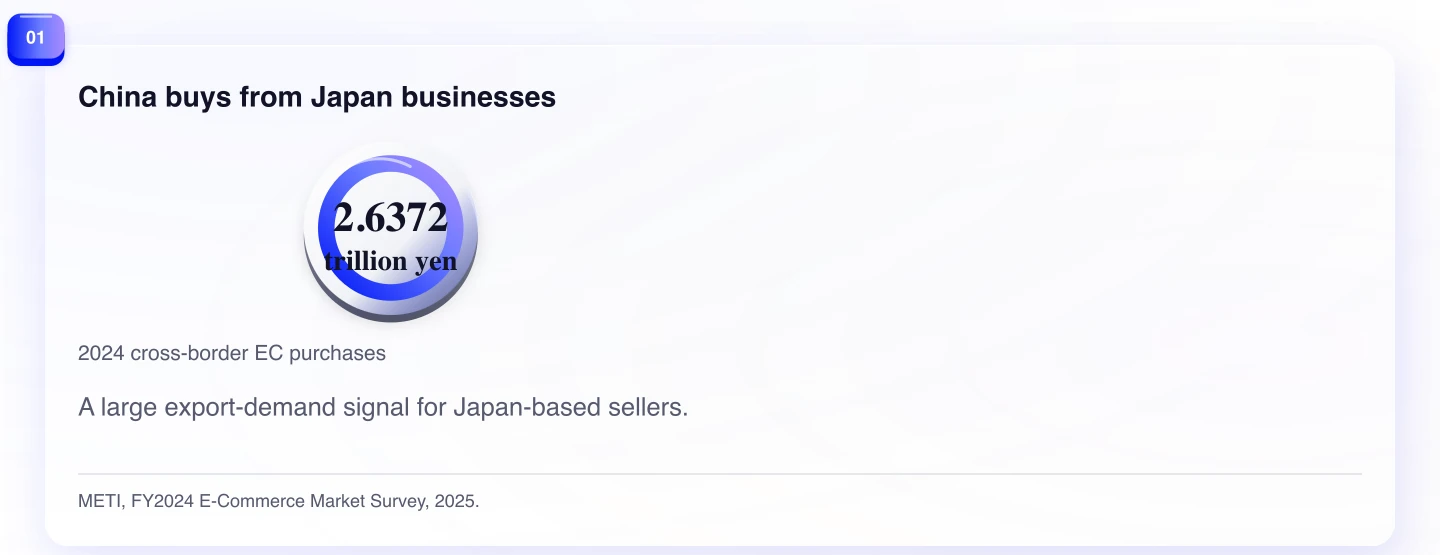
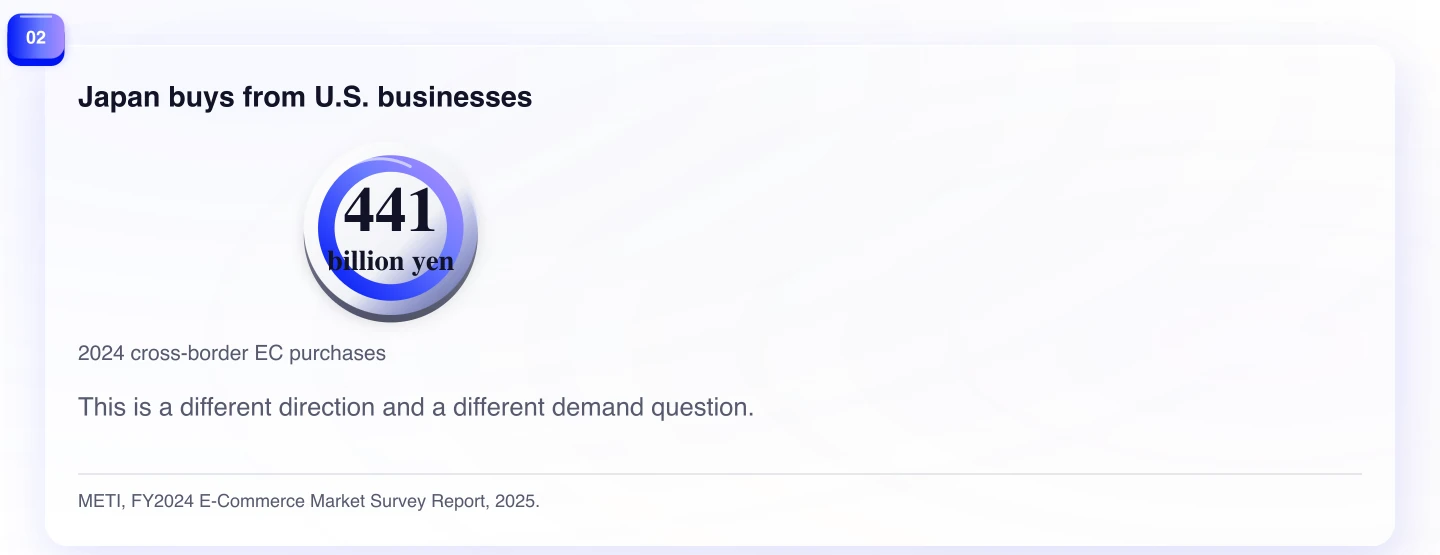
Cross-border ecommerce is often described as a single international opportunity. METI's country-direction data says otherwise. Chinese consumers bought 2.6372 trillion yen from Japanese businesses in 2024; Japanese consumers bought 441 billion yen from U.S. businesses. The flows answer different demand questions. A large export signal from Japan is not a proxy for import behavior into Japan.
That distinction changes the order of a market-entry decision. A company with Japan-based inventory may ask whether buyers abroad want the offer. A foreign company that wants Japanese customers may ask whether buyers in Japan will accept the product, price, delivery, support, and compliance path. Those are not mirror images just because both can involve a checkout page and a parcel.
The symmetry trap starts with a country total
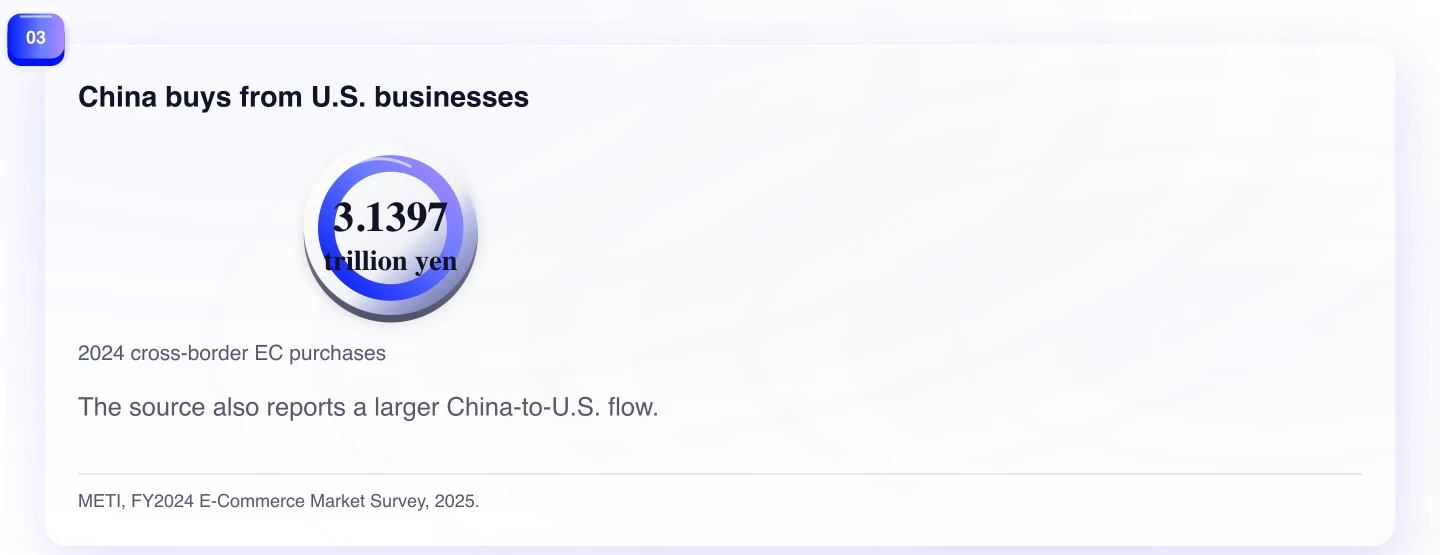
METI reported that Chinese consumers purchased 2.6372 trillion yen through cross-border ecommerce from Japanese businesses in 2024, up 8.5 percent year on year. It also reported 3.1397 trillion yen in Chinese consumers' purchases from U.S. businesses, up 6.0 percent. These are substantial country-direction flows.
In the other direction relevant to a U.S. seller considering Japan, METI estimated Japanese consumers' cross-border purchases from U.S. businesses at 441 billion yen. That is not a small number. It is, however, a very different magnitude from the China-to-Japan-businesses flow.
The temptation is to read all three values as a leaderboard for “cross-border readiness.” That flattening loses the thing that makes the data useful: the direction of the purchase. A customer in China buying from a Japan-based seller is expressing demand in a different market, through a different route, under a different delivery and regulatory context, from a Japanese customer ordering from a U.S. seller.
Direction changes the commercial question
A Japan-based operator can treat the 2.6372 trillion yen figure as evidence that cross-border export demand from China has scale. It cannot conclude that a particular Japanese product, price, or platform will work. Still, the direction is aligned with the operator's question: can Japan-based supply meet demand outside Japan?
A foreign brand looking to sell into Japan has a different question. The 441 billion yen figure tells it that Japanese consumers did buy from U.S. businesses through cross-border ecommerce in the reported period. It does not tell the brand whether the relevant product category has demand, whether its price will be accepted after shipping and tax, or whether buyers will be comfortable with an overseas seller's returns and support model.
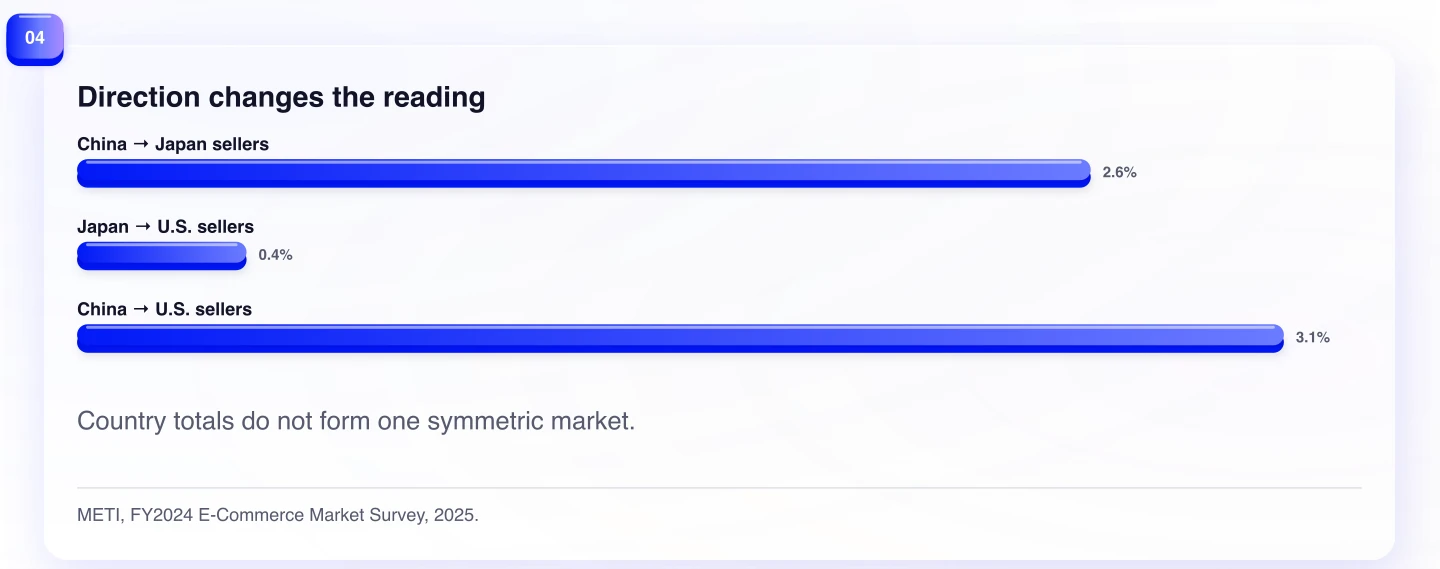
This is the core asymmetry. A large export-demand flow should encourage a seller to investigate export demand. It should not be used as a behavioral stand-in for domestic import demand. Treating it that way can make a team choose the wrong experiment before it has chosen the right customer.
Scope is part of the figure
METI's detailed FY2024 report describes a sales-side survey of businesses with a domestic base. It includes exports from Japan-based businesses, but excludes imports into Japan and sales by overseas production that do not pass through Japan. That boundary is not an academic qualification. It determines what the result can describe.
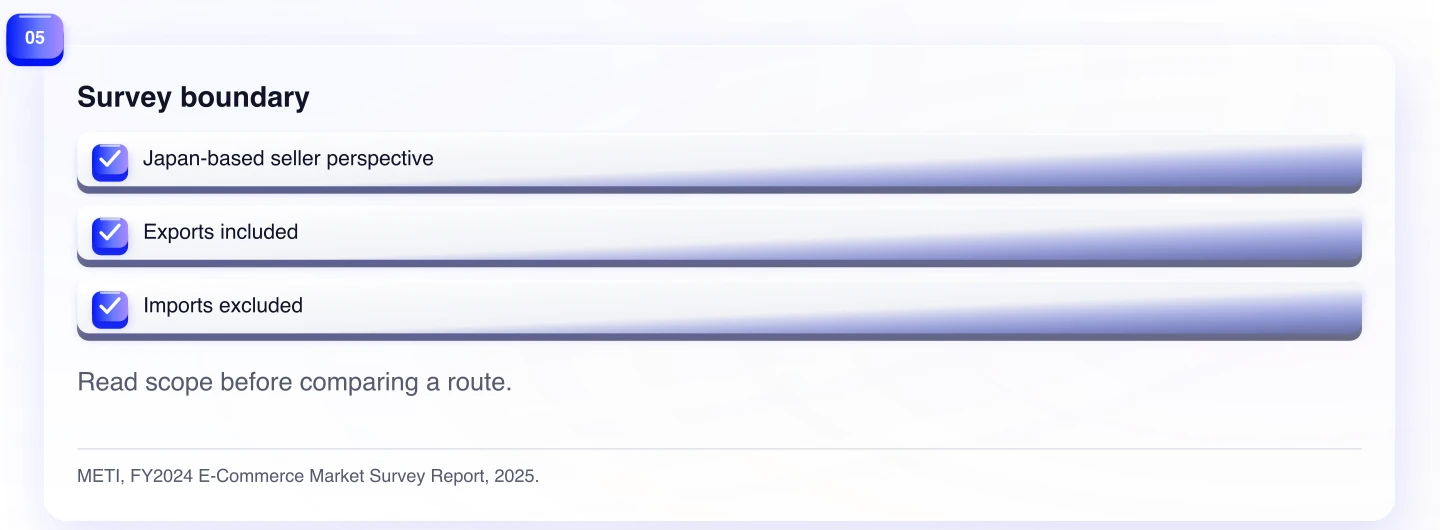
The report can support a statement about purchases from Japanese businesses in the specified cross-border relationship. It does not create a complete census of all products moving into Japan, all overseas supply chains, or all ways in which a foreign company might serve a Japanese customer. A team that wants an import strategy must add product, buyer, and route evidence.
There is a useful discipline here. Label the buyer, the seller location, the year, and the direction every time the number appears. The extra words prevent a large total from silently changing meaning while it moves through a deck.
Product work does not disappear at checkout
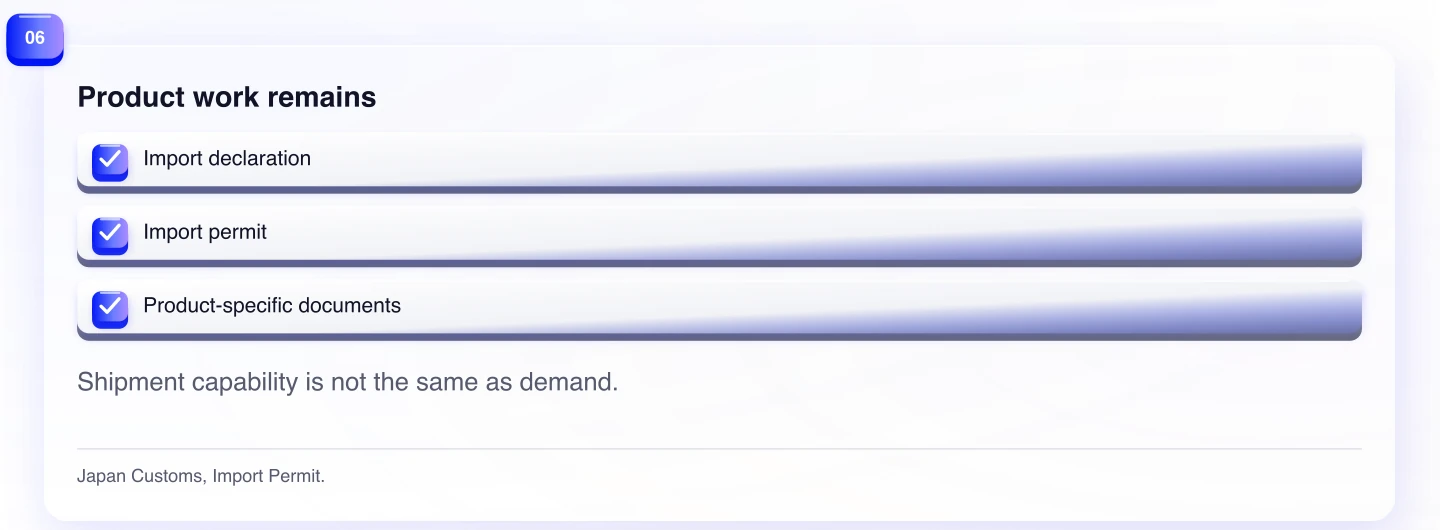
Cross-border demand is only one part of a viable offer. Japan Customs says an importer must submit an import declaration and obtain an import permit before goods can be imported. It also says that documents and approvals can depend on the goods and the laws that apply to them.
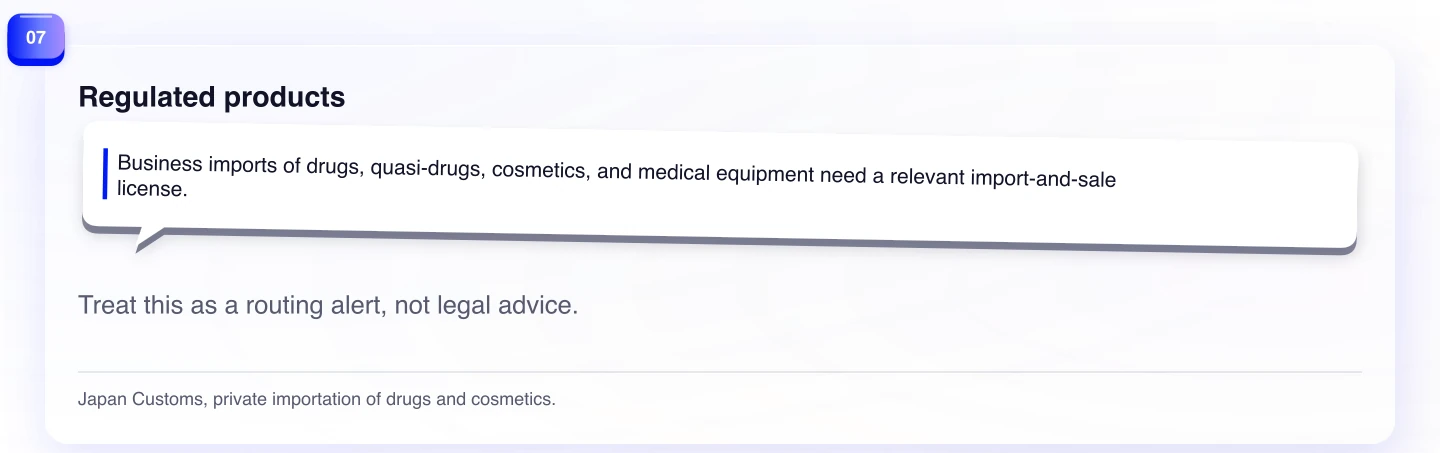
For certain regulated products, the route can become more specific. Japan Customs states that business importation of drugs, quasi-drugs, cosmetics, or medical equipment requires an import-and-sale business license, while personal imports operate under limited permitted scopes. That is a practical alert to check the route before promising delivery. It is not legal advice, and it should not be stretched into a claim about every consumer product.
The commercial point is simpler: a demand figure does not settle the product path. A team can have a promising product and still need a different importer, documentation process, stock model, or service design. Conversely, a workable import route does not prove demand. The two questions must remain separate long enough to test them.
The objection: country totals are not product forecasts
The strongest objection is that a country-direction total does not predict a product. It does not identify the product mix behind the flow, customer-acquisition cost, return rate, platform contribution, local stock need, or the margin available to a specific seller. The objection is correct.
It also sharpens rather than defeats the argument. The article is not recommending a country from a table. It is arguing that teams should stop using one direction of cross-border demand as if it validates the other. Country totals are useful for choosing the question. They are too broad for answering it.
A foreign brand should therefore run an import-demand test in Japan as an import-demand test. Check product eligibility and the route to clearance. Test pricing with the actual delivery, tax, and returns promise. See whether the buyer understands who is responsible when something goes wrong. Measure repeat behavior separately from the first order. A Japan-based seller investigating China should build a comparable export test, not borrow assumptions from a Japan-import project.
What remains unknown is the offer
The official sources do not disclose the product mix within a particular business, the conversion effect of local inventory, or the contribution of an individual marketplace. They do not tell an overseas brand which partner should hold stock, whether consumers will accept the service promise, or how the offer performs after acquisition cost and returns.
Those unknowns are not empty space. They are the research plan. Start by naming the direction, then test the smallest compliant route that can reveal product fit and contribution margin. Keep export demand and import behavior in separate columns until the evidence gives a reason to connect them.
Cross-border demand is real. It is not symmetric. Japan is a powerful source of export demand in the China-to-Japan-businesses measure; that fact does not substitute for evidence that an imported offer will win Japanese customers. Choose the direction first. Then let the product and route decide the experiment.
Keep the two scorecards separate
This distinction is especially useful when one company has more than one possible route. A Japanese distributor may be considering exports to China while an overseas manufacturer is considering a direct offer into Japan. Both projects may use the phrase “cross-border ecommerce,” but they should not share a success metric by default. The first needs evidence about foreign demand for Japan-based supply. The second needs evidence about Japanese demand for an imported proposition and the obligations around it.
Write the scorecard in directional language. For an export test, measure product discovery in the target market, the economics of shipping from Japan, checkout completion, delivery reliability, return handling, and contribution after platform costs. For an import test, measure the same commercial steps in Japan, while adding the product route, importer responsibilities, documents, and buyer confidence in the responsible seller. The metric names force the team to expose assumptions that a country total can conceal.
The cleanest initial experiment is often narrow. Use one compliant product set, one clear delivery promise, and one channel whose responsibilities can be understood. Do not read a weak first result as a verdict on a country until the team knows whether the issue was product fit, price, route, discoverability, or execution. Do not read a strong first result as proof that every direction, category, or customer segment will behave the same way.
This is not a call to avoid country totals. It is a call to give them the right job. METI's figures make the directional asymmetry visible. The commercial work begins when a team turns that asymmetry into a testable offer, rather than smoothing it into a generic story about international demand.
The distinction is also useful for partnerships. A partner that is excellent at export fulfillment may not be the right party to own customer care for an imported offer in Japan. A marketplace that supplies discovery in one direction may not give a new seller enough control over returns or customer data in the other. Describe the job before selecting the partner, and make the commercial owner visible to the buyer.
That small act of specificity is often where a broad cross-border statistic becomes a workable plan.
It also makes later comparison honest: compare tested offers in the same direction, with the same responsibility model, before drawing a conclusion.
For a smallest operable owned-audience test, the Beehiiv versus Kit versus Brevo guide walks through choosing a newsletter system by audience ownership and sending relationship.
Evidence
Sources
The works below support the article's factual claims and were rechecked on .
- Results of FY2024 E-Commerce Market Survey CompiledMinistry of Economy · August 26, 2025 · Accessed August 10, 2026
- FY2024 E-Commerce Market Survey ReportMinistry of Economy · August 26, 2025 · Accessed August 10, 2026
- Results of FY2023 E-Commerce Market Survey CompiledMinistry of Economy · September 25, 2024 · Accessed August 10, 2026
- Import PermitJapan Customs · Accessed August 10, 2026
- Private importation of drugs, cosmetics, etc.Japan Customs · Accessed August 10, 2026