Climate and Operations
Carbon cost is now an operating-data problem.
Written by Kaito Yoshizumi
- Published
- Last checked
- Reading time
- 9 minutes

Direct answer
The operating decision is to treat Japan's fiscal 2026 emissions trading system as a controlled data process, not as an annual sustainability-reporting exercise. For a potentially covered company, the immediate questions are operational: which legal entity owns each emission source, which activity records support the calculation, who approves the result, what must enter ERMS, and when evidence must be ready for external verification.
Japan's statutory emissions trading system began in fiscal 2026 under the amended GX Promotion Act. The Ministry of Economy, Trade and Industry's current ETS page describes covered entities as those whose direct carbon dioxide emissions averaged at least 100,000 tCO2 over the previous three fiscal years. That threshold is important, but it is only the entry point. Once a business is covered, compliance depends on a sequence of calculations, filings, published planning information, verification, and allowance management.
The first decision is whether the company is in scope
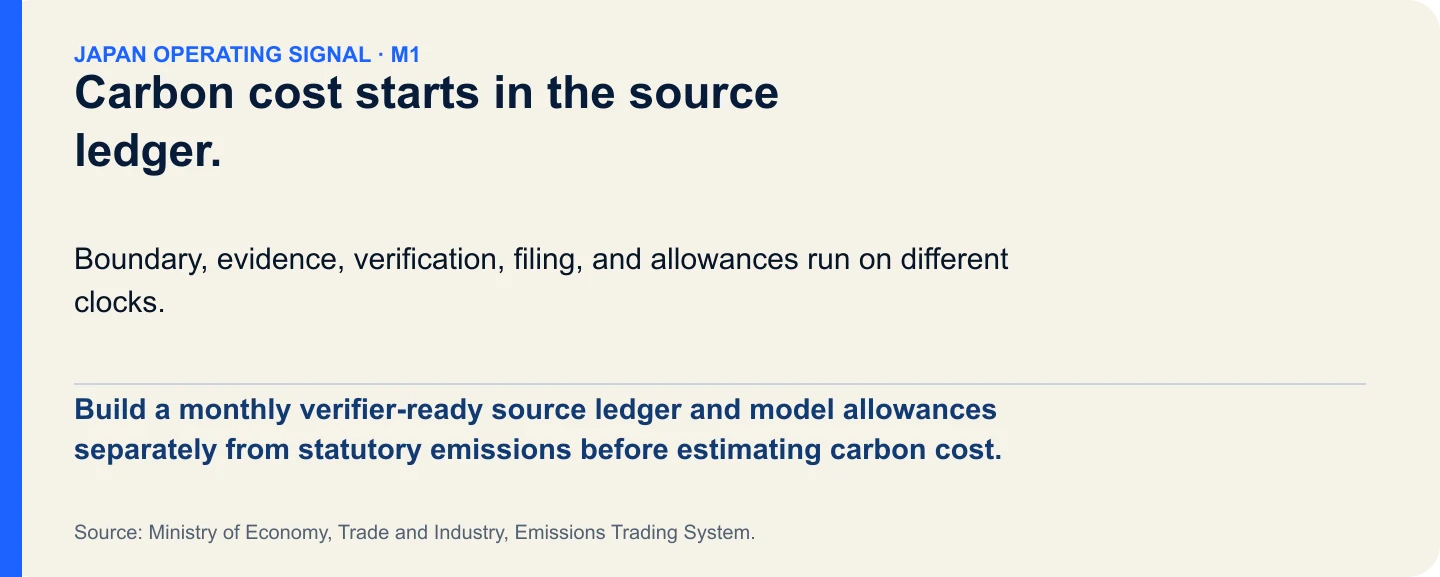
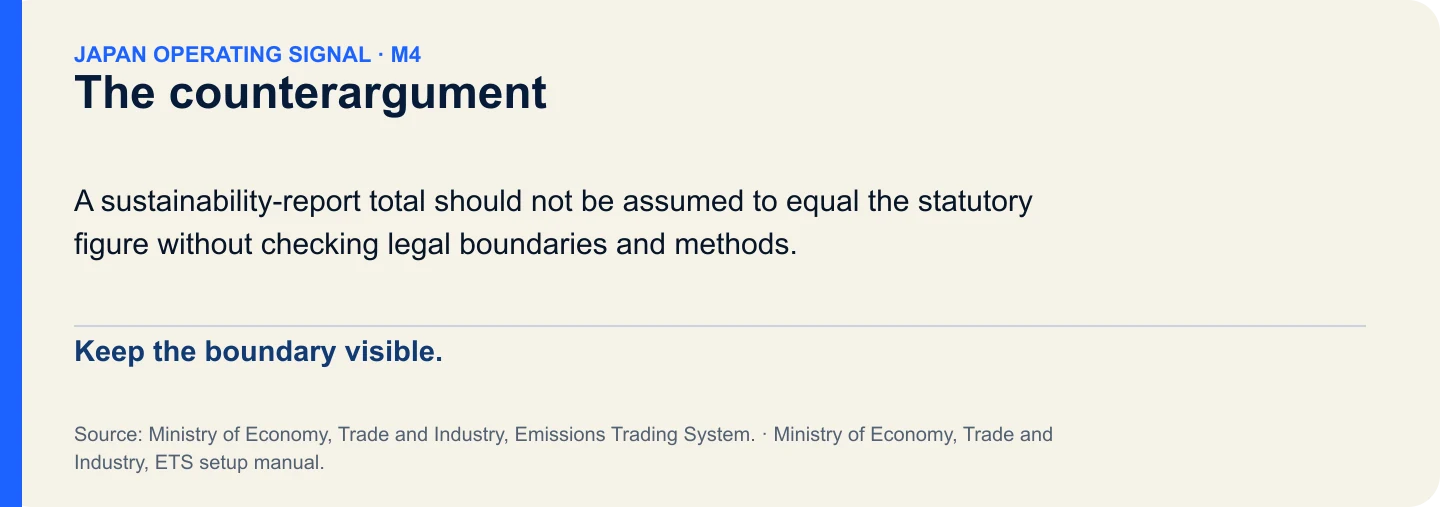
A company cannot answer the scope question from a group-wide sustainability total alone. The statutory test concerns direct CO2 emissions and applies through the legal definitions and calculation rules of the scheme. A consolidated Scope 1 number may be useful as a warning signal, but it should not be assumed to be the statutory figure without checking entity boundaries, covered sources, and the prescribed methodology.
METI's public summary uses a three-fiscal-year average. That makes threshold monitoring a rolling operating control. A company below the line in one year may still be covered because of the preceding years, while acquisitions, divestitures, reorganizations, and changes in production can alter both the data and the applicable boundary.
The practical control is a documented scope memo that can be refreshed each year. It should identify the relevant entity, facilities, and transport activities; reconcile the statutory inventory with other emissions reporting; record exclusions and estimates; and name the person who approves the conclusion. A business near the threshold should not wait for year-end certainty before preparing ERMS access and evidence.
There is a narrow source-language issue to handle carefully. METI's live overview says "100,000 tonnes or more," while an explanatory leaflet asks whether the average "exceeds 100,000 tonnes." That difference may be brochure shorthand, but a company exactly at the boundary should use the current statute, order, and calculation manual rather than rely on a paraphrased threshold.
Fiscal 2026 starts the evidence clock
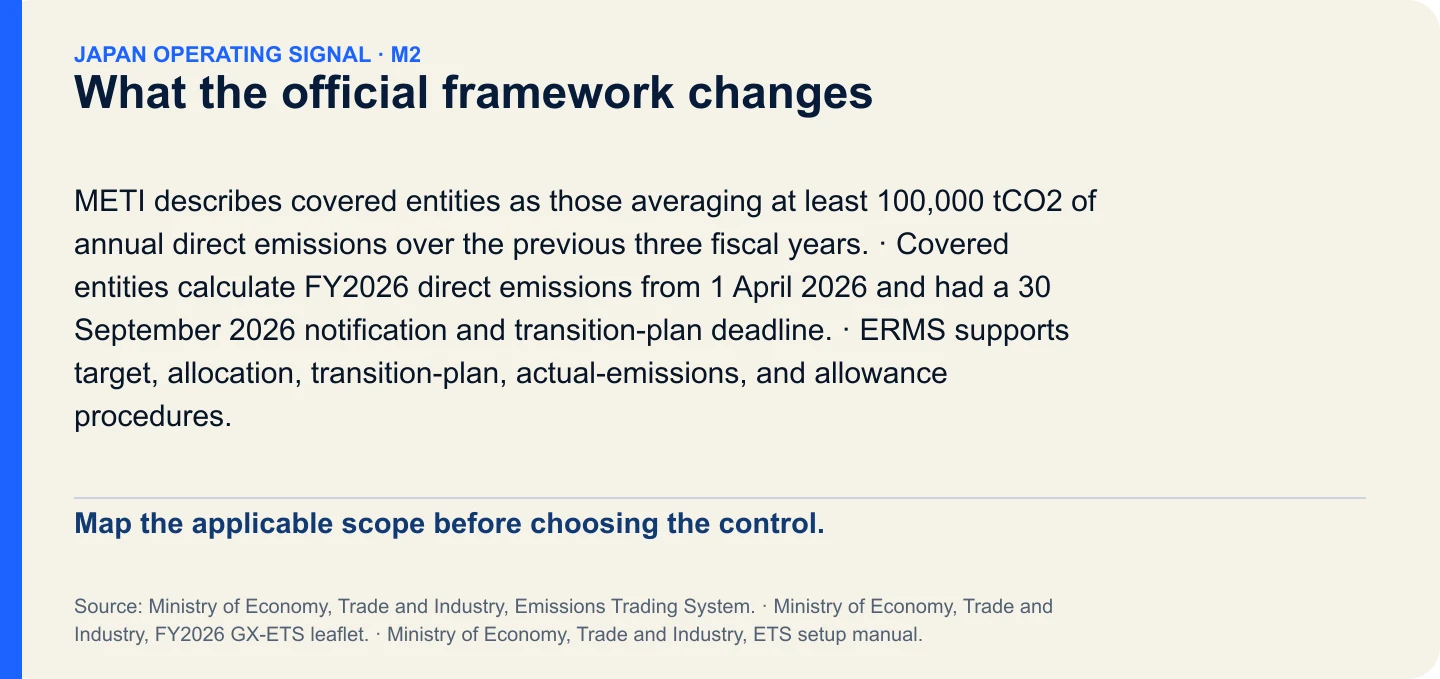
The METI fiscal 2026 leaflet says covered entities calculate direct emissions from April 1, 2026. It also identifies two initial-year deadlines: notification of the entity's average annual emissions and submission of a transition plan by September 30, 2026.
Those dates can create a false impression that the work is mainly a September filing project. The more consequential requirement is that fiscal 2026 operating data is already becoming the basis for later reporting, verification, and allowance obligations. Fuel invoices, meter readings, production records, source classifications, and calculation assumptions need to remain traceable after the accounting period closes.
A workable ledger should retain, for every material source:
- the responsible legal entity and site;
- the activity quantity and unit;
- the original evidence and system of record;
- the applicable factor and calculation version;
- any estimate, allocation, or correction;
- the preparer, reviewer, and approval date; and
- the relationship to the figure submitted through ERMS.
This is not a recommendation to create a second uncontrolled emissions database. Where reliable energy, finance, or plant systems already exist, the better design is to connect those records to a controlled calculation layer and preserve the reconciliation.
The initial-year transition changes the sequence
METI's setup manual explains a special fiscal 2026 transition. In the ordinary sequence, an entity calculates its average emissions and target amount, obtains required confirmation, files the information, receives an allocation, calculates actual emissions, reports them, and then holds the required allowances for surrender.
For fiscal 2026, the target-amount notification and allocation are shifted into fiscal 2027. The September 2026 filing consists of the average-emissions notification and transition plan, and those initial filings contain no item requiring registered-verifier confirmation. That is administrative relief, not a one-year exemption from emissions data work. Fiscal 2026 remains the first emissions period in scope.
The same official materials show fiscal 2026 actual emissions being reported by September 30, 2027, followed by the corresponding allocation, holding, and surrender sequence. METI recommends that covered businesses select and contract with a registered verification body during fiscal 2026.
That recommendation is operationally significant. Verification capacity, site access, evidence requests, and correction cycles can create a bottleneck if procurement starts only after the emissions year closes. A company should define verifier selection criteria, confidentiality handling, source sampling, and issue-resolution ownership while the underlying evidence is still accessible.
ERMS turns organizational design into a compliance issue
The Emission Reporting and Management System, or ERMS, is used for target and allocation procedures, transition-plan submission, actual-emissions reporting, and allowance management. METI states that an account is opened by company and can contain multiple users. It also requires an appropriate G-Biz ID Prime or Member account.
The system requirement means access governance should be explicit. A single sustainability employee should not become the unreviewed owner of scope determination, emissions calculation, publication, and allowance transactions. At minimum, the company needs differentiated responsibilities for preparation, review, formal submission, and allowance approval, with a documented substitute for absences.
ERMS also creates a master-data question. Legal names, organizational changes, user permissions, and transaction authority need to stay aligned with corporate records. The compliance process should include periodic access review and an incident route for unavailable accounts, incorrect filings, or disputed values.
The transition plan connects operating data to public claims
Covered entities must submit a transition plan each year. METI's materials identify fields including prior-year direct and indirect emissions, targets through fiscal 2030, investment measures and expected reductions, research and development information, and references to public strategy documents. Specified portions are published company by company by METI and the ministry responsible for the business sector.
That publication feature changes the control standard. The plan is not only an internal forecast submitted to a regulator. It can be compared with financial plans, investor materials, sustainability disclosures, and later emissions performance.
The company therefore needs a claims reconciliation before submission. Capital projects should have the same timing and status used in internal investment governance. Expected reductions should state their basis and avoid implying certainty where the project or methodology remains conditional. Public strategy references should not contradict the numeric plan.
This does not require every internal scenario to be published. It requires the filed information to have an identified source, approval, and relationship to the company's other statements.
Carbon cost remains a scenario, not a single number
A covered company is required to hold allowances corresponding to its notified obligation, and it may trade allowances when it has a surplus or shortfall. But coverage does not itself reveal the company's cash cost. Free allocation, actual emissions, market transactions, and future prices all matter.
The useful operating model separates three quantities:
- statutory emissions;
- allocated or otherwise eligible units; and
- the residual position to be acquired, retained, or sold.
Finance can then test price scenarios against the residual position rather than multiplying all direct emissions by an assumed carbon price. Procurement and treasury can define transaction authority, counterparty controls, and concentration limits as the market develops. Investment committees can compare abatement projects with an explicit range rather than a falsely precise "carbon tax."
Counterargument: free allocation may mean little immediate cost
The strongest counterargument is that the system initially uses free allocation and some covered companies may not need to buy allowances. For those companies, "carbon cost" can sound premature.
That objection is valid if the phrase is used to claim an immediate tax-like expense. It is not a reason to defer the data controls. The same emissions records determine scope, allocation, actual-emissions reporting, the residual allowance position, and the credibility of the published transition plan. Even a company with no initial purchase requirement can incur verification, system, governance, and opportunity costs. A surplus allowance position also needs accurate data.
The decision is therefore not whether to book a universal carbon charge. It is whether to establish the information needed to know what the company's position is.
Unknowns and source limitation
Several commercially important variables remain unknown at company level: the final free allocation, the future transaction price, the amount of eligible units, the resulting cash requirement, and the effect of later rule changes. None can be inferred from the threshold alone.
METI's official page and manuals are the primary sources for the operating sequence, but the ETS landing page and PDFs returned HTTP 403 when opened directly in the research environment. Their indexed official text remained accessible. Operators should retrieve the current versions directly from METI or the official ETS portal before implementing a control because manuals can be revised.
The older leaflet also described ERMS as expected to open around April 2026. That was a forward-looking transition statement; the live METI page should govern current access instructions.
Legal and program-scope caution
This article does not determine whether a particular company is legally covered or calculate its allowance obligation. The GX ETS should not be described as a universal carbon tax, and statutory emissions should not be equated automatically with a company's Scope 1 disclosure. Exact-boundary cases, reorganizations, and specialized transport treatment require the current law, orders, and manuals.
Practical operator decision
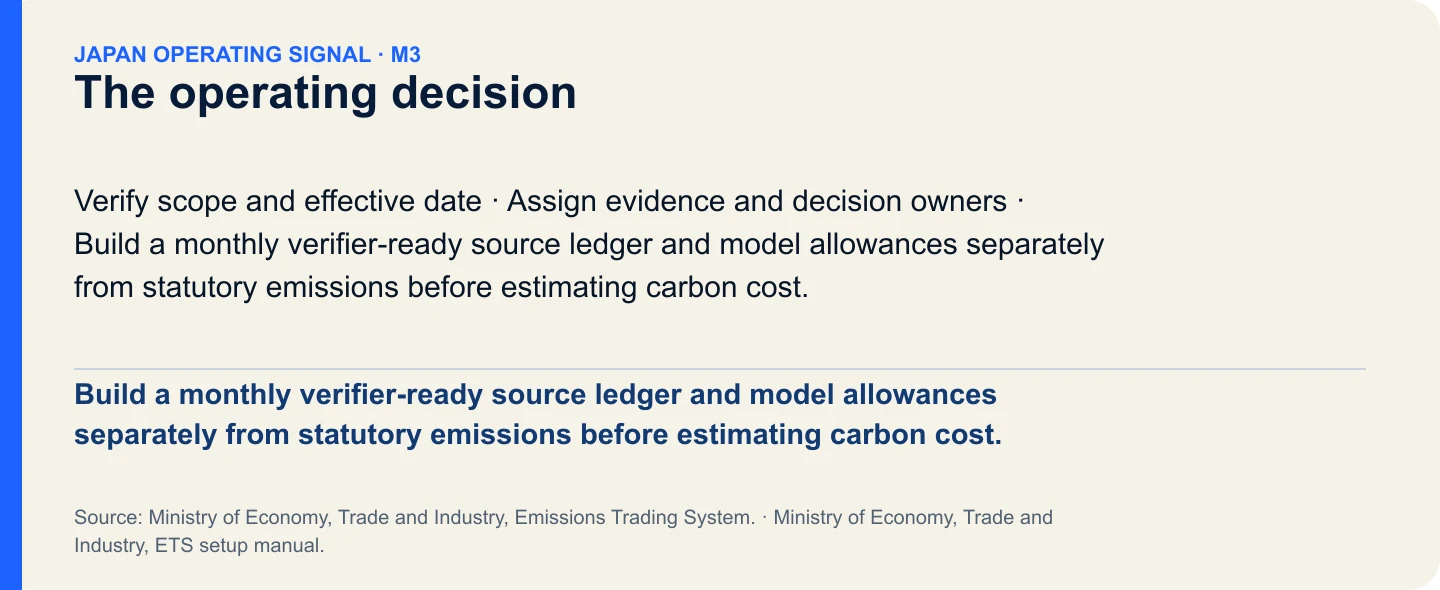
Create one controlled fiscal 2026 emissions operating model now. It should combine a rolling threshold assessment, source ledger, calculation and change controls, evidence retention, transition-plan reconciliation, registered-verifier preparation, ERMS access governance, and allowance scenarios.
The minimum decision package for management is not a single emissions total. It is a clear statement of scope, data confidence, filing readiness, expected verification work, public-plan dependencies, and the range of possible allowance positions. That turns carbon exposure from an abstract policy issue into a manageable operating process.
Evidence
Sources
The works below support the article's factual claims and were rechecked on .
- Emissions Trading SystemMinistry of Economy, Trade and Industry · July 8, 2026 · Accessed August 11, 2026
- FY2026 GX-ETS leafletMinistry of Economy, Trade and Industry · January 1, 2026 · Accessed August 11, 2026
- ETS setup manualMinistry of Economy, Trade and Industry · June 1, 2026 · Accessed August 11, 2026
- GX Act amendment bill overviewMinistry of Economy, Trade and Industry · February 25, 2025 · Accessed August 11, 2026