Data and Governance
A translated privacy policy is not a data-transfer plan.
Written by Kaito Yoshizumi
- Published
- Last checked
- Reading time
- 10 minutes

Direct answer
A Japanese privacy policy can be accurate in Japanese and still describe an operating model that nobody has mapped. Under Japan's Act on the Protection of Personal Information, a transfer of personal data to a third party in a foreign country can require consent, information about the destination, or a system that continuously provides protections equivalent to those expected in Japan. Translation explains a promise. It does not decide who receives the data, where they are, or which safeguard supports the handoff.
This distinction matters because the modern launch stack is assembled before the first Japanese customer arrives. A global CRM stores leads. An analytics service records behavior. A support tool exposes tickets to another team. Headquarters may receive customer records from a Japanese subsidiary. Each choice can change the legal and operational map.
This article is not legal advice. It cannot determine whether a specific data flow is a third-party provision, an outsourcing arrangement, or another category under Japanese law. It offers a management test: if a team cannot draw the flow and name the owner of every handoff, a translated notice is not enough.
The launch plan that ends with a notice
Privacy work often appears late in a market launch. The product and growth stack is already selected, so the remaining task looks like copy: translate the global policy, add a Japanese contact, and publish. The temptation is familiar because the visible deliverable is a page.
The Personal Information Protection Commission's foreign-transfer guideline describes a different problem. Article 28 of the APPI addresses the provision of personal data to a third party located in a foreign country. As a general structure, prior consent is required unless the recipient is in a country recognized as having an equivalent protection system, the recipient has an eligible system for continuously implementing equivalent measures, or a statutory exception applies.
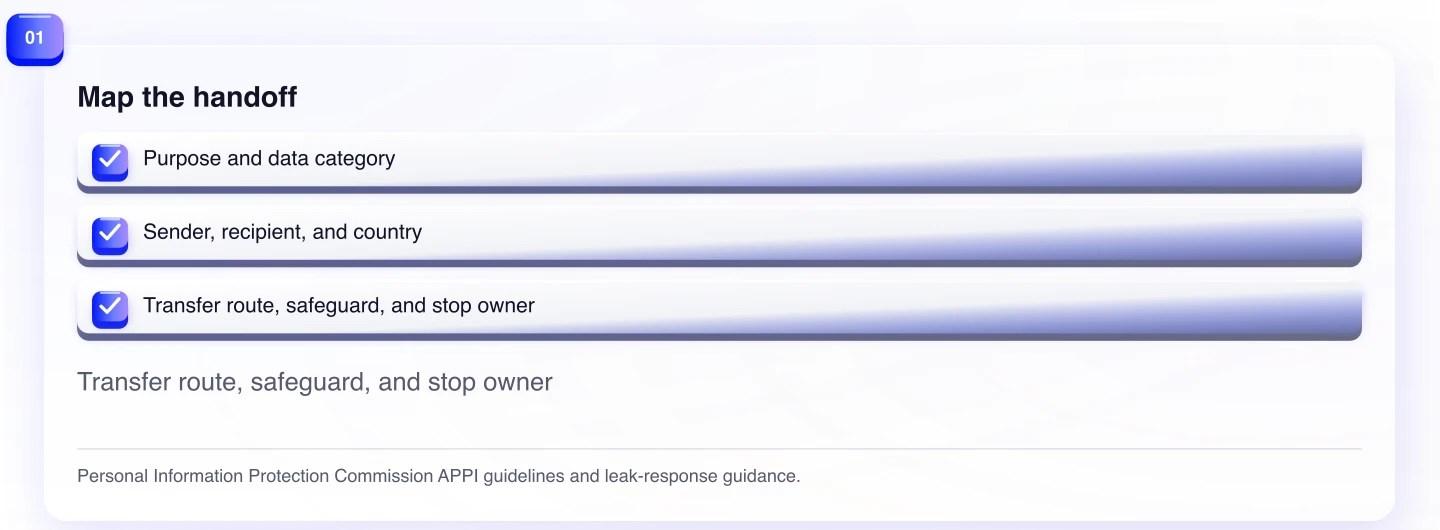
Those alternatives are not translations of one another. They are different bases for a data movement. A team has to know the recipient, the country, the relationship, the information being moved, and the safeguard it is relying on before it can describe the flow responsibly.
A vendor list is not yet a transfer map
A procurement spreadsheet may list the CRM, cloud host, payment processor, support platform, and analytics vendor. That is useful, but it does not show the route a Japanese customer's data takes through those services.
A useful map begins with events, not logos. A person requests a demo. A form sends contact details to a CRM. A sales representative at headquarters opens the record. A support agent sees a ticket. A marketing tool adds the person to an audience. A contractor exports a report. Each event identifies a sender, recipient, purpose, country, and access path.
The same brand name can conceal different legal roles. A tool may process data on documented instructions in one flow and receive it for its own purpose in another. A Japanese branch and an overseas corporation may look like one company to a customer while remaining different legal persons. The guideline specifically makes the third-party question depend on who receives the data and where that recipient is located, not on whether the interface feels internal.
The operational discipline is to maintain a register at the level of the actual handoff. Record the data category, purpose, sending entity, receiving entity, country, transfer route, contractual control, retention, and the person who can stop access. Link each public statement to that register. Then a policy becomes the readable edge of a system rather than its substitute.
Consent is not a universal repair button
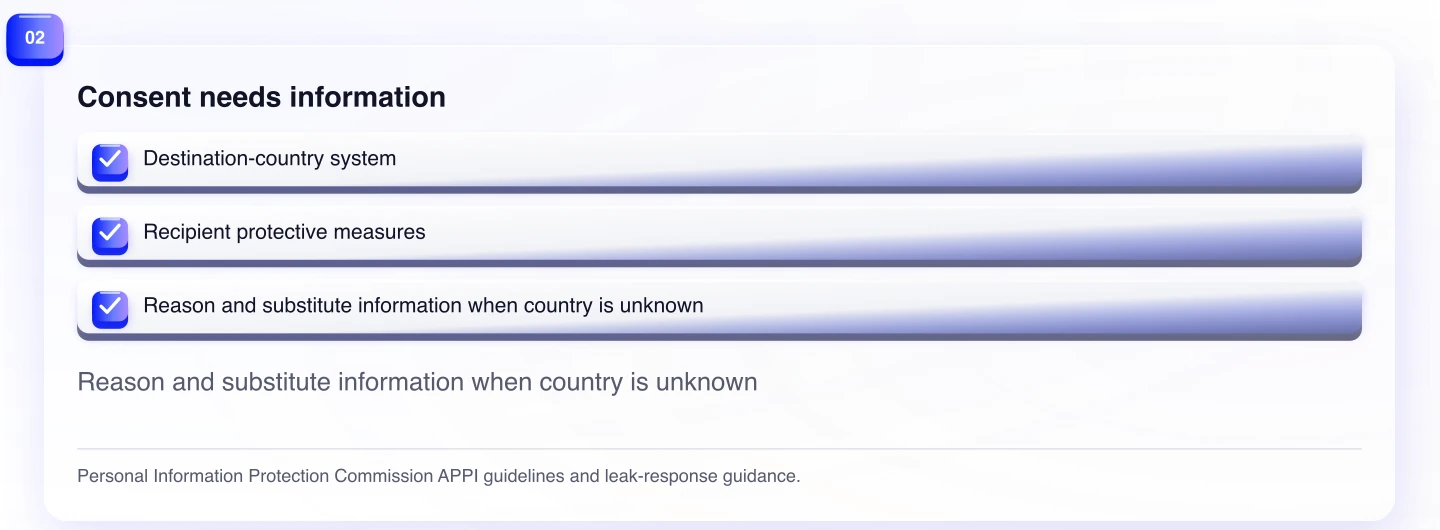
It is tempting to solve uncertainty by adding a consent box. But consent is meaningful only if the information around it is sufficient for the person to make the choice. The PPC guideline requires information at the time consent is obtained about the foreign country's personal-information system, the recipient's protective measures, and other useful information prescribed by the rules.
The guideline also anticipates a difficult case: the destination country cannot be identified when consent is requested. In that situation, the business must say that the country cannot be identified and explain why. If information that may help the person is available instead, the guideline calls for providing it. An unknown destination is therefore not a blank field to hide behind generic language.
The point is not that consent is weak. It is that consent does not remove the need to know what the system is doing. If the company relies instead on an eligible arrangement under which the foreign recipient continuously implements equivalent protective measures, the operator still needs contractual or organizational controls, periodic checks, and a way to respond when the arrangement stops working.
That is why privacy belongs in architecture review. A product manager choosing a new integration can change the data route. A regional sales leader changing account access can create a new recipient. A support reorganization can move records to another country without changing the public page. The operating map must change when the system does.
The incident clock begins before the translation meeting
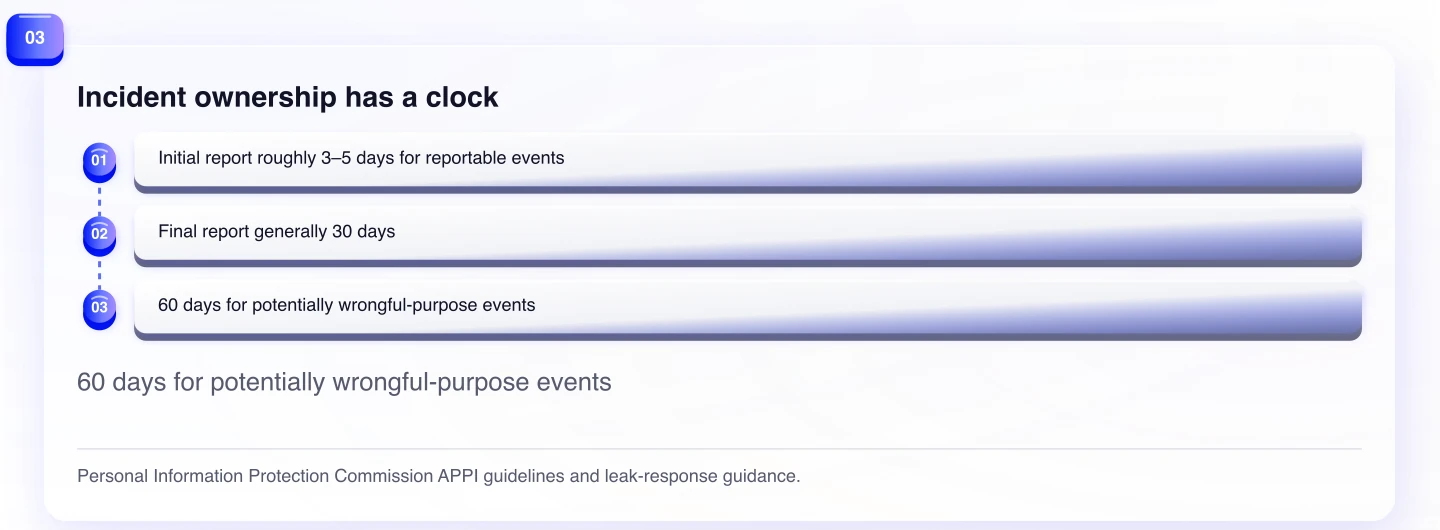
The PPC's leak-response page makes the ownership problem concrete. For reportable events, it directs businesses to make an initial report promptly, described on the page as roughly three to five days after discovery. A final report is generally due within 30 days, or within 60 days where the event may have been committed for a wrongful purpose.
The reporting categories include leaks involving sensitive personal information, a risk of financial harm, conduct possibly undertaken for a wrongful purpose, or personal data concerning more than 1,000 people. These are legal categories with factual boundaries, not a universal reporting rule for every support error.
Still, the time frame exposes a practical weakness. A Japanese-language privacy inbox is of little help if the person reading it cannot identify the system, preserve the evidence, reach the security owner, and determine which entity learned what and when. Incident response is part of the transfer plan because data that crosses teams and countries creates more places where the first signal can arrive.
Before launch, rehearse one scenario. A support platform configuration exposes customer tickets. Can the Japan owner identify which records are involved? Can headquarters suspend the relevant access? Does the processor have a notification route? Who decides whether the event falls within a reportable category? Who can prepare notices in Japanese without waiting for a new translation vendor?
The exercise should be reviewed by qualified privacy counsel. Its business value comes earlier: it reveals missing owners and inaccessible evidence while those gaps can still be fixed.
The objection: global tools are not automatically prohibited
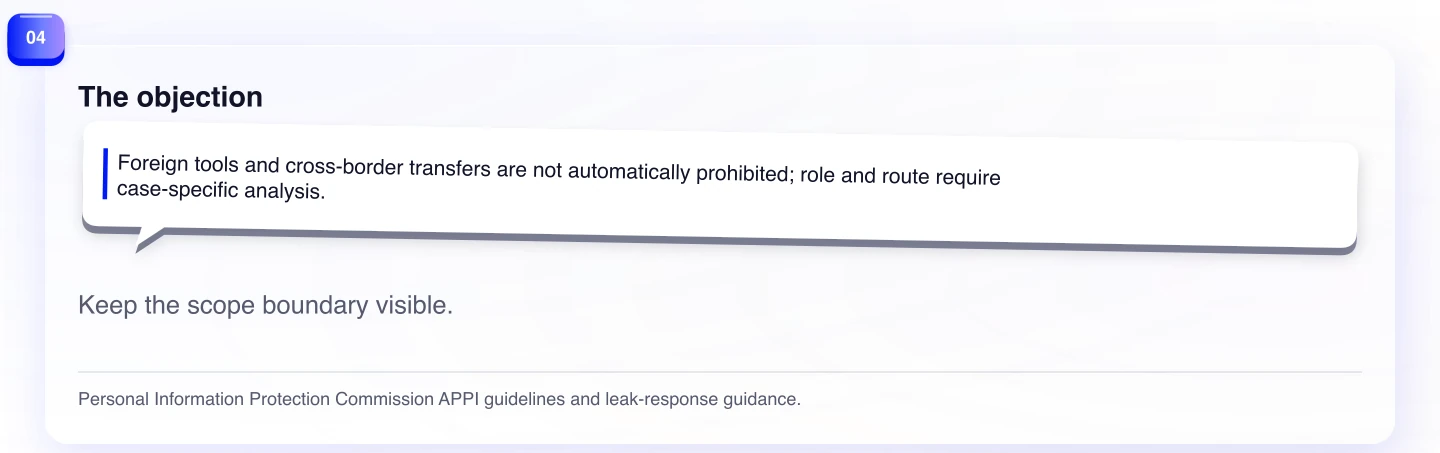
There is a necessary counterargument. The APPI does not say that a Japanese business must keep every record inside Japan. The foreign-transfer guideline exists in part to show routes by which cross-border provision can occur with consent, equivalent-country treatment, qualifying safeguards, or an applicable exception. A global CRM or overseas support team is not automatically unlawful merely because it sits outside Japan.
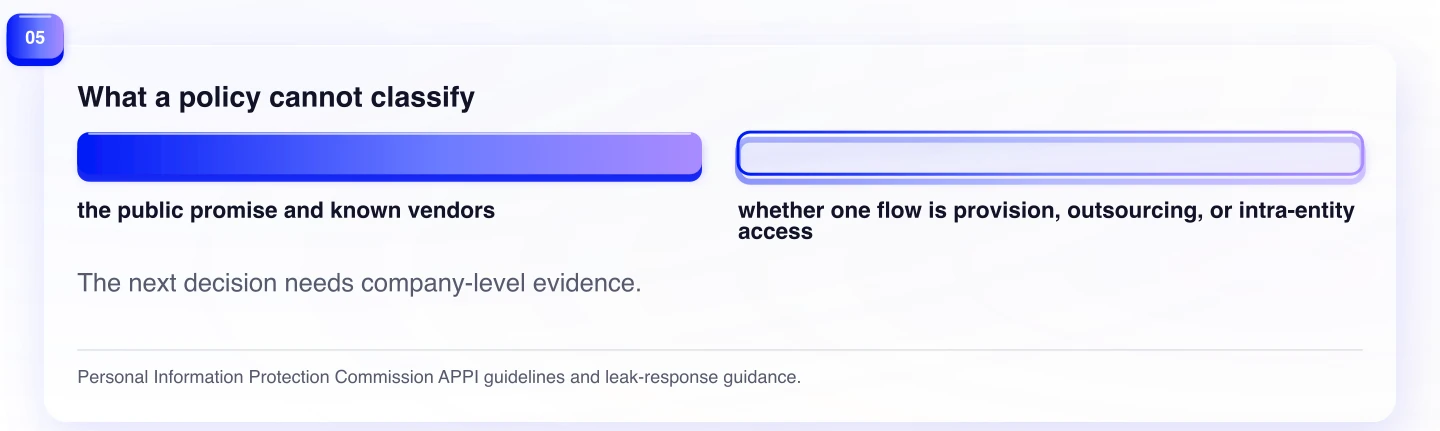
That objection is correct. A simplistic data-localization message would replace an operating question with a geographical slogan. It would also ignore distinctions between third-party provision, processing on behalf of a business, access within the same legal entity, and other arrangements that require specific analysis.
The conclusion is narrower. A foreign location makes the team identify the route and its basis. A domestic location does not eliminate ordinary duties such as purpose limitation, security controls, processor oversight, or incident response. Geography matters, but governance decides whether the data movement is understandable and controllable.
What remains unknown from a policy page
A public notice cannot tell an operator whether permissions in the CRM match the documented purposes. It cannot show whether a subprocessor has changed, whether a regional admin can export records, or whether deleted customer data remains in an analytics profile. It does not prove that the recipient's equivalent measures continue in practice.
Those unknowns belong in a recurring control. Review the transfer register when a vendor, subprocess, region, or user role changes. Test access with real role profiles. Record the latest safeguard check and the person who accepted the residual risk. Keep a fast route from a Japanese customer complaint to the people who can inspect and contain the relevant system.
For a small entrant, this does not require a large privacy department. It requires a compact source of truth and clear decisions. One owner can maintain the map. Product, sales, support, security, and counsel can review only the flows that concern them. The important thing is that the map reflects the system and the notice reflects the map.
Build the map before rewriting the promise
Start with a ninety-minute workshop. Choose one real Japanese customer journey and trace it from collection to deletion. For each handoff, write down the data, purpose, entity, country, access method, safeguard, retention period, incident owner, and the public statement that describes it. Mark every field that is assumed rather than verified.
Then make three decisions. Remove access that has no current purpose. Escalate unresolved legal classifications to qualified Japanese counsel. Finally, rewrite the policy from the verified map, not from the global template.
A CMP can record banner choices, but it does not make the legal and operating decisions; the consent-management guide separates records from decisions.
A translated policy matters because people deserve clear information in the language they use. But clarity on the page cannot compensate for ambiguity in the system. The durable Japan launch is the one in which a team can show where the data goes, why it moves, who can act, and what happens when the arrangement fails. Translation is the final expression of that work, not the work itself.
Evidence
Sources
The works below support the article's factual claims and were rechecked on .
- Guidelines on provision to a third party in a foreign countryPersonal Information Protection Commission · December 1, 2025 · Accessed August 10, 2026
- General APPI guidelinesPersonal Information Protection Commission · December 1, 2025 · Accessed August 10, 2026
- Response to personal-data leaksPersonal Information Protection Commission · Accessed August 10, 2026