Culture and Commerce
One person is a market unit, not an exception.
Written by Kaito Yoshizumi
- Published
- Last checked
- Reading time
- 10 minutes

Direct answer
The one-person household is often treated as the edge case that a Japan offer can accommodate later. Official statistics suggest the opposite starting point. In the 2020 census, one-person households were 38.1 percent of private households. That does not say what one person wants to buy. It does say that designing only for a shared household leaves a large household form outside the default case.
A one-person household is not merely a smaller family household. It has one purchaser, one user, one storage space, one delivery recipient, and one person who must understand setup, payment, maintenance, and support. Each can change the product experience. This is not an argument that every Japanese customer lives alone, or that people who do have one identity. Household statistics cannot tell us whether someone is young, affluent, lonely, independent, or a particular kind of shopper. They can tell us which unit is common enough to deserve a separate research and design path.
The familiar pitch: Japan is a household market
Many overseas teams begin with a reasonable image of the household: a group that shares food, space, decisions, subscriptions, appliances, and the work of making a purchase. Product bundles, account structures, package sizes, and support flows often inherit that image without saying so.
The problem is not that shared households are unimportant. It is that the word household hides the number of people inside it. The 2020 census recorded 55.705 million private households and an average of 2.21 members per household. Within that total, one-person households accounted for 38.1 percent, compared with 29.5 percent in 2005.
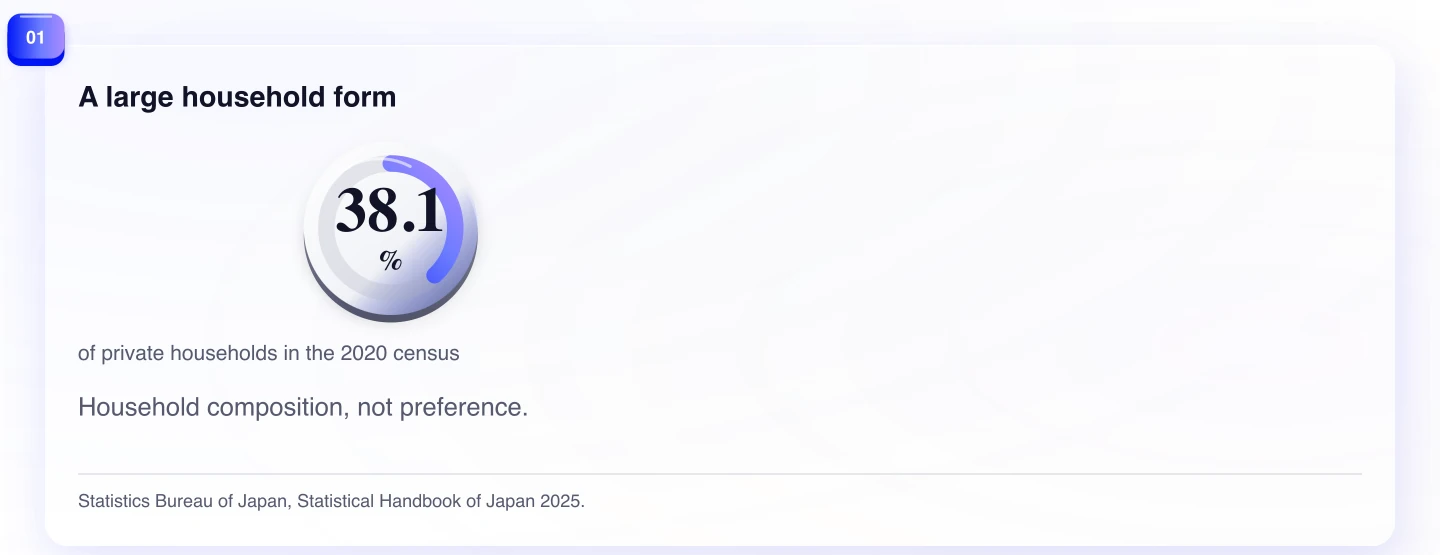
That is a composition result, not a consumer segment. It says nothing about who chooses a product or whether a one-person household is more likely to use a service. It changes the baseline question. If an offer assumes a second person to share cost, storage, installation work, or confidence, the team should test what happens when that person is absent.
The Statistics Bureau publishes a dedicated yearly-average result for one-person households, including monthly receipts and disbursements by sex and age group. A statistical series is not a product brief. Still, a national system that measures one-person households separately is a useful prompt for commercial research to do the same.
A household form that is already large
It is tempting to treat one-person households as a new urban microtrend. The census result resists that framing. A share of 38.1 percent is not a signal from a handful of early adopters; it is a structural feature of the household base as counted in 2020.
The age distribution cautions against a single stereotype. The census recorded 6.717 million one-person elderly households, including 2.308 million male and 4.409 million female households. It does not mean older people make the same choices as younger people, nor explain why those households formed. It shows why a one-person default cannot be designed only as a youth offer.
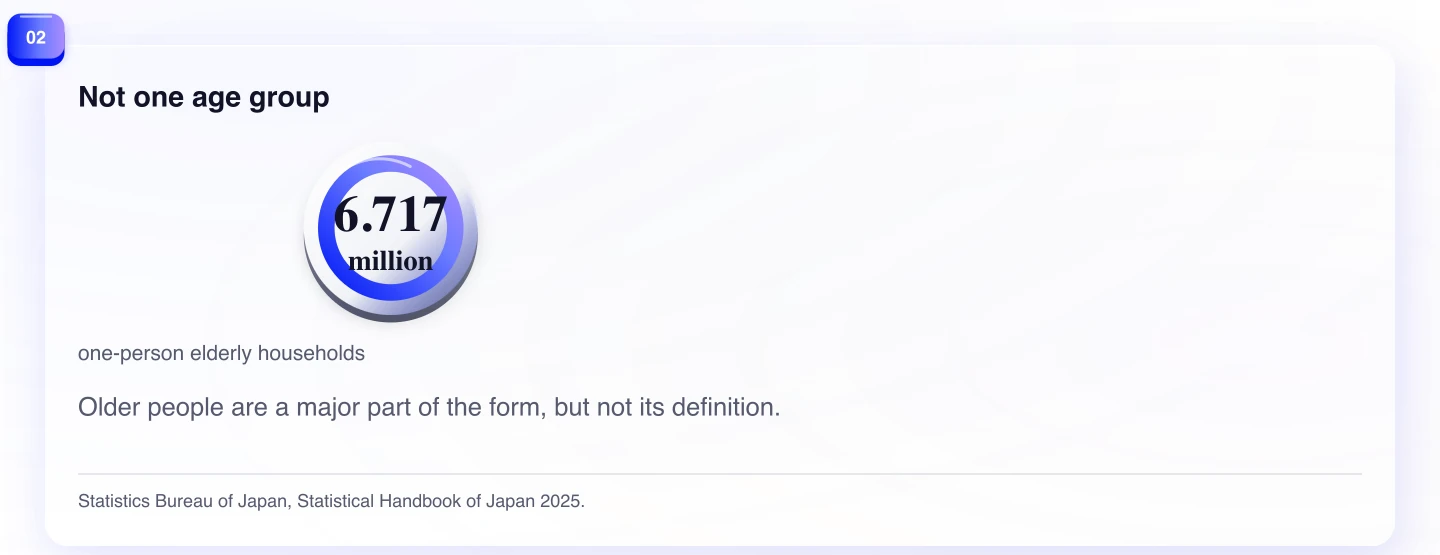
The commercial consequence is not make everything smaller. One person can face a larger individual burden for a product requiring lifting, assembling, scheduling, learning, storing, or repairing. A small physical package can still be a difficult service. A subscription can still be confusing if the account assumes another person can remember a login or troubleshoot a problem.
The more precise design question is: what work has been silently allocated to another household member? Once named, that work can be removed, made optional, or supported clearly.
The spending unit is not a tiny family
Spending data makes the distinction concrete, as long as the unit remains visible. In 2024, average monthly consumption expenditure for one-person households was 169,547 yen. The age-group averages were 176,160 yen for under 34, 184,750 yen for 35 to 59, and 159,249 yen for 60 and over.
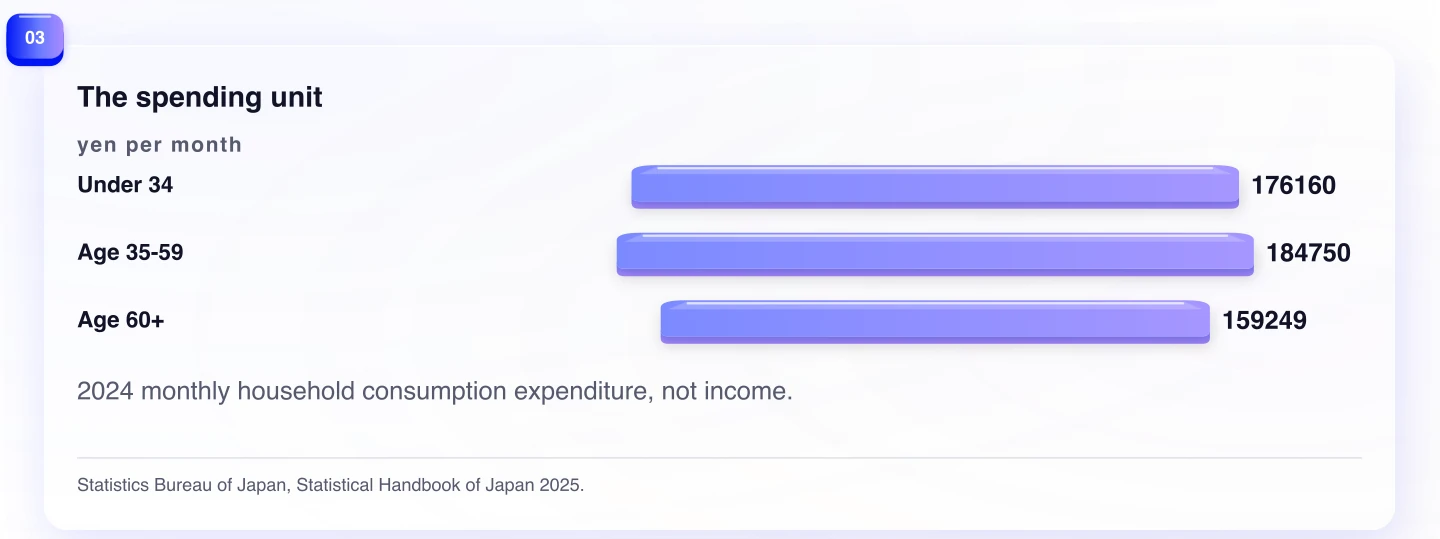
These are average monthly household consumption expenditures, not income, disposable budget, or willingness to pay for a product. The 2025 summary for two-or-more-person households reports average monthly consumption expenditure of 314,001 yen, up 4.6 percent nominally and 0.9 percent in real terms from the previous year. That is a different household group and a different year. It is not a clean head-to-head comparison.
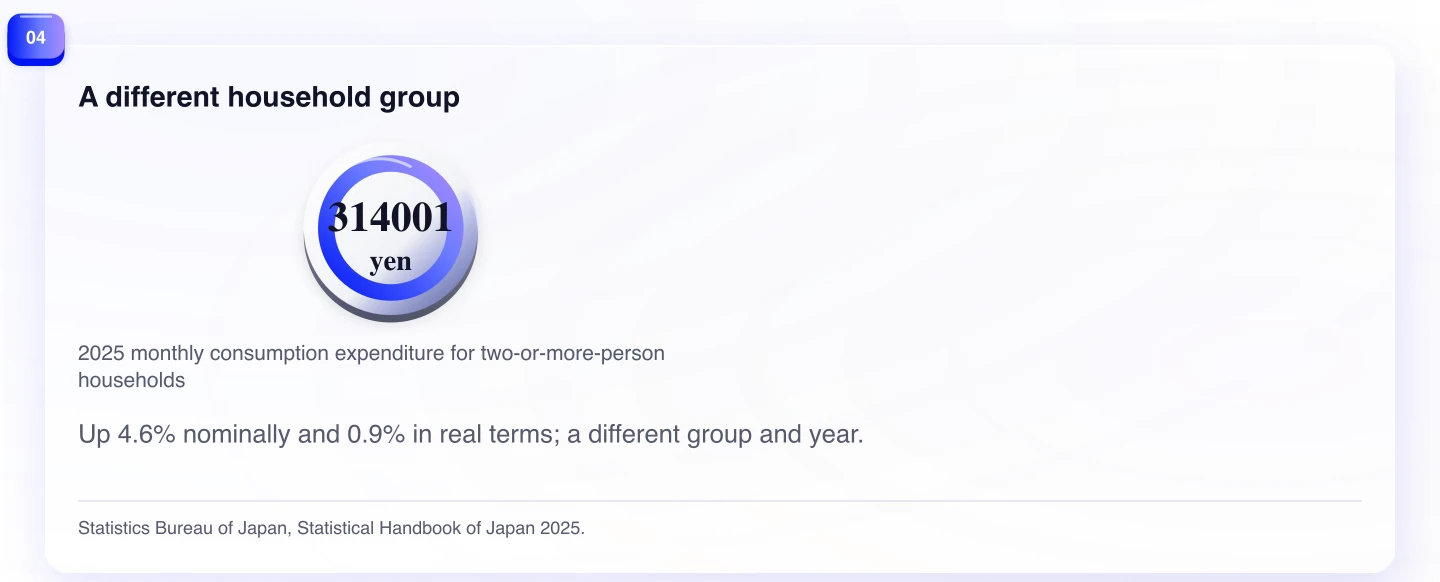
The useful lesson is not a ratio. If a company divides a multi-person package by assumed users, it may miss costs that do not divide: delivery, setup, storage, a minimum order, time to learn, or the need to contact support. A solo customer may need less quantity but not less clarity.
The official results point to variation within one-person households. In 2024, food, fuel light and water, and furniture and household utensils expenditure tended to be larger in older one-person age groups, while housing and culture and recreation declined in successively older groups. This is not a category forecast. It is a reminder that one-person status and age should be examined together rather than collapsed into a generic solo customer.
Design for one without assuming solitude is a preference
Designing for one is not marketing solitude. It means accounting for the fact that one person may perform the full sequence from discovery to support. A food product may need a sensible portion and low waste. A service may need a clear single-user account, transparent total price, and a support route that does not presume an internal administrator. A physical product may need packaging one person can carry, open, install, return, and store.
These are hypotheses, not findings in the Statistics Bureau data. Their value is operational. They turn a household share into observable test conditions. Can one person find the product, understand full cost, receive it, set it up, and get help without borrowing space, time, strength, or expertise? Then test the differences a second user creates. This reverses the usual approach: instead of treating the solo path as an exception to a family default, it treats the family path as an additional coordination case.
The counterargument: households are not customer segments
The strongest objection is correct. A household is a statistical unit, not a customer segment. The same one-person category contains different incomes, ages, locations, relationships, housing, and needs. Average spending cannot prescribe a feature, package, or message. Nor can a 2020 composition result prove category demand in 2026.
The evidence also spans years: composition is 2020, detailed one-person expenditure is 2024, and the cited multi-person summary is 2025. A team should not use these figures as a same-year comparison or calculate an addressable market without category-level research.
The objection changes what the evidence can do. It cannot identify the best solo offer. It can identify an assumption that deserves testing. When nearly two in five private households are one-person households, testing only shared use is the stronger unsupported generalisation.
What remains unknown
The sources do not say why a person lives alone, who makes a specific purchase, how much storage or assistance they have, or which design they prefer. They do not show whether one-person households are more likely to buy a given product, or whether an individual plan will outperform a shared plan.
Household data should shape the question, not impersonate the answer. That work belongs in category research, interviews, prototype tests, and product analytics.
What an overseas team should test
Make a one-person journey a required test case. Give one participant product information, price, delivery instructions, onboarding, and support. Do not let a companion fill missing information or perform the difficult step. Observe where the journey asks for a second person without admitting it.
Then separate quantity from effort. Test a smaller pack, but also a simpler choice, lower setup burden, explicit delivery window, single-user account, and a support path built for one person. The winning change may not be size. It may be removal of a hidden coordination cost.
One person is not a niche version of the household. It is a market unit with its own sequence of work. Designing for that sequence does not abandon family households. It stops treating another person as free infrastructure.
The same approach improves measurement after launch. Segment the journey by household situation only when consent, relevance, and privacy permit it; otherwise use task-based signals. Did one person complete delivery scheduling without assistance? Did setup end in a support request? Was a package returned because storage or quantity was wrong? These are more useful questions than an assumed solo identity. They show where an offer is relying on a second pair of hands, a second wallet, or a second memory.
This is also a way to avoid false simplicity. A one-person option should not be stripped of choice, quality, or status in the belief that one user necessarily wants the cheapest version. The evidence supports neither that claim nor its opposite. What it supports is a design process that does not require a companion to make the ordinary path work. When a service works cleanly for one person, adding another user becomes a feature rather than a repair.
For a market-entry team, the first deliverable can be modest: a one-person journey map, a list of assumptions about shared resources, and a prototype test with one participant completing the full task. That work is cheaper than rebuilding a package, an account model, or a support operation after the product has taught customers that it expects a household they do not have.
Evidence
Sources
The works below support the article's factual claims and were rechecked on .
- 2025 Yearly Average Survey Results: One-person HouseholdsStatistics Bureau of Japan · February 6, 2026 · Accessed August 10, 2026
- Summary Results of the 2025 Family Income and Expenditure SurveyStatistics Bureau of Japan · February 6, 2026 · Accessed August 10, 2026
- Statistical Handbook of Japan 2025Statistics Bureau of Japan · December 1, 2025 · Accessed August 10, 2026