Commerce and Infrastructure
Japan's redelivery rate fell to 7.6%—but the last mile still needs redesign.
Written by Kaito Yoshizumi
- Published
- Last checked
- Reading time
- 9 minutes

Direct answer
Japan's parcel redelivery rate fell to 7.6 percent in April 2026. That is real progress. It is not permission for an e-commerce operator to treat delivery as a carrier plug-in. The merchant still designs the address, promise, receipt choice, notification, exception, and return journey around the physical handoff.
The national number is useful when read precisely. The Ministry of Land, Infrastructure, Transport and Tourism counted 253,128 redeliveries among 3,322,699 parcels in a six-carrier sample. The comparable rate was 8.3 percent in October 2025 and 8.4 percent in April 2025.
The decline tells operators that behavior and receipt infrastructure can change. The remaining share, multiplied across a market that handled more than five billion parcels in fiscal 2024, tells them why the edges still matter.
The improvement is measurable
The April 2026 result extends a short sequence of lower redelivery rates in the ministry's comparable six-carrier samples. It also shows geographic variation: 8.5 percent in urban areas, 7.2 percent in suburban areas, and 6.0 percent in rural areas.
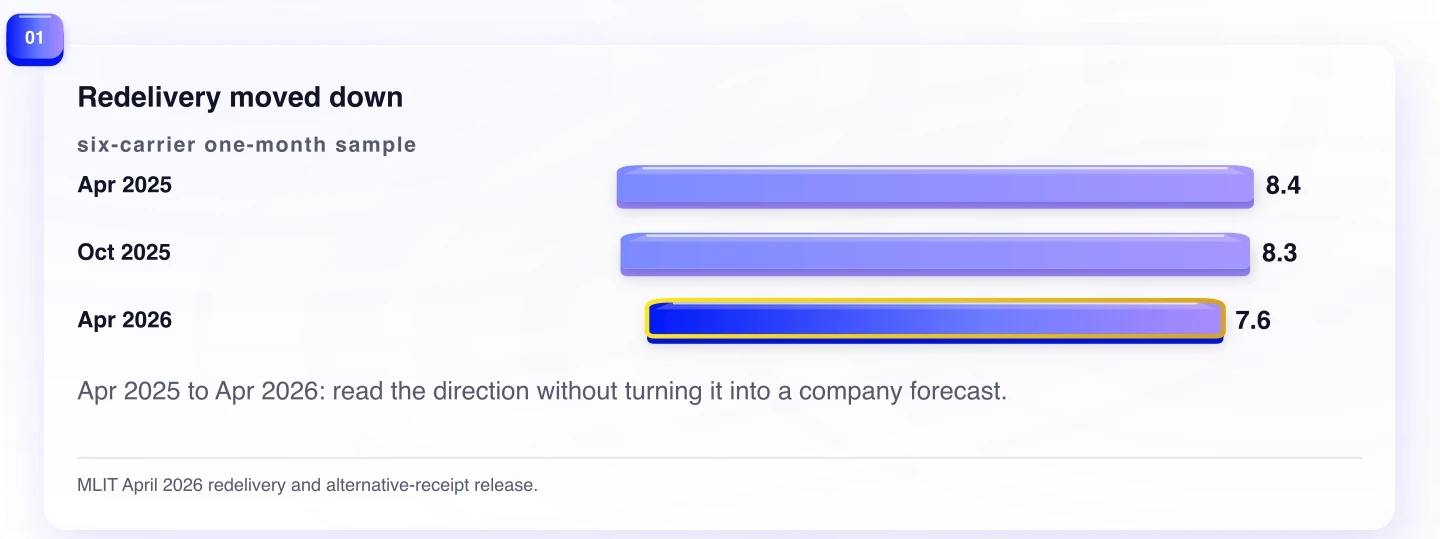
These are sample results, not a census of every carrier, merchant, parcel type, or household. They do not predict the redelivery rate for a particular store. They do establish that a national average can hide materially different delivery contexts.
An urban apartment order can fail because an intercom name does not match, a building rule blocks unattended delivery, or the buyer is away during a narrow window. A rural order can face distance, route frequency, and address interpretation. A merchant that sees only one national benchmark may miss the problem its category and customer actually experience.
The right performance question is not “Are we below 7.6 percent?” It is “What share of our orders complete on the first attempt, and why do the others fail?” The official rate is context. The merchant's event data is the diagnosis.
Do not merge two official series
The same ministry release reports another encouraging indicator. Use of alternative receipt methods in a three-carrier series rose from 25.6 percent in February 2025 to 29.9 percent in October 2025 and 31.0 percent in April 2026. The fiscal 2030 policy target is about 50 percent.
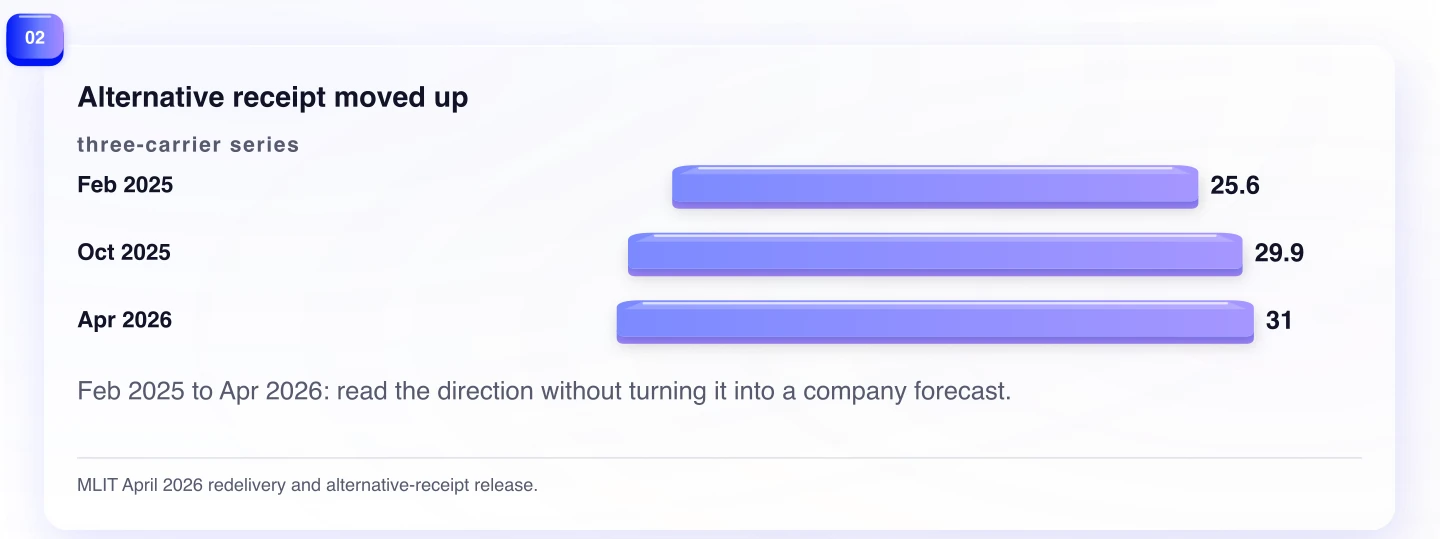
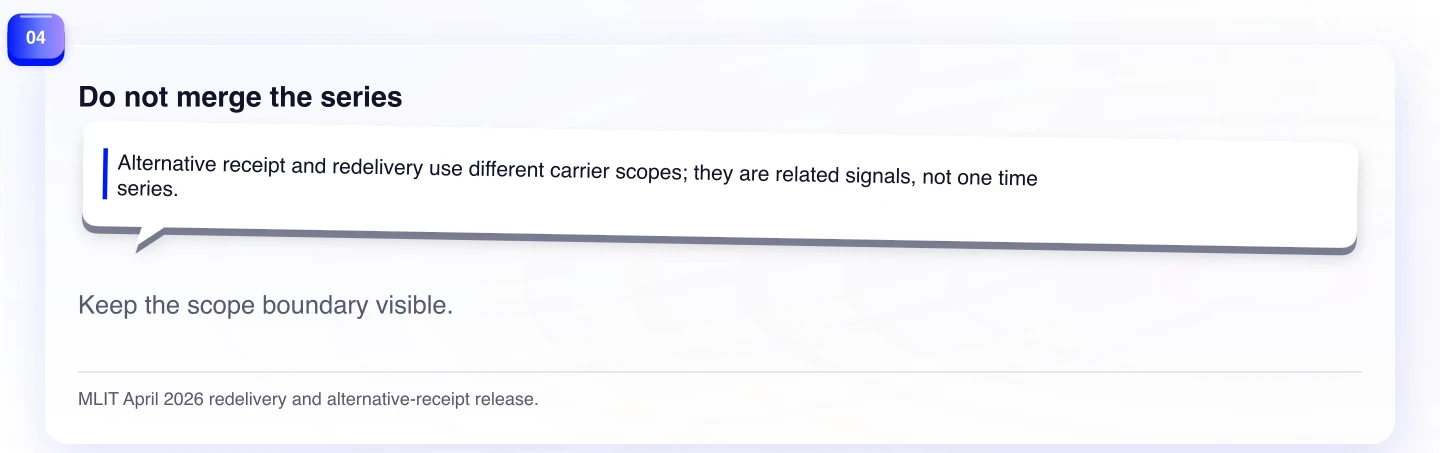
Alternative receipt can include non-face-to-face and other flexible methods measured by the release. It is tempting to place that rising line directly beside the redelivery decline and claim one caused the other. The source does not support that calculation. The indicators have different definitions and carrier scopes: three carriers for the alternative-receipt series and six for the headline redelivery series.
They can be discussed as related policy signals. They should not be fused into one synthetic time series. A clean operating dashboard keeps receipt-option selection, first-attempt completion, redelivery, and customer satisfaction separate. The business can then test causal hypotheses inside its own orders.
That separation also prevents a vanity metric. A merchant can show more receipt options without making them discoverable or reliable. A customer may select unattended delivery but receive an exception because of the item, building, weather, address, or carrier rule. Count the selection and the completed outcome.
The carrier executes a promise the merchant made
Japan handled 5.03147 billion parcel deliveries in fiscal 2024. The system operates at extraordinary scale while logistics labor faces structural pressure. An annual overtime limit of 960 hours for truck drivers has applied since April 2024.
A foreign store does not control carrier workforce policy. It does control many causes of avoidable work before the parcel enters the network.
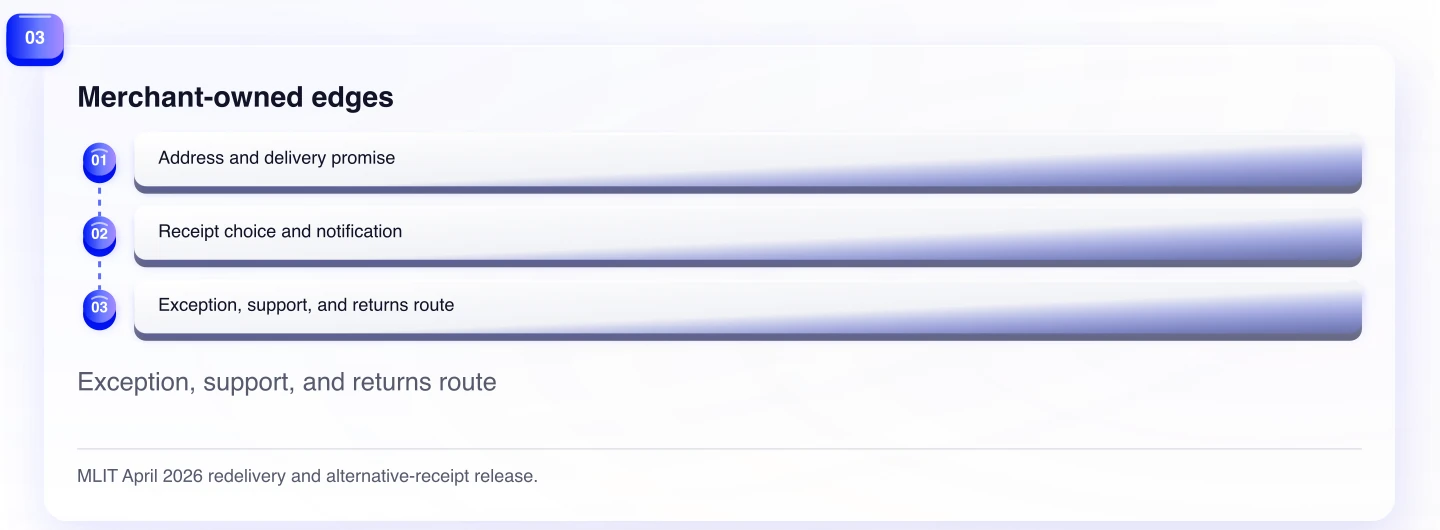
Address design is one. A global form can split Japanese addresses into fields that do not match how customers understand them. It can reject building names, lose apartment numbers, mishandle full-width characters, or force a prefecture into the wrong line. Validation that makes sense in another market can create a deliverability error in Japan.
Promise design is another. “Ships in two days” is not the same as “arrives in two days.” A checkout can present a date that ignores cutoff time, inventory location, carrier service level, island routes, or holidays. The carrier becomes the visible face of a promise the merchant's interface invented.
Notification is a third. The customer needs to recognize the sender, understand the action, and reach the correct receipt option without a suspicious link or account dead end. A notification delivered too late is not a useful notification, even if the system marks it sent.
Exception design is the fourth. Failed address confirmation, weather delay, damaged parcel, access restriction, refused delivery, and return-to-sender each need an owner. If the merchant and carrier send the customer back and forth, the physical location of the parcel matters less than the absence of service ownership.
Receipt choice belongs before dispatch
The rising use of alternative receipt methods supports an operational principle: the best redelivery intervention often occurs before the first attempt.
Offer only options that the carrier, product, and destination can actually support. Explain unattended-delivery constraints before payment, not after dispatch. Preserve the customer's selection into the carrier request and show it in the order record. If a choice changes, record who changed it and notify the customer.
Then make the default intelligent. A returning buyer who successfully used a parcel locker may prefer it again. A high-value or age-restricted item may require another route. The correct default is not the most operationally convenient option for the merchant; it is the most likely compliant completion for that order, with the customer's informed choice.
Returns are part of the same last mile. A seller that optimizes outbound delivery but requires an obscure, printer-dependent, weekday-only return path shifts friction rather than removing it. Track return pickup success, customer effort, and time to refund alongside first-attempt delivery.
The objection: the carrier owns the route
The strongest objection is practical. The merchant does not schedule every driver, control every depot, or decide every building rule. Carrier capacity, service design, and local conditions constrain what a store can promise. A small cross-border seller cannot independently eliminate redelivery.
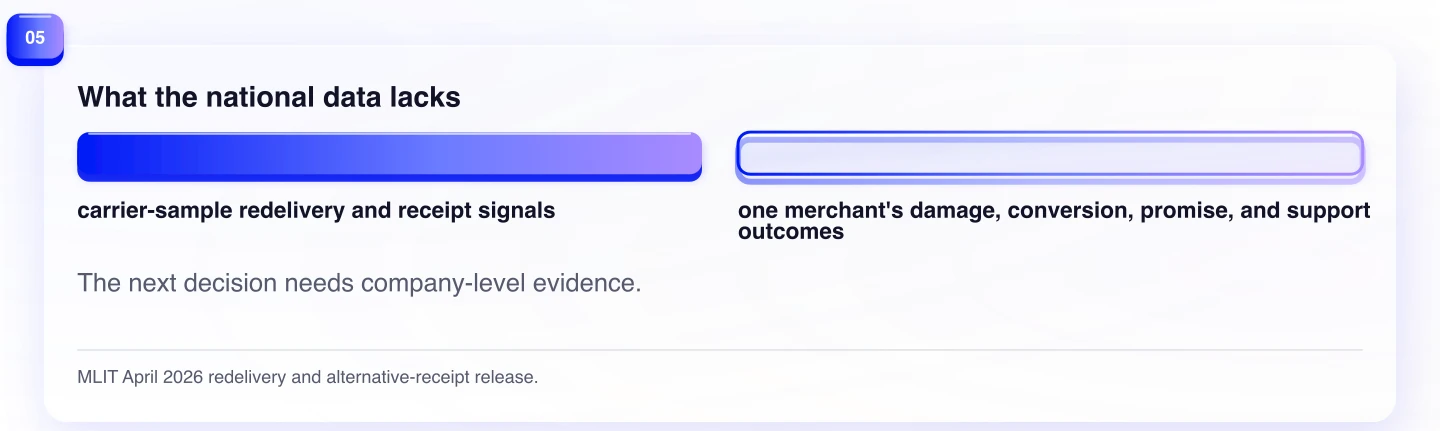
That is correct. The article is not asking a merchant to become a logistics company. It is asking the merchant to own the interface between customer intent and carrier execution.
The national sources do not reveal a specific seller's redelivery, damage, delivery-promise, conversion, or return performance. They cannot select a carrier or service level for a particular category. They show why that evidence must be collected locally.
Build a compact event chain for the next thousand orders: receipt option shown, option selected, address validation outcome, promised date, dispatch, notification, first attempt, completion, redelivery request, return-to-sender, support contact, and refund. Segment by region, building type where legitimately available, carrier, service, item constraints, and new versus returning customer. Avoid collecting personal data that is not needed for delivery analysis.
Review the failures as customer journeys, not carrier blame. If an apartment number disappeared between checkout and label, fix the integration. If customers repeatedly miss a delivery window that the checkout presented as certain, change the promise. If a selected locker route is frequently overridden, verify eligibility earlier.
Set a small scorecard around the promise. First-attempt completion is the primary result. Add address-correction rate, receipt-option eligibility failure, notification-to-delivery time, redelivery request rate, return-to-sender rate, support contacts per shipment, and days from return handoff to refund. Cost per parcel without customer outcome will encourage the team to make the interface cheaper while leaving failure elsewhere.
The scorecard needs cohorts. A national aggregate can hide a new-customer problem, a mobile-form problem, a fragile-item restriction, or one carrier service that does not match the displayed choice. Compare like with like and retain the carrier-scope notes used in the official series. When the denominator changes, mark it instead of drawing a smooth trend.
Procurement should connect service promises to the carrier contract. Confirm which receipt options are supported, which events arrive through the integration, how address correction is handled, what proof exists after completion, and which exceptions have response commitments. A technically available event that arrives after support has already answered the customer is not operational visibility.
One final design choice is restraint. Do not promise minute-level tracking or an unattended-delivery outcome that partners cannot reliably provide. A narrower, accurate promise can create more trust than a sophisticated interface that converts uncertainty into false precision.
Review the promise in Japanese as well as in the source language. Terms such as dispatch, delivery attempt, delivery completed, and return can look equivalent in a translation table while pointing to different events in the carrier system. Give every customer-facing phrase one event definition and one accountable owner. That language layer is part of the last-mile integration.
The 7.6 percent result is good news. It demonstrates that the last mile is not fixed. It also sharpens the task for each merchant. National redelivery can fall while an individual store still loses customers at the address form, promise, notification, exception, or return. A carrier carries the parcel. The business still owns whether the journey is legible.
Evidence
Sources
The works below support the article's factual claims and were rechecked on .
- Alternative receipt use reached 31.0 percent; redelivery fell to 7.6 percentMinistry of Land, Infrastructure, Transport and Tourism · July 10, 2026 · Accessed August 10, 2026
- FY2024 parcel delivery volumeMinistry of Land, Infrastructure, Transport and Tourism · August 22, 2025 · Accessed August 10, 2026
- 2025 White Paper on logisticsMinistry of Land, Infrastructure, Transport and Tourism · June 27, 2025 · Accessed August 10, 2026