Company Formation and Immigration
Incorporation is not a Business Manager visa plan.
Written by Kaito Yoshizumi
- Published
- Last checked
- Reading time
- 9 minutes

Direct answer
A founder planning to live in Japan should separate two workstreams that are often treated as one: forming a company and qualifying for a status of residence.
A Japanese company can exist without its foreign founder qualifying for the “Business Manager” status. Conversely, a Business Manager application must show more than a registered entity. Since October 16, 2025, the criteria require evidence about the business's scale, staff, office, the applicant's background, Japanese-language capability, and the feasibility of the business plan.
The practical decision comes before incorporation: can the proposed operating business satisfy and document the immigration criteria, or is a different timing, role, or status route needed?
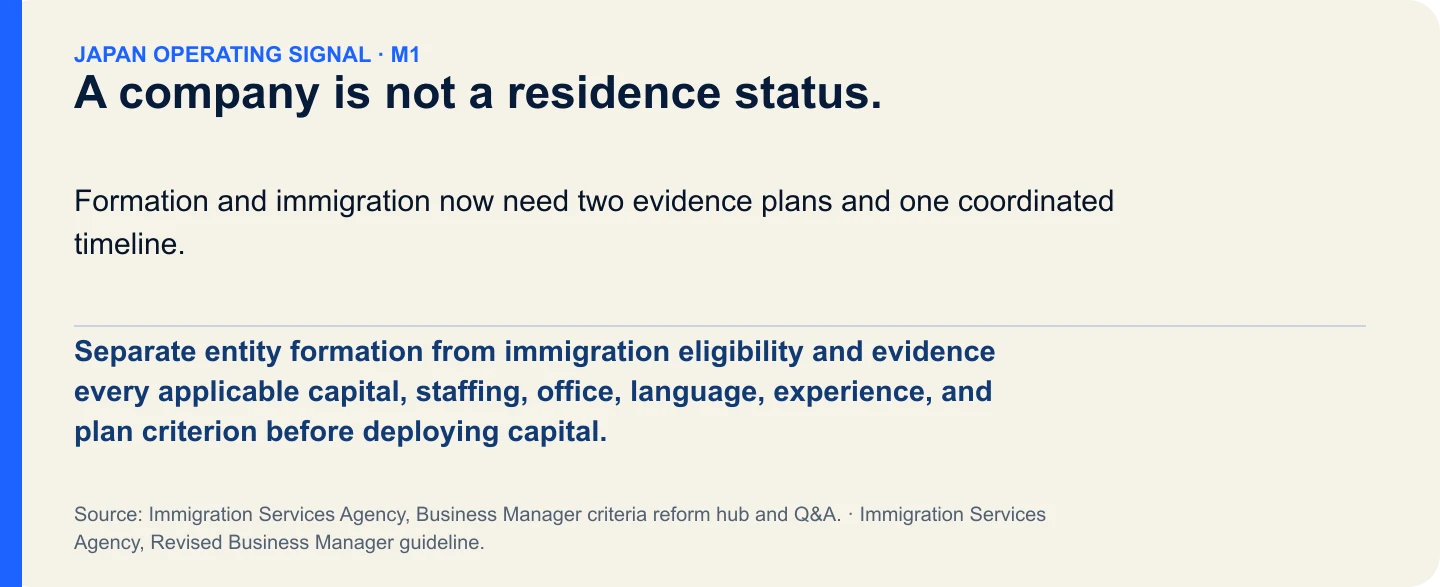
Capital should not be committed on the assumption that registration of a company produces residence rights.
The post-October 2025 baseline
Japan's Immigration Services Agency, or ISA, revised the Business Manager landing-permission criteria and related application requirements with effect from October 16, 2025.
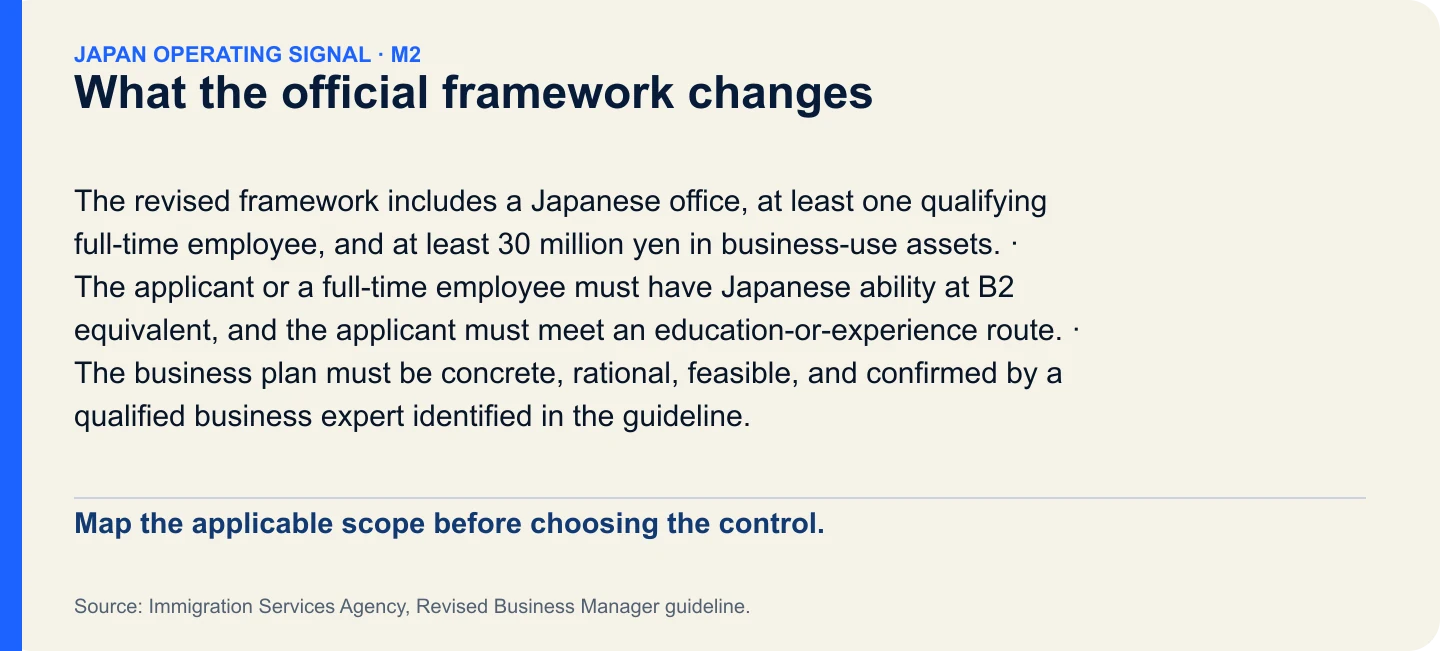
The official reform guidance, published on October 10 and updated on October 30, sets out the main criteria. For a new application under the revised framework, the business needs an office in Japan. It must employ at least one qualifying full-time employee. The total property used for the business, including stated capital or total contributions, must be at least ¥30 million.
The applicant or a full-time employee must have Japanese ability equivalent to B2 under the Japanese-language education reference framework. The applicant must also have either a doctorate, master's degree, or professional degree in business management or a field needed for the proposed business, including an equivalent foreign degree, or at least three years of experience in business management or administration.
The business plan must be specific, rational, and feasible. At the time the revised rules took effect, the guidance identified a registered small and medium enterprise management consultant, certified public accountant, or tax accountant as a professional who could confirm the plan from a business-expertise perspective.
These items are not an incorporation checklist. They are evidence used in a status-of-residence decision.
The employee rule has two different functions
The staffing criterion is easy to misstate because the mandatory employee rule and the Japanese-language rule are related but not identical.
To satisfy the requirement to employ at least one full-time employee, the qualifying person must be a Japanese national, a special permanent resident, or a foreign national residing under a status listed in Table II of the Immigration Control Act, such as Permanent Resident, Spouse or Child of Japanese National, Spouse or Child of Permanent Resident, or Long-Term Resident. A foreign national residing under a Table I work or activity status cannot alone satisfy this mandatory-employee criterion.
For the separate Japanese-language criterion, the person demonstrating B2-level ability can be the applicant or a full-time employee. The ISA's Q&A clarifies that a Table I foreign worker can count for this language function even though that person does not count as the mandatory qualifying employee.
A compliant staffing design may therefore involve one person satisfying both requirements, or different people satisfying them. The applicant should map each person to the exact criterion and preserve evidence of status, employment, wages, and language ability.
The phrase “full-time employee” is also evaluated substantively. A nominal appointment that does not reflect stable, full-time employment is unlikely to provide reliable evidence. Payroll, labor insurance, social insurance, residence records, and actual duties can all be relevant to the application record.
The ¥30 million criterion is not a visa price
The revised business-scale criterion refers to the total value of property used for the business, including capital and total contributions. It is often summarized as a ¥30 million capital requirement, but that shorthand can be misleading.
First, transferring ¥30 million into a company does not by itself establish a credible business. The office, employee, applicant background, language ability, plan, permits, activity, and other requirements still matter.
Second, evidence of source, availability, corporate treatment, and use of funds can matter in immigration review. A balance shown briefly for application purposes is not the same as capital committed to a feasible operation.
Third, business capital is exposed to business risk. An applicant should not capitalize a company at this level without a plan for runway, payroll, premises, taxes, insurance, professional fees, and the product or service being sold.
The correct decision is therefore a combined capital-and-operation test: if the business needs ¥30 million, at least one employee, and a Japanese office to qualify, does the commercial model still make sense independent of the immigration objective?
The applicant must actually manage
The status covers activity to manage a business or administer its operations in Japan. The guidance warns that when work is outsourced to the extent that genuine activity as a manager is not sufficiently recognized, the proposed activity may not fit Business Manager.
This is another reason incorporation alone is insufficient. A founder cannot rely only on share ownership, a director title, or third parties performing the business while the applicant has no credible management function.
The application should make the role legible: decisions the applicant will make, staff and providers the applicant will supervise, financial responsibility, customer and supplier relationships, regulatory duties, and the connection between the applicant's background and the business.
Office evidence is also substantive. The revised guidance says combining a residence and business office is generally not accepted, reflecting the expected scale and activity of the post-reform business.
This does not mean that every office must look the same. It means the premises, staffing, and operations should be consistent with the plan presented.
The expert-confirmed plan changes preparation
A company can be legally incorporated with broad business purposes and little operating history. The immigration application requires a more disciplined record.
The plan needs enough specificity to assess the proposed customers, product or service, route to market, pricing, costs, staffing, premises, funding, permissions, and financial outlook. It must be rational in relation to the applicant's background and feasible in the Japanese market.
Professional confirmation is not a substitute for evidence. The named expert can assess the plan, but cannot turn unsupported revenue, missing permits, or an incoherent operating model into a feasible business.
Applicants should use the confirmation process as a challenge function. Forecasts should connect to customer assumptions. Hiring costs should match the mandatory employment model. Office cost should appear in cash planning. If the business is regulated, the timetable should include required licenses or approvals.
A short legal caution is necessary: immigration decisions are case-specific exercises of legal criteria and administrative review. Meeting a checklist does not guarantee permission. This article is an operating framework, not legal advice; applicants should confirm current forms and evidence with a qualified immigration professional.
The counterargument
The strongest counterargument to the title is that incorporation remains a central part of many Business Manager plans.
That is true. A company can provide the vehicle for capital, employment, premises, contracts, accounting, and the applicant's management role. For a genuine, adequately funded business, incorporation may be the correct foundation.
The error is not incorporating. The error is treating incorporation as the dispositive immigration event.
A well-designed company can help satisfy several criteria, but each must still be evidenced. A registered address does not automatically prove an acceptable office. Paid-in capital does not prove a feasible business. A person listed as an employee does not automatically meet the qualifying full-time-employee rule. A director title does not prove actual management activity.
The revised criteria do not close the route to genuine founders. They require the commercial and residence plans to be aligned before the application is made.
Transition for existing holders
The October 2025 change does not mean that every person already holding Business Manager status immediately lost eligibility.
For an existing holder applying to renew during the three years after the effective date, through October 16, 2028, the ISA can decide the application by considering the state of the business and the prospect of satisfying the revised criteria even when the business does not yet meet every new requirement. The agency may request an evaluation document from a business professional.
After that three-year period, the revised criteria generally need to be met. The guidance also contains a narrower note: where the business is in good condition, corporate tax and other obligations have been properly fulfilled, and compliance is expected by the next renewal, the agency can consider the overall residence circumstances in deciding the case.
Applications accepted before the effective date and still under review use the previous criteria. Particular startup-visa and other designated-activities transitions also depend on when the relevant confirmation or application occurred.
These are transition rules, not a three-year exemption. An existing operator should build a dated compliance plan now, especially where capital, hiring, office, or applicant-background evidence requires restructuring.
What remains unknown
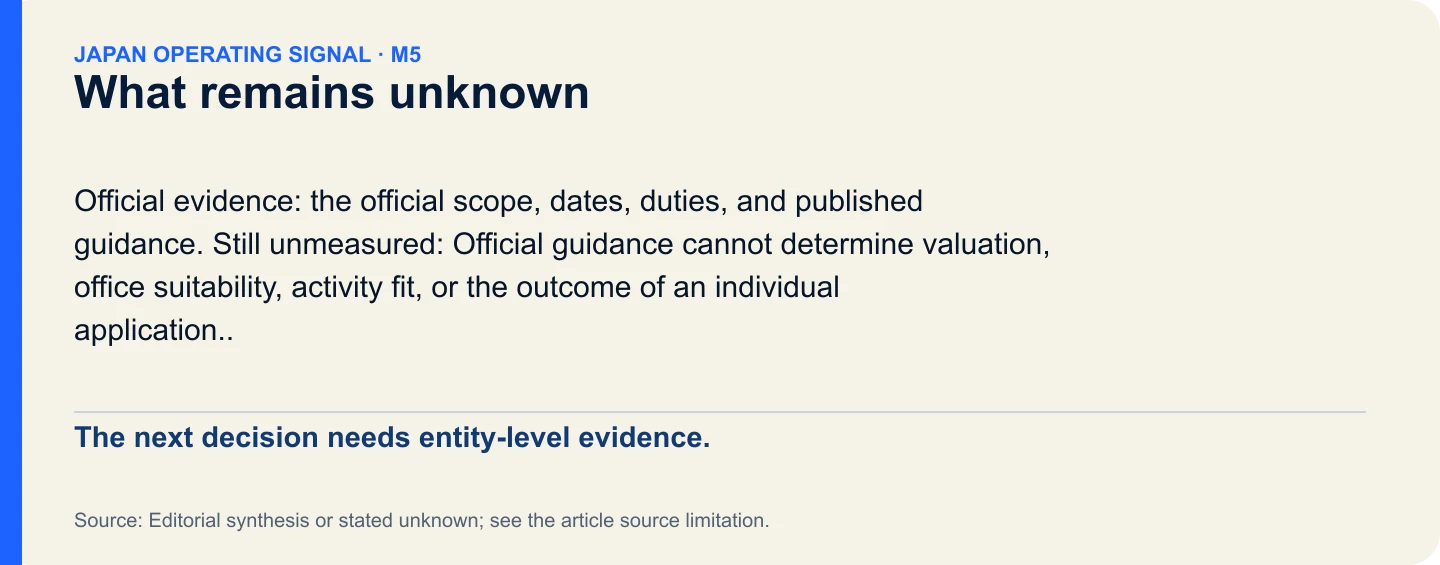
The official criteria do not eliminate case-specific judgment. How a particular asset is counted toward business-use property, whether a role is genuinely managerial, whether an office fits the operation, and whether the plan is feasible depend on facts and evidence.
The acceptable proof for a foreign degree, overseas work history, capital source, language ability, or employee status can also vary. Translations and document currency matter.
For an existing holder, the weight given to business performance and the likelihood of future compliance cannot be reduced to a public formula. The narrow post-transition flexibility should not be treated as a promised additional grace period.
Business conditions can also change between formation and filing. A lease, hire, funding source, or permit described in the plan may not be available on the intended date. The application should be built around current, supportable facts rather than a corporate template.
A practical operator decision
Create a criterion-to-evidence file before forming or recapitalizing the company. For each requirement, name the fact, document, owner, expiry date, and unresolved issue.
Model the business with the revised operating floor: at least ¥30 million in business-use property, a qualifying full-time employee, a separate Japanese office, payroll and insurance, professional support, and the real costs of market entry. If the model is not commercially credible with those inputs, pause the immigration-led incorporation plan.
Verify the applicant's degree or experience path early. Three years of management or administration experience needs documentary support. A relevant advanced degree needs an acceptable degree record and a clear connection to management or the business field.
Choose who satisfies the language requirement and who satisfies the mandatory employee requirement. Do not assume that one foreign hire qualifies for both without checking residence category and B2 evidence.
Use the expert plan review before, not after, major commitments. A qualified reviewer should test the plan while the office, hiring, capitalization, and route to market can still be changed.
The operator decision is to proceed only when the company works as a business under the revised criteria and the immigration evidence can be assembled without nominal arrangements. Formation then supports the visa plan; it does not substitute for one.
Source limitation
This analysis relies on ISA primary materials available through August 11, 2026: the reform hub and Q&A, the October 2025 revised-criteria guidance, and the current Business Manager application page. During source verification, direct opening of some MOJ/ISA pages and PDFs returned HTTP 403 in the research tool, although their official indexed text was retrievable. Readers should confirm the live Japanese originals and current application forms. ISA content is generally subject to the agency's Public Data License 1.0 terms, including attribution and modification disclosure.
Evidence
Sources
The works below support the article's factual claims and were rechecked on .
- Business Manager criteria reform hub and Q&AImmigration Services Agency · October 16, 2025 · Accessed August 11, 2026
- Revised Business Manager guidelineImmigration Services Agency · October 30, 2025 · Accessed August 11, 2026
- Business Manager status and application pageImmigration Services Agency · Accessed August 11, 2026