Entry Operations
Japan growth needs a hiring system, not a hiring plan.
Written by Kaito Yoshizumi
- Published
- Last checked
- Reading time
- 10 minutes

Direct answer
Japan can look unusually attractive when other markets are volatile. That does not make expansion simple. JETRO's latest survey of foreign-affiliated companies finds a credible growth outlook alongside a practical constraint: 44.5 percent of respondents reported difficulty filling positions, and sales-related roles were the hardest field to secure. The useful conclusion is not to stop planning for growth. It is to treat hiring as part of the route to revenue, rather than an administrative consequence of it.
That distinction matters when an overseas team writes a Japan plan. The market case can be strong, a launch budget can be approved, and a regional leader can be appointed. Yet the commercial model often still assumes that a local seller appears when the forecast requires one. The survey suggests that this is the assumption to expose.
The evidence is narrower than a national labour-market verdict. It records what foreign-affiliated companies already operating in Japan expected and reported in autumn 2025. It does not count every vacancy, applicant, or failed search. That boundary is useful. The task is not to turn a company questionnaire into a story about Japanese workers. It is to understand why a plan that relies on local commercial capacity needs an operating design of its own.
The familiar pitch: stable Japan makes expansion straightforward
The familiar pitch is compelling for a reason. Japan is often presented as a large, reliable market whose stability becomes more valuable when other markets are uncertain. For an international company, that can turn Japan from a distant localisation project into a serious growth option.
JETRO's survey gives that reading a basis. Of respondents, 45.9 percent expected revenue to rise by at least one percent in the current fiscal year; 20.4 percent expected it to fall by at least one percent. Looking to the next fiscal year, 50.3 percent expected growth and 11.0 percent expected a decrease. These are companies' expectations, not a forecast for Japan's economy or realised revenue. Still, the direction matters: more respondents saw expansion than contraction in their own businesses.
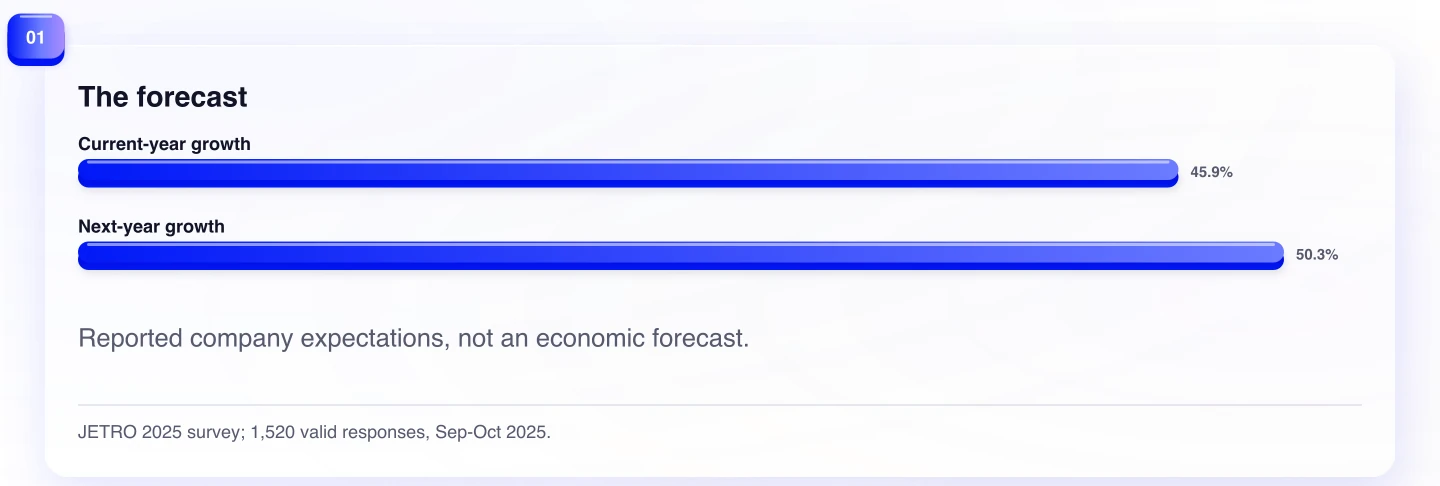
JETRO contacted 7,698 foreign-affiliated companies between 25 September and 31 October 2025 and received 1,520 valid responses, a 19.7 percent response rate. Its definition includes companies with at least 25 percent foreign ownership and firms identified as Japanese subsidiaries of foreign companies. This is a population with market experience, not a sample of potential entrants. It is also concentrated: 86 percent of responding head offices were in Tokyo, Kanagawa, Aichi, or Osaka. The results are most useful as an operating signal from places where foreign-affiliated activity is already dense.
What optimism asks a company to do
Revenue expectations are not a hiring plan, but they make a hiring plan consequential. A company expecting Japanese revenue to grow must decide how demand will be found, qualified, converted, supported, and renewed. Some work can be shared with a distributor, global team, or partner. The plan should say so. It should not quietly assume that one local hire will carry every commercial function once a target is approved.
This is where the hardest role is revealing. Among companies recruiting but struggling to secure talent, 60.2 percent named sales-related positions as difficult to fill. Non-IT technical roles followed at 28.3 percent and administrative roles at 21.7 percent. These were multiple-response answers from a subset, not percentages of all Japanese sales jobs. They nevertheless point at the role through which many overseas teams expect their market thesis to become customer work.
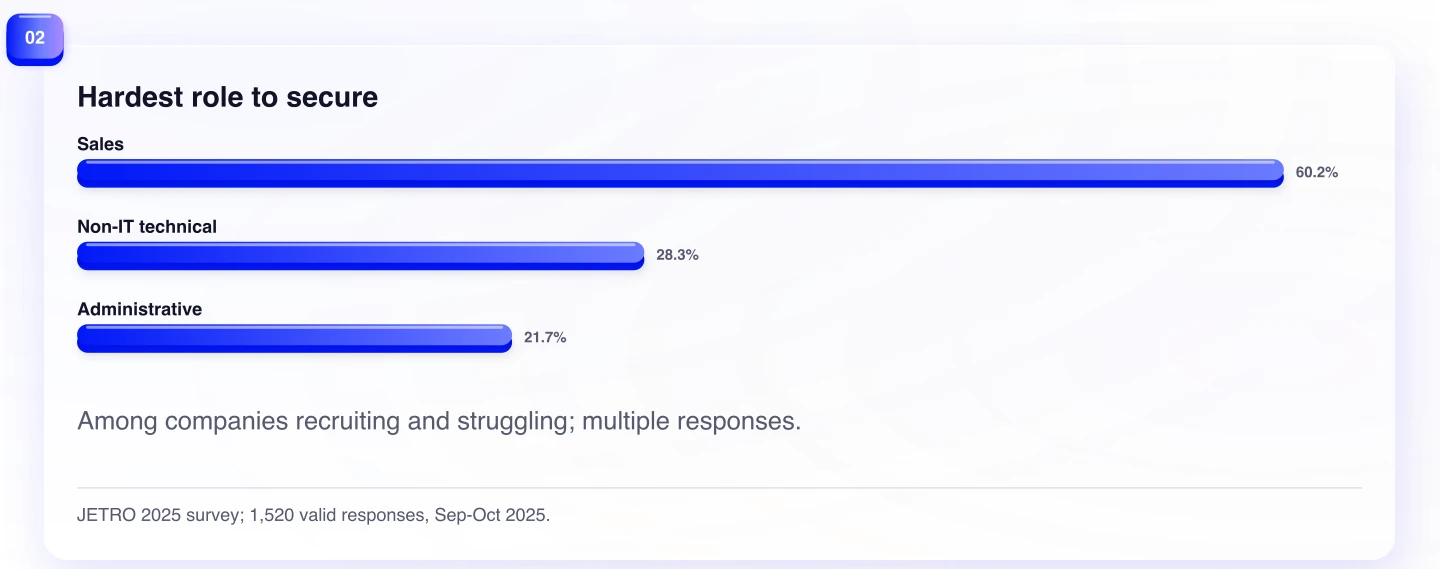
Calling sales the bottleneck needs care. The survey does not show that a missing salesperson caused a missed revenue target. It shows a mismatch between a growth outlook and the availability of a role that frequently carries local discovery, trust-building, account development, and feedback into the product team. That mismatch is enough to change sequencing.
An entry plan should therefore specify commercial work before headcount. Who can sell during the first six months? Which conversations require Japanese fluency, local presence, product expertise, or authority to negotiate? Where does a customer receive support after the first meeting? Which decisions can the local team make without waiting for another time zone? These are not survey findings. They are operating questions made difficult to postpone by the survey.
A difficulty signal, not a vacancy count
The headline figure needs a label. In the survey, 56.2 percent of respondents said they were conducting recruitment. Across all respondents, 44.5 percent said filling positions was difficult or expected to be difficult, while 11.6 percent said positions had been filled or were expected to be filled. The recruitment results use a 1,512-company subset.
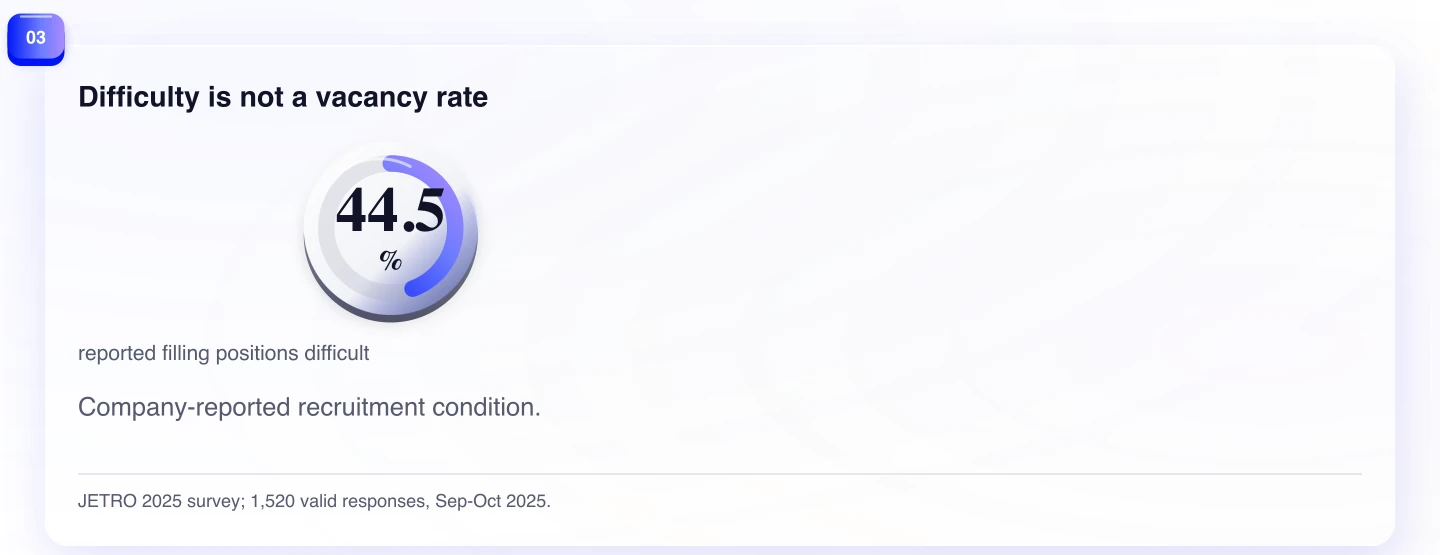
This does not mean 44.5 percent of all jobs in Japan are unfillable. It does not give a time-to-hire, salary benchmark, or turnover rate. It reports a condition as seen by respondent companies. The distinction prevents a familiar error: treating a company difficulty report as a complete measure of labour supply and demand.
Narrow evidence can still be commercially useful. A forecast that relies on one type of local employee is fragile when comparable firms say that type of hiring is difficult. The appropriate response is not a generic pledge to invest in talent. It is a contingency model: decide which activities must be local on day one, which can be handled by a partner or regional team, and what happens if the preferred hire arrives late.
Why a hiring plan is too small
Hiring plans often begin with a title, salary range, and deadline. Those inputs matter, but they arrive late if candidates cannot see a credible local employer or a workable job. JETRO asked companies using or planning recruitment measures what they were doing. Salary increases were selected by 35.9 percent, company visibility and public relations by 34.4 percent, and remote work by 25.5 percent. These are reported measures, not proof that any measure fills a role. They do show that companies are not treating recruitment as only a compensation problem.
The practical unit should be a hiring system: a visible local reason to join; a job with clear scope and decision rights; a credible interview process; a compensation and progression story; and operating backup when a search takes longer than expected. A company may start with a partner. Another may hire a country manager before a salesperson. The survey cannot choose between them. It makes the dependency visible.
The employer proposition deserves the same localisation discipline as the customer proposition. A candidate is assessing what information is missing: manager, remit, language environment, customer type, authority, and the path after year one. A global careers page can be accurate while leaving these questions unanswered.
The strongest objection: these are companies already in Japan
The objection should carry weight. The survey is not a study of firms that considered Japan and declined to enter, nor a random survey of Japanese employees. Companies chose whether to respond, and the sample is geographically concentrated. Revenue answers are expectations; recruitment answers are self-reported conditions. The report does not establish that hiring difficulty reduces revenue, or that stronger employer visibility solves a particular search.
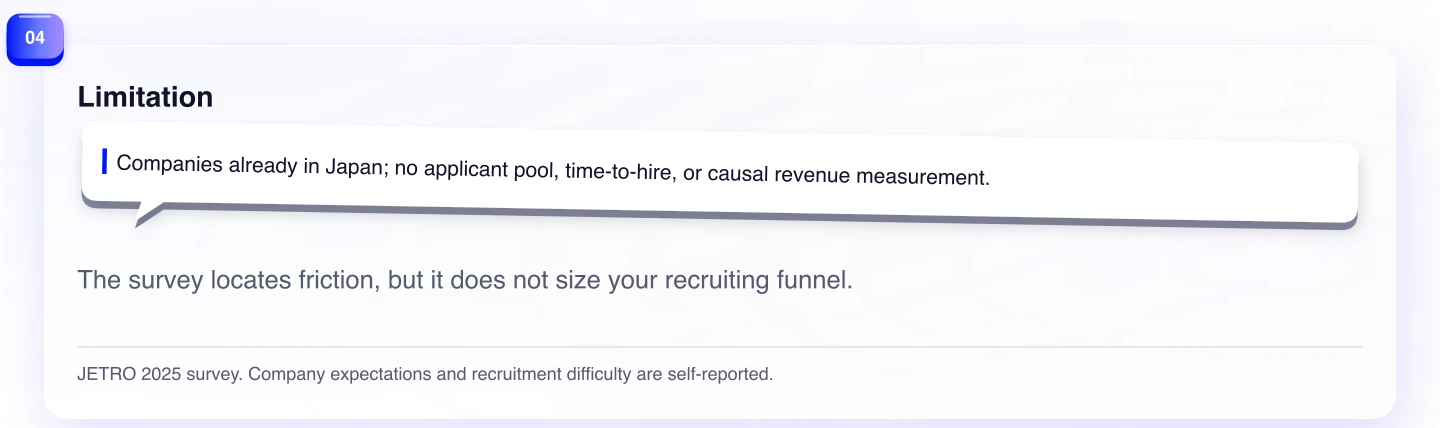
That objection rules out a large claim. An entrant cannot infer its own hiring odds from 60.2 percent or copy a generic response. Startups, large enterprises, product-led companies, and distributor-led manufacturers can face different constraints. Yet JETRO's Invest Japan Report describes talent shortages as the biggest challenge in its annual survey and as a potential barrier to expansion, regional entry, and new business development. That is contextual official analysis, not causal proof. It is enough to make one planning rule reasonable: do not give the sales organisation a deadline while leaving the hiring system undefined.
What remains unknown
The sources do not reveal the right employer proposition, compensation design, recruitment channel, or operating model for a particular overseas company. They do not show whether a candidate will value a global brand, local manager, remote work, cash compensation, product autonomy, or something else. They do not tell a team whether it should hire, partner, acquire, or wait.
They also do not measure conversion from candidate conversation to accepted offer. The next step is a test, not a claim that sales talent is impossible to find.
What an overseas team should build first
Before fixing a Japan revenue target, draw the route from first customer conversation to renewal. Name the local roles required at each point, then identify the dependencies that fail if a search runs late. This turns headcount from a box on an organisation chart into an explicit risk in the market model.
Build the smallest repeatable hiring system. Write the role in the language of real customer work, publish decision rights, prepare candidate materials where needed, and agree who can interview quickly enough to maintain momentum. Decide in advance which work a regional leader, partner, or temporary specialist can cover. Then measure qualified conversations, interview completion, offer acceptance, time to productive customer work, and reasons candidates decline. JETRO supplies a warning label, not the operating dashboard. The dashboard must be built by the company.
Japan growth may be a credible expectation. It becomes a plan only when the people who create that growth have a route into the organisation. Treat that route as market infrastructure, and the forecast becomes more honest as well as more executable.
The resulting discipline also improves conversations with headquarters. Instead of reporting that Japan needs one salesperson, describe the customer work that must be covered and the evidence required before that work can move in-house. This makes a delayed hire visible as a commercial scenario, not a human-resources surprise. It also gives a local leader permission to say which promises cannot be made yet. That is a better basis for a small launch than a larger forecast resting on an unnamed future employee.
Evidence
Sources
The works below support the article's factual claims and were rechecked on .
- JETRO 2025 Foreign-affiliated Companies Survey releaseJapan External Trade Organization · February 26, 2026 · Accessed August 10, 2026
- 2025 Survey on Business Operations of Foreign-affiliated Companies in JapanJapan External Trade Organization · February 26, 2026 · Accessed August 10, 2026
- JETRO Invest Japan Report 2025Japan External Trade Organization · December 1, 2025 · Accessed August 10, 2026