B2B Operations
Cash flow belongs in procurement design.
Written by Kaito Yoshizumi
- Published
- Last checked
- Reading time
- 10 minutes

Direct answer
Japan's transaction rules for covered SME contractors no longer fit inside a contract template. Since 1 January 2026, the renamed and amended regime has added employee-based scope criteria, covered specified transport consignments, prohibited promissory-note payment, and prohibited unilateral price setting where a covered supplier requests consultation and the buyer fails to engage or explain. The payment date, however, still starts from receipt of performance—not from the buyer's preferred month-end process.
The operational point is not that every vendor contract in Japan falls under this Act. Coverage depends on the type of consignment and the capital or employee relationship between the parties. The point is that, where the regime applies, procurement, finance, legal, operations, and the business requester have to run one connected process.
This article is not legal advice. A qualified Japanese adviser should determine coverage and obligations for a specific transaction.
The familiar problem is called payment terms
An overseas buyer may begin Japan procurement with a global purchase order and a familiar instruction: invoices received by a cutoff are paid at the end of the following month. The term may be standard across the group. It may also be disconnected from the event that Japanese law uses to measure payment timing.
The current Act states that, for covered manufacturing, repair, information-product, service, and specified transportation consignments, the due date must be set within 60 days and as short as possible from the date the entrusting business receives the performance. For services and specified transportation, the relevant event is receipt of the service. The deadline does not wait for the buyer to finish inspection.
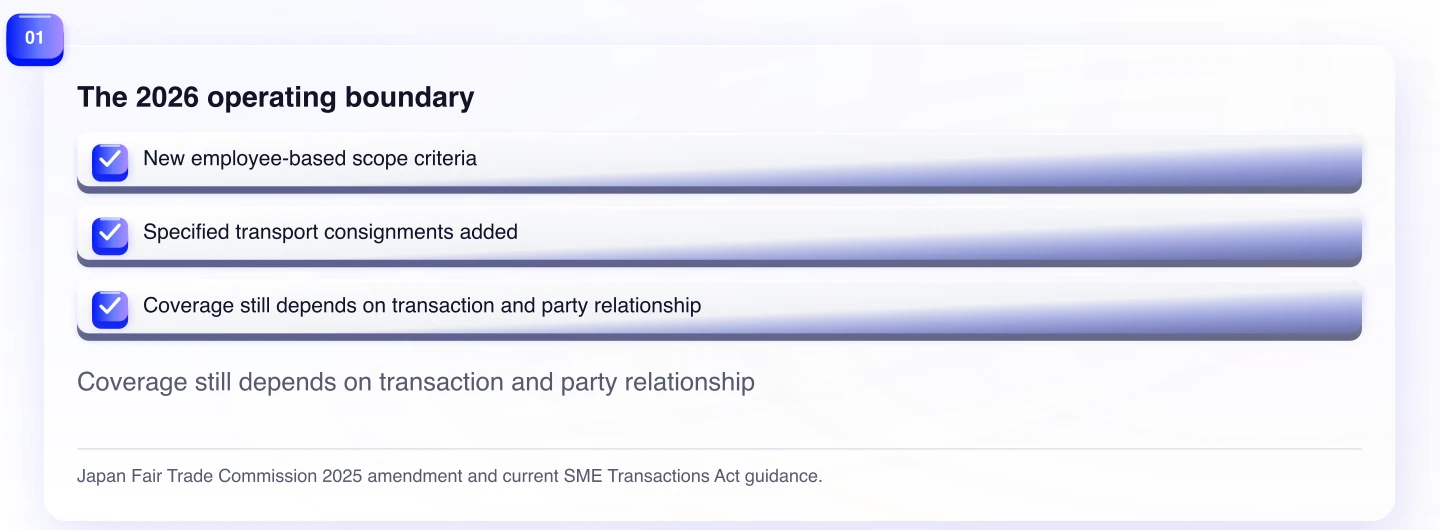
A payment-term clause therefore cannot be tested in isolation. The system needs to know when performance was received, whether the agreed due date is valid, and whether accounts payable will release the money by that date. If operations records receipt in one tool while finance calculates maturity from an invoice date in another, a compliant sentence can produce a noncompliant outcome.
Scope is a relationship, not a vendor label
The 2026 framework uses the kind of consignment and differences in capital or regular employee counts to identify covered relationships. The amended Act added employee criteria: more than 300 regular employees versus 300 or fewer for certain consignments, and more than 100 versus 100 or fewer for information-product creation and service contracts, subject to the detailed statutory exclusions and relationships. Capital criteria also remain.
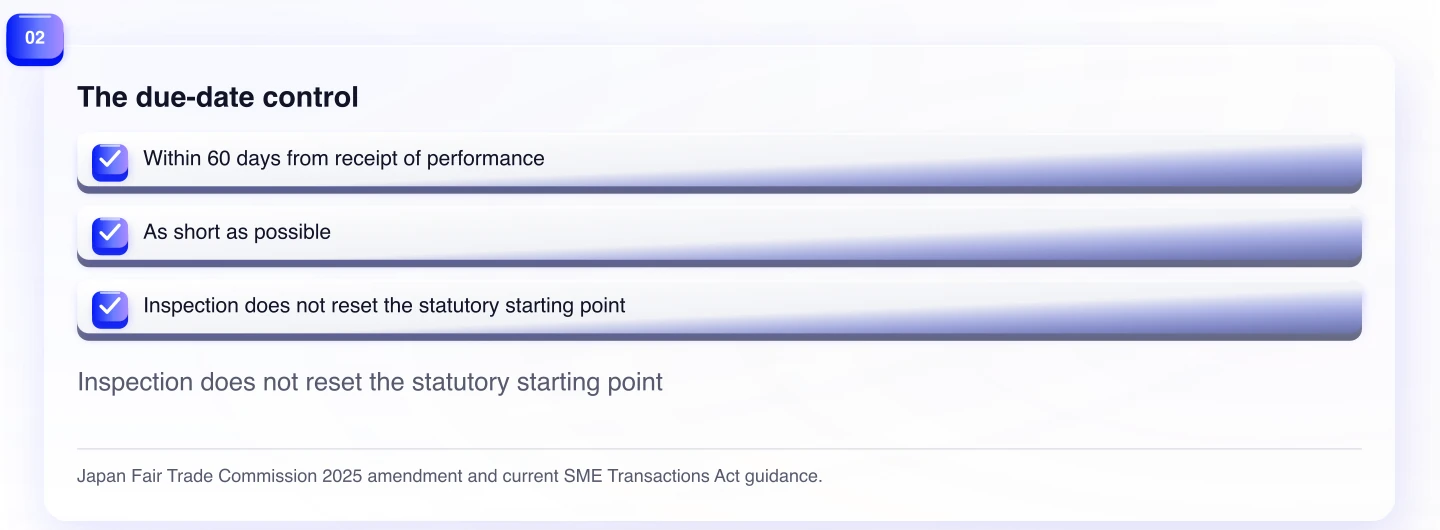
That means the word supplier is too broad. A software license, a custom software build, a creative production, a logistics service, a repair, and the manufacture of a private-label product may not be classified in the same way. A small company is not automatically protected in every transaction, and a large buyer is not automatically covered for every purchase.
The practical control is a coverage decision record. Before the order, capture the contracting entities, consignment type, capital, regular employee counts, performance, and any relevant statutory or Cabinet Order classification. Record who approved the conclusion. Do not force accounts payable to reverse-engineer legal scope after delivery.
The purchase order is part of the cash-flow system
For a covered consignment, the Act requires the entrusting business to clearly indicate the content of performance, payment amount, payment date, payment method, and other prescribed matters promptly in writing or by electronic means. Where a matter cannot be fixed for a justifiable reason, it must be indicated promptly after it becomes definite.
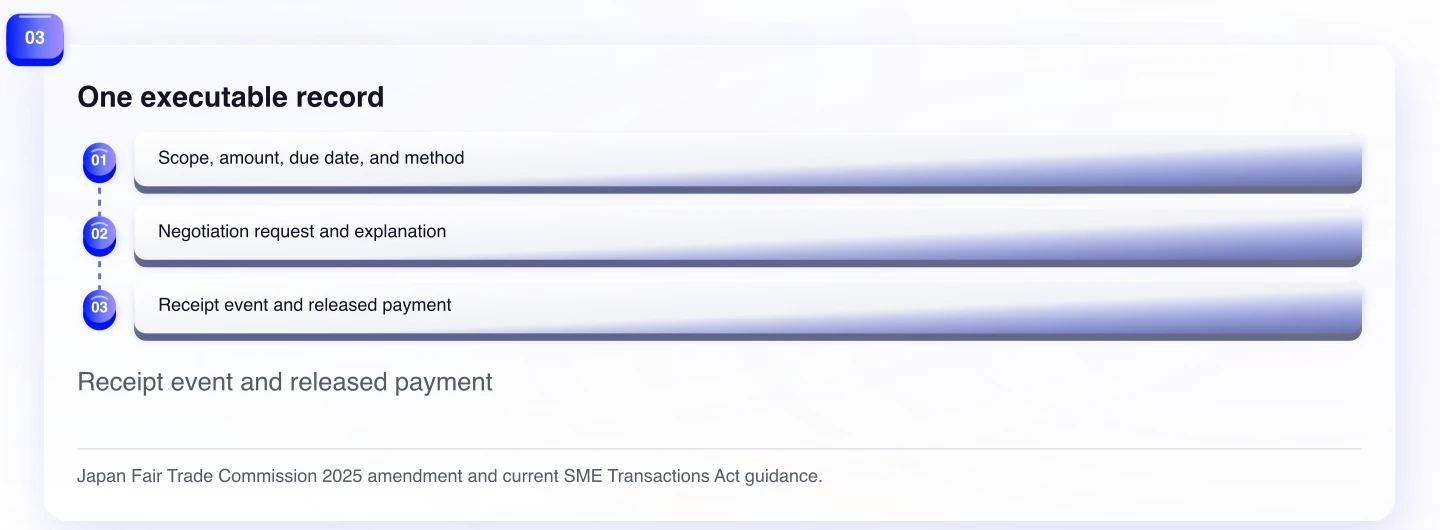
This turns order quality into payment control. An oral request followed by a late purchase order can leave the supplier performing without a stable record of scope, amount, due date, or acceptance. A vague change request can turn into a dispute about whether the work was additional. A payment date stated as a formula that no system calculates reliably can become no date at all in practice.
Procurement should therefore treat the written order as an executable record. It needs a versioned scope, amount or valid calculation method, receipt point, due date, payment method, change route, and named owner. Finance should be able to ingest those fields without retyping them. Operations should be able to confirm receipt without waiting for subjective acceptance.
Price negotiation is now a traceable decision
The 2025 amendment, effective in its main provisions from 1 January 2026, prohibited unilateral price determination in a covered transaction where the supplier requests consultation and the buyer neither responds to the consultation nor supplies necessary explanations or information about the requested matters.
The rule does not promise that every supplier receives the price it asks for. It changes the process by which a covered buyer can reach the price. A global rate card or a frozen budget is not, by itself, evidence that consultation occurred.
A workable negotiation record is modest. Preserve the request, cost change or basis raised, dates, participants, information exchanged, alternatives considered, decision, and explanation. The record should show a real conversation rather than a form sent after the price was already fixed.
That has a commercial benefit beyond compliance. A supplier facing higher labor, materials, or logistics costs may respond to a silent price ceiling by reducing capacity, declining priority work, or exiting. A structured discussion gives the buyer earlier information about operational risk.
Payment method is not a cosmetic field
The amendment also prohibited promissory-note payment in covered transactions and payment methods that make it difficult for the supplier to receive the full amount by the due date. The change matters because the legal promise is not merely that the buyer initiates something called payment. The supplier must be able to receive the amount by the relevant date under the applicable rules.
Transfer fees, financing mechanics, internal approvals, and holiday calendars can all affect that result. The payment method and party bearing costs should be decided when the order is created. If finance discovers at release that the vendor's bank details are incomplete or the chosen instrument does not produce timely full value, the process is already late.
The Act also provides for delayed interest when covered payment is not made by the due date, calculated for the period beginning after 60 days from receipt as specified by the law and JFTC rules. That does not turn 60 days into a safe target. The statutory rule says the due date must be within 60 days and as short as possible.
The objection: this is not every B2B purchase
There is a necessary counterargument. The Act is not a general rule that every Japanese vendor must be paid within 60 days under every commercial relationship. Coverage depends on definitions, consignment content, entity characteristics, and detailed criteria. Other laws and contract duties can matter outside it.
That objection is correct. A broad slogan would create false assurance for some suppliers and unnecessary controls for others. The right response is a defensible classification, not universal application by analogy.
But scope complexity does not justify ignoring the workflow. A company that cannot identify its contracting entity, performance type, supplier size relationship, receipt date, or actual payment date cannot reliably determine that it is outside the regime either. The same basic data supports both compliance and good procurement.
What remains unknown until the work begins
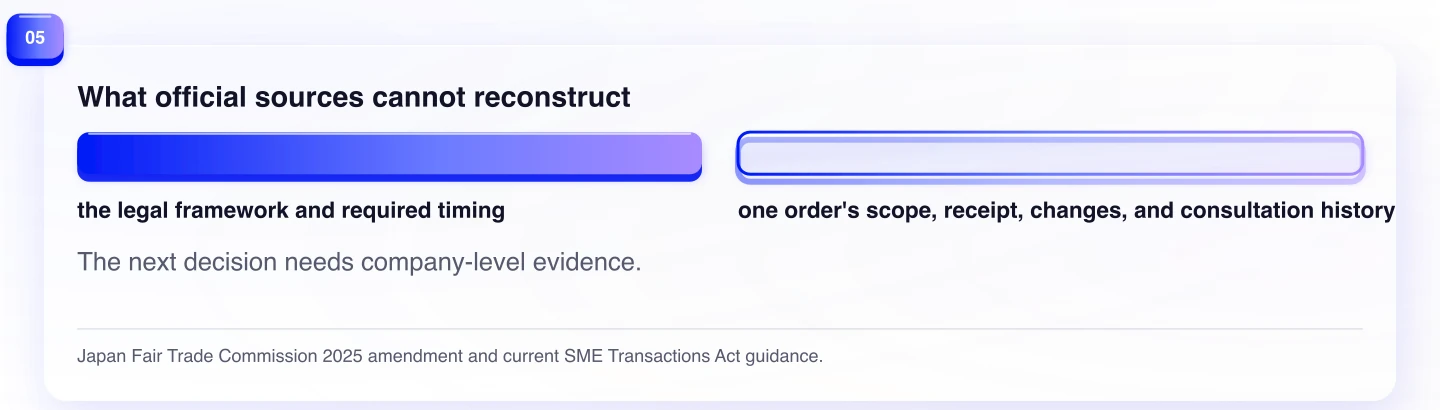
The official rules cannot tell an overseas buyer when a particular deliverable will be received, whether a change request altered the scope, whether a supplier requested price consultation, or why an invoice became blocked. These facts live in operating systems and conversations.
Create one timeline for each covered order: order issued, performance received, inspection completed if relevant, invoice received, due date, approval, and money available to the supplier. Alert on the legal due date derived from receipt, not only the accounting term. Track exceptions by cause: missing order, disputed scope, missing receipt, bank setup, internal approval, or deliberate hold.
Then run a monthly sample. Choose ten orders to smaller Japanese suppliers. Verify the coverage record, written terms, receipt evidence, price-consultation history, payment method, and actual availability date. Fix the system field that caused each exception instead of asking the supplier to send the invoice again.
Cash flow is not the last box in procurement. It is the outcome of decisions made at classification, negotiation, ordering, receipt, and payment setup. Japan's 2026 rules make those connections harder to ignore. The strongest operator response is not a longer clause. It is one traceable workflow from request to money received.
Evidence
Sources
The works below support the article's factual claims and were rechecked on .
- Passage of the amendments to the Subcontract ActJapan Fair Trade Commission · May 16, 2025 · Accessed August 10, 2026
- Act on Preventing Delay in Payment to Small and Medium-Sized Entrusted Business OperatorsJapan Fair Trade Commission · January 1, 2026 · Accessed August 10, 2026
- Obligations of entrusting business operatorsJapan Fair Trade Commission · January 1, 2026 · Accessed August 10, 2026