Tourism and Demand
Tourism growth is still geographically thin.
By Japan Legible
- Published
- Last checked
- Reading time
- 9 minutes

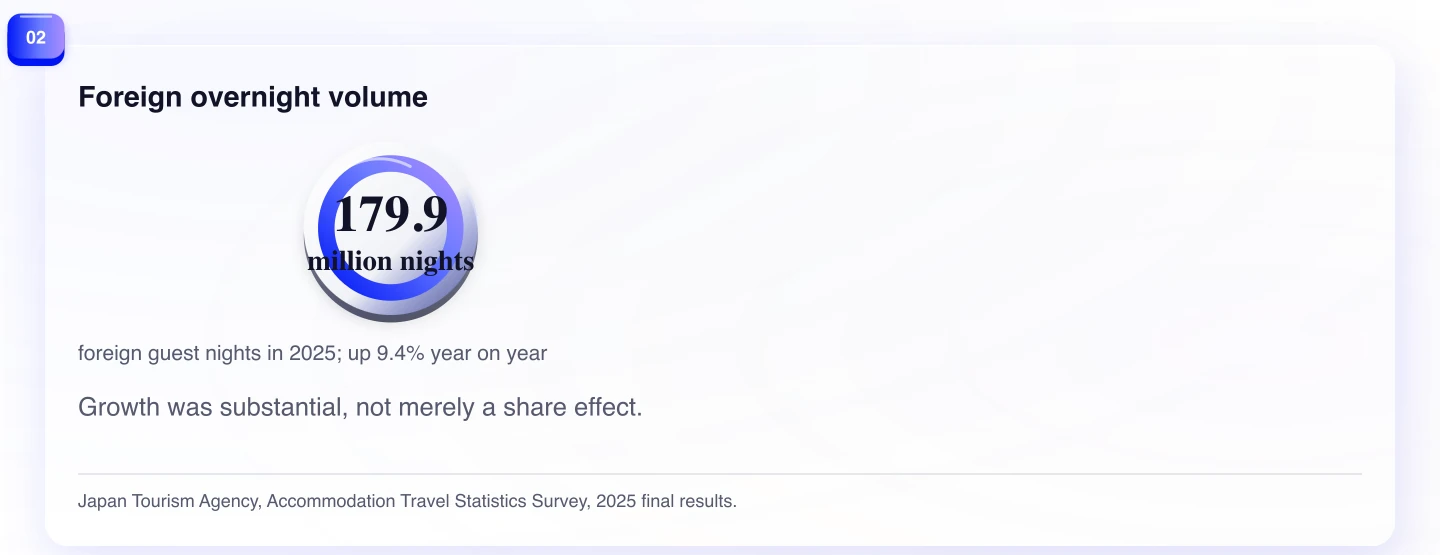
Japan's national inbound headline grew spectacularly in 2025: JNTO estimated 42,683,600 visitor arrivals, up 15.8 percent. The Japan Tourism Agency also recorded 179.9 million foreign guest nights, up 9.4 percent. But national growth is not a local-demand map. In the agency's eight-prefecture “three major metropolitan areas” group, 66.3 percent of foreign guest nights were still recorded. The flow is spreading, but it remains geographically concentrated.
That is the useful contradiction for an operator choosing a location, allocating staff, forecasting footfall, or interpreting a national tourism headline. The record is real. It does not license an assumption that a town, regional mall, hotel, attraction, rail link, or retail concept automatically participates in it.
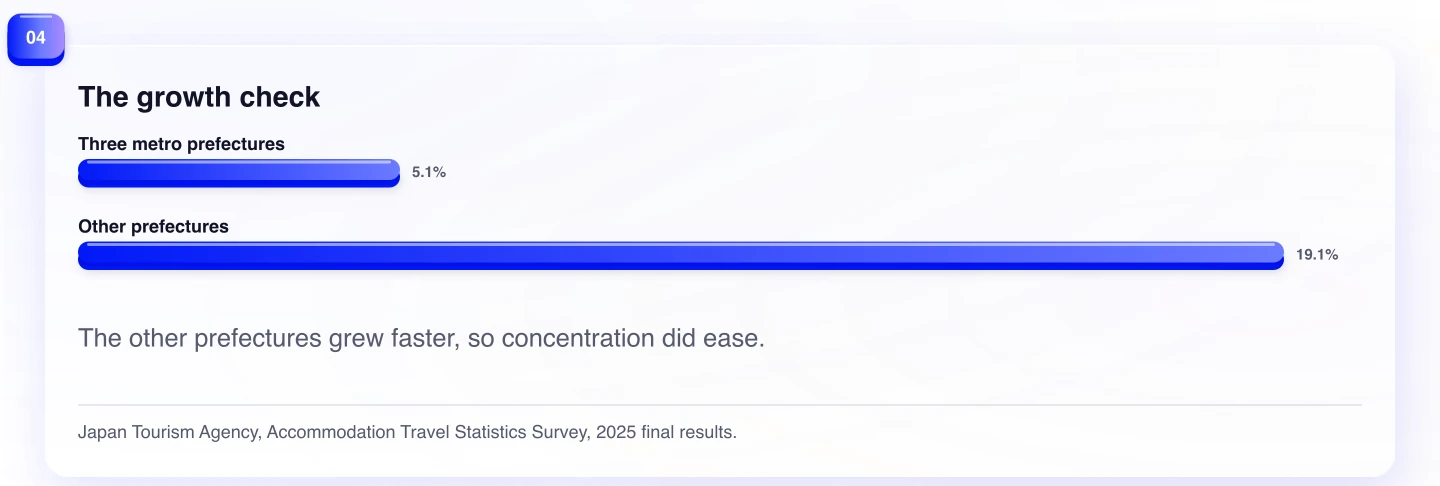
The data also rules out the opposite slogan. Foreign guest nights outside the eight prefectures grew 19.1 percent year on year, faster than the 5.1 percent growth in the metropolitan group. Their share rose from 30.9 percent in 2024 to 33.7 percent in 2025. Japan did become less concentrated on this measure. It just did not become evenly distributed.
The difference between “some dispersion” and “uniform opportunity” is where a local commercial decision lives.
A record is not a map
JNTO estimated 42,683,600 visitor arrivals in 2025, an annual record and a 15.8 percent increase from 2024. It is an important national volume signal. It is not a count of unique leisure tourists; JNTO's immigration-based series can include expatriates, their families, and students. It should be read as a robust indicator of incoming flow, not as a customer list for a particular prefecture or business.

The Japan Tourism Agency's final 2025 Accommodation Travel Statistics Survey reported 179,922,130 foreign guest nights, 9.4 percent above 2024 and 55.6 percent above 2019. That is a different but complementary fact: overseas guests used a great many accommodation nights in Japan.
Neither national total says where a given operator will see demand. A visitor can arrive in Tokyo and travel elsewhere, stay in more than one prefecture, visit an attraction without staying nearby, or buy in a place that is not their accommodation base. Guest nights are more geographically informative than arrivals, but they are still an accommodation-location measure rather than a complete path through the country.
That limitation is not an excuse to ignore the data. It is the reason to use the right question. Rather than asking whether inbound tourism is “big,” ask where the relevant visitor stays, how long, at what time of year, and whether the business can reach and convert that visitor during the actual journey.
Two-thirds of foreign guest nights were still in eight prefectures
For this comparison, the tourism agency defines the three major metropolitan areas as Tokyo, Kanagawa, Chiba, Saitama, Aichi, Osaka, Kyoto, and Hyogo. Every other prefecture sits in the local-area grouping. This is an administrative aggregation designed by the agency for the published comparison; it is not a universal definition of “urban” or “regional Japan.”
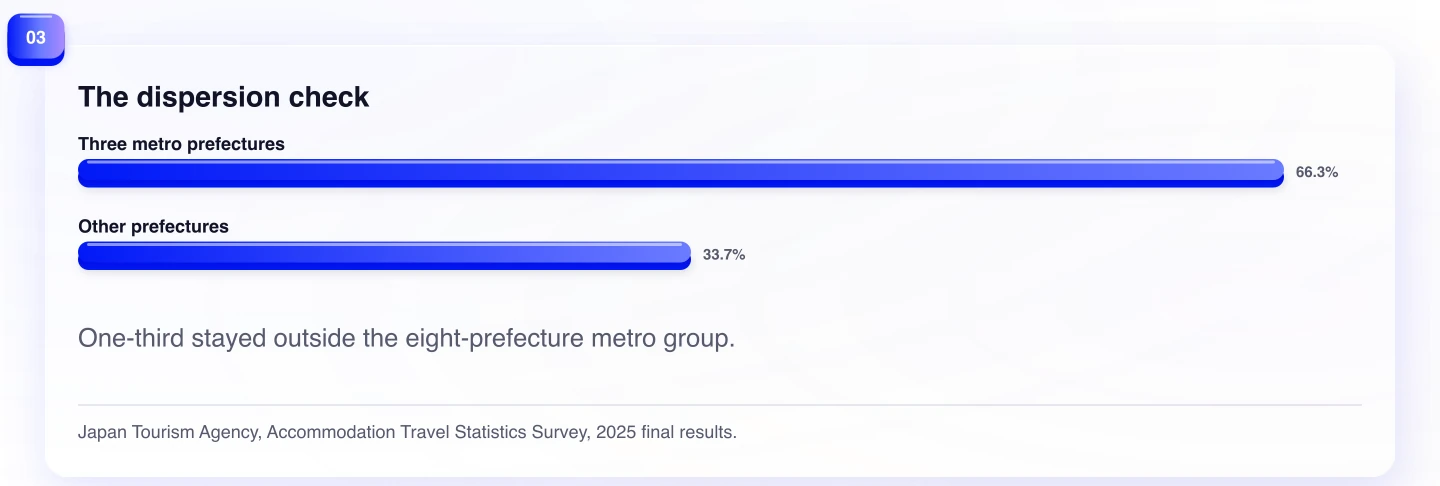
In 2025, those eight prefectures accounted for 66.3 percent of foreign guest nights. The other 39 prefectures accounted for 33.7 percent.

The result is concentrated even before a team zooms into individual destinations. The five largest prefectures for foreign guest nights were Tokyo, Osaka, Kyoto, Hokkaido, and Okinawa, in that order. Hokkaido and Okinawa matter here because a simple “Tokyo–Osaka–Kyoto” story is too narrow; substantial foreign overnight demand also reaches major non-mainland and seasonal destinations. Yet their presence does not change the central planning point: a national total remains an uneven distribution of stays.
For a company that sells where people sleep, eat, shop, transfer, or queue, the difference is material. A national visitor total can make an opportunity look ubiquitous. A guest-night distribution asks the more useful question: is the flow dense enough at the actual point of service, at the time when capacity and inventory are available, for the offer to work?
Dispersion is real, and it belongs in the same sentence
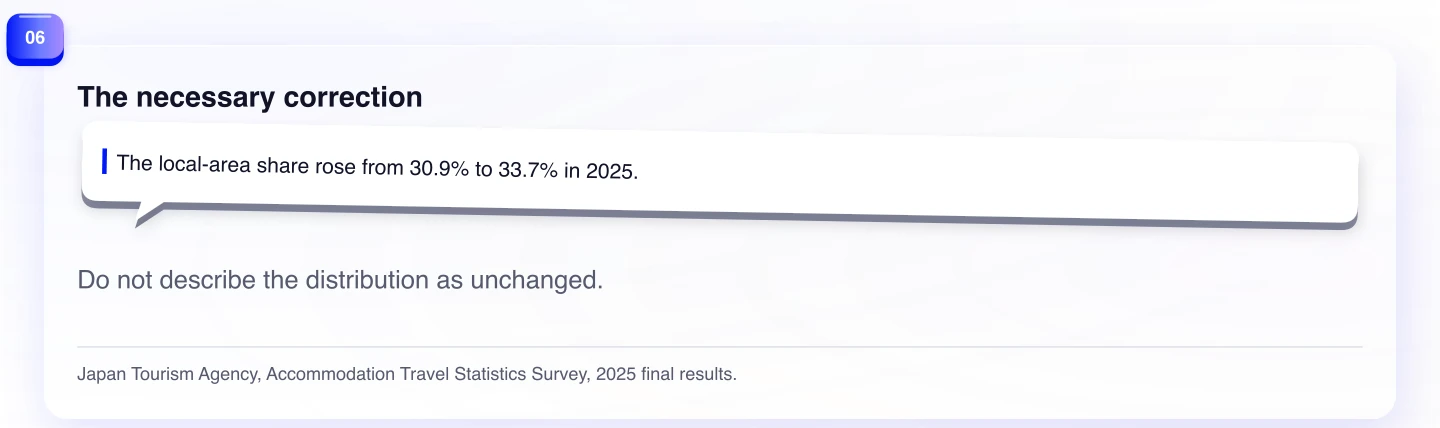
The concentration reading needs its correction. Foreign guest nights in the eight three-metro prefectures rose 5.1 percent year on year. In the other prefectures, they rose 19.1 percent. The local-area share increased from 30.9 percent in 2024 to 33.7 percent in 2025.
That is not a trivial movement. A 2.8-point change in share is evidence that part of the growth reached beyond the agency's metropolitan group. A strategy that assumes only the familiar gateways matter can miss real growth outside them. It may overlook a regional city with improved access, a destination that fits a different trip motive, a repeat-visitor itinerary, or a product that works better outside a highly competitive core.
But the pace of regional growth does not erase the stock of concentration. The local area started from a smaller share. Even after faster growth, it held about one-third of foreign guest nights, while the eight-prefecture group held roughly two-thirds. “Growth is broadening” and “demand is evenly distributed” are not interchangeable conclusions.
This matters most when a decision is irreversible. A hotel operator adding rooms, a retailer taking a long lease, an attraction funding capacity, or a transport business fixing a schedule needs more than a national growth rate. Faster growth outside the major metros may be a reason to investigate. It is not proof that the local demand base can absorb a particular capacity addition or price point.
What the measure sees—and what it leaves open
The Accommodation Travel Statistics Survey is designed to report accommodation use. Its geography is the location of the accommodation. A foreign guest night is therefore not the same thing as a unique visitor, a day visitor, a yen of spending, an attraction admission, or a sale at a particular shop.
This distinction blocks several confident but unsupported leaps. The 66.3 percent share does not show that two-thirds of visitor spending occurred in the eight prefectures. It does not show that two-thirds of all visitor experiences occurred there. It does not identify which locations are crowded at a particular hour, where a brand's target customer shops, or which local residents bear the costs of tourism. Nor does it tell us whether a promotion, route, subsidy, new store, or destination campaign caused the pattern.
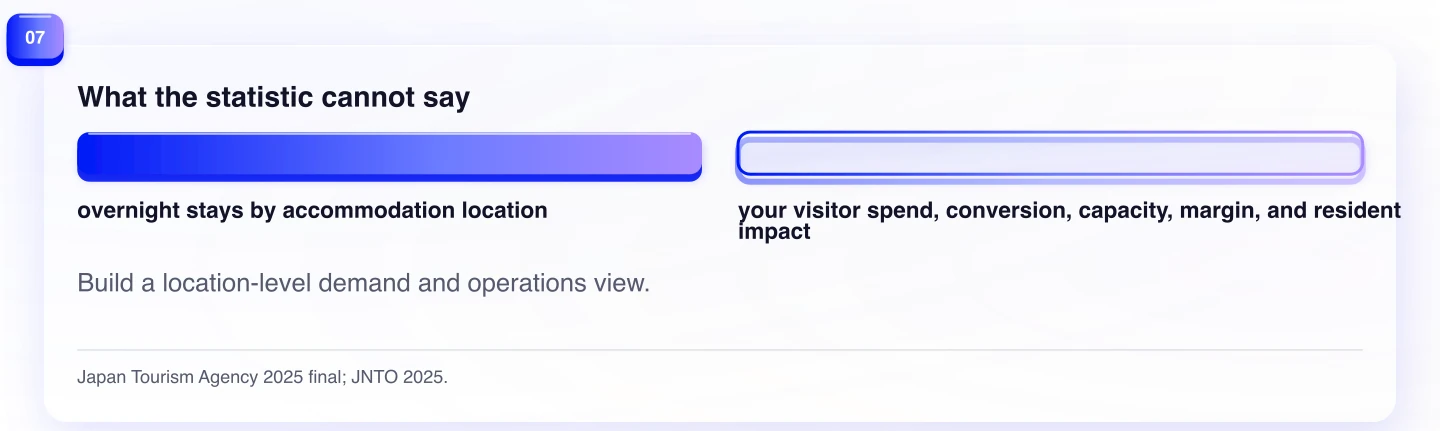
The survey result still has operating value. It says overnight visitor demand is materially more concentrated than a national headline may suggest. It also says the non-metro group gained ground. Those are two reasons to replace an all-Japan assumption with a location-specific demand model.
A useful local model has at least four layers. First, exposure: who arrives in the relevant catchment, through which stations, airports, roads, or online journeys, and when? Second, stay pattern: where do they sleep, how long do they stay, and which dayparts are accessible to the offer? Third, conversion: can they discover the offer, understand it, book or buy, pay, and receive service without a friction that domestic customers do not face? Fourth, economics: what do incremental demand, labour, inventory, service time, rent, and capacity do to margin?
The national series cannot fill these layers. It can tell a team which assumption should not survive untested: that all of Japan receives inbound demand in roughly national proportion.
A concentration fact changes the operating job
In a high-density visitor market, the first opportunity may be execution. More guest nights can turn availability, reservations, wayfinding, language clarity, payment, staffing, and replenishment into revenue constraints. The immediate question is often how to serve a full flow without eroding the experience or the margin.
In a smaller but faster-growing market, the first opportunity may be discovery and route fit. The visitor may not know the offer exists, may not stay long enough to find it, or may require a transport, booking, language, or package adjustment to make the transaction plausible. The question is not whether the national volume is large. It is whether a specific visitor segment reaches the offer often enough to support the cost of becoming available.
These are hypotheses, not causal claims from the tourism survey. They are the appropriate experiments produced by a distributional fact. A regional location may perform exceptionally well; an urban location may fail. The guest-night share tells neither story in advance. It tells a manager not to use an aggregate as if it did.
There is also a competitive implication. The largest visitor markets may offer volume but also higher attention, cost, crowding, and substitution. A faster-growing local area can offer an opening, but it may have thinner service infrastructure, more seasonality, or less repeatable demand. The trade-off has to be measured at the business model's level, not resolved by a national arrival record.
Turn the national signal into a local test
Before committing capacity, build a small location dossier. Separate overnight guests, day visitors, domestic customers, and through-traffic where possible. Track the relevant weeks rather than an annual average. Observe how customers discover the offer, where they come from, what language and payment needs appear, and where the transaction fails. Compare contribution margin, service time, and stock availability by segment.
Then test one constraint. A hotel might test a booking explanation or late-arrival handoff. A retailer might test findability, product explanation, tax-free processing where relevant, or a re-order path after the trip. An attraction might test timed entry, multilingual route guidance, or distribution through a local stay partner. A transport-linked business might test the interval between arrival and the offer's opening hours. These are not solutions prescribed by the national data. They are local questions that the national data makes urgent.
The same discipline helps public and private actors avoid mistaking a national target for a local success measure. A region can gain foreign guest nights while its busiest businesses lack margin, its transport capacity is mismatched to arrival times, or visitors skip the offer a project was meant to support. Conversely, a location with a modest overnight count can earn a defensible role if it reaches the right segment, solves a journey problem, and delivers its offer efficiently. Distribution changes the starting assumption; it does not determine the outcome.
Japan's 2025 inbound growth was national in scale. Its overnight footprint remained concentrated: 66.3 percent of foreign guest nights were in the eight three-metro prefectures, even as other prefectures grew faster and gained share. Treat that as neither a reason to ignore regional opportunity nor a reason to assume it is everywhere. Locate the actual flow, test the actual transaction, and make the capacity decision from the local economics.
Evidence
Sources
- Accommodation Travel Statistics Survey, calendar year 2025 final resultsJapan Tourism Agency · July 6, 2026
- Accommodation Travel Statistics Survey: results and survey overviewJapan Tourism Agency · July 31, 2026
- Visitor arrivals, December 2025 estimateJapan National Tourism Organization · January 21, 2026