People and Due Diligence
The gender pay gap is now due-diligence data.
By Japan Legible
- Published
- Last checked
- Reading time
- 9 minutes

A company with Japanese operations should decide who owns its gender pay-gap data before a buyer, investor, employee, or job candidate interprets it first.
From April 1, 2026, Japan expanded mandatory publication of the gender pay gap to employers with 101 to 300 regularly employed workers. Employers with 301 or more workers were already subject to mandatory pay-gap publication from July 8, 2022. The 2026 reform also makes the share of managers who are women a mandatory published item for employers with at least 101 workers.
The figures are labor-transparency disclosures. They are not formally a corporate due-diligence statute. But once published in a comparable format, they become evidence that counterparties can use in diligence, recruiting, procurement, and workforce assessment.
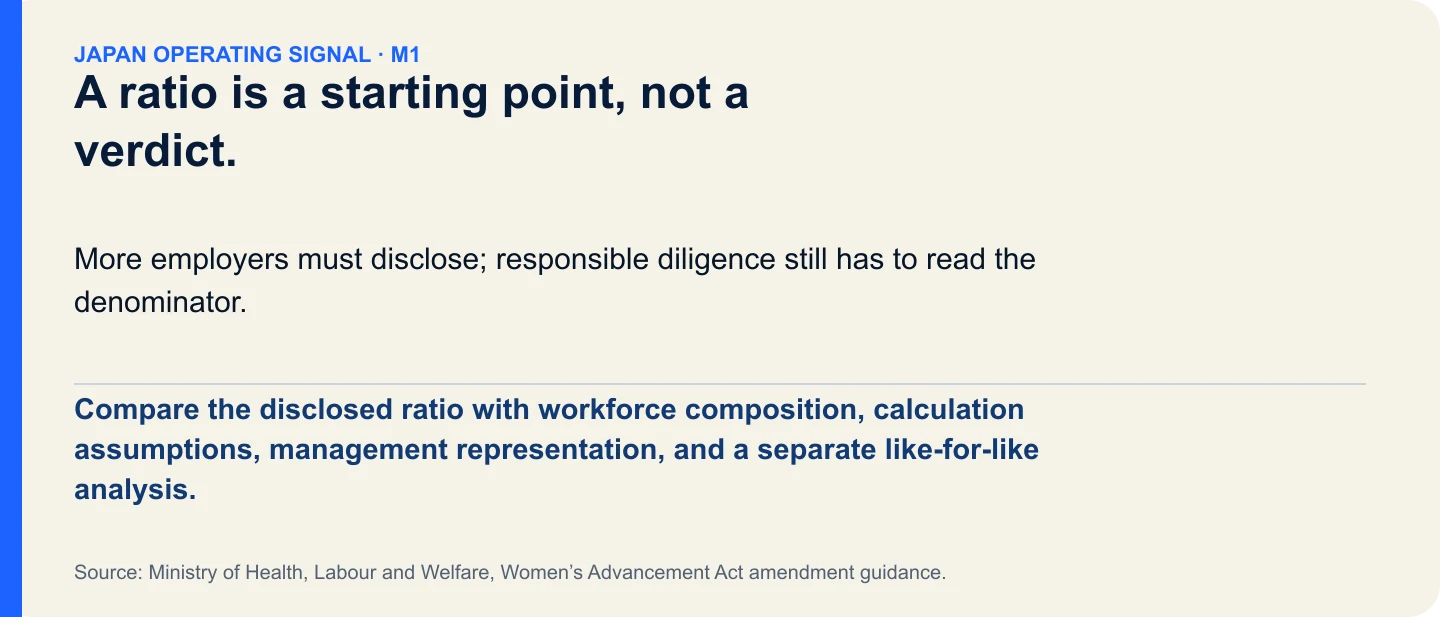
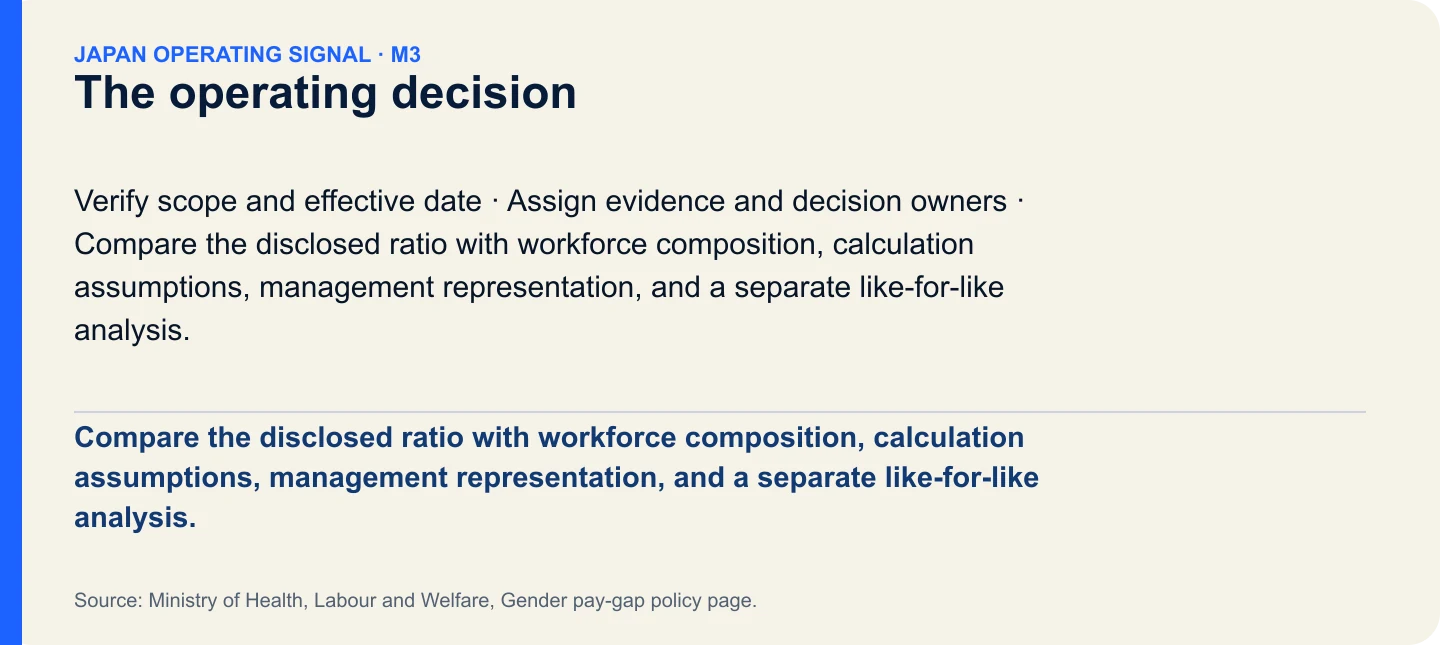
The operating decision is to treat the statutory ratio as governed public data, while keeping it distinct from an adjusted equal-pay analysis.
What is now mandatory
The amended Act on Promotion of Women’s Participation and Advancement in the Workplace took effect for these disclosure changes on April 1, 2026.
An employer with 301 or more regularly employed workers must publish the gender pay gap, the proportion of managers who are women, and the additional information required for that size category.
An employer with 101 to 300 regularly employed workers must publish the gender pay gap, the proportion of managers who are women, and at least one additional item selected from the statutory information categories.
For employers with 100 or fewer regularly employed workers, publication remains an effort obligation rather than the same mandatory rule.
The threshold is applied to the employer covered by the Act. A group with several Japanese entities should not assume that global consolidated headcount or brand-level reporting answers each entity's obligation. Scope should be checked against the legal employer and the definition of regularly employed workers.
The Ministry of Health, Labour and Welfare, or MHLW, summarizes the reform on its gender pay-gap policy page. The implementing materials revised on February 18, 2026 provide calculation and publication guidance.
The statutory number is a raw ratio
The gender pay gap is reported as women's average annual pay divided by men's average annual pay, multiplied by 100.
It must be shown for three populations:
- all workers;
- regular workers; and
- non-regular workers.
The reporting period must be identified. The disclosure is based on annual pay for the relevant business year, not a point-in-time salary snapshot.
For this purpose, pay includes wages, salary, allowances, bonuses, and other amounts paid in consideration for labor, regardless of label. The official guidance allows an employer to exclude severance pay because it reflects service across years and commuting allowance because it reimburses actual expense. If an employer uses these choices, it should disclose important calculation assumptions, including the names of excluded allowances.
Headcount and calculation methods must be applied without treating men and women differently. After initial publication, the employer should use a consistent method over time. If the method must change, the change and reason should be stated.
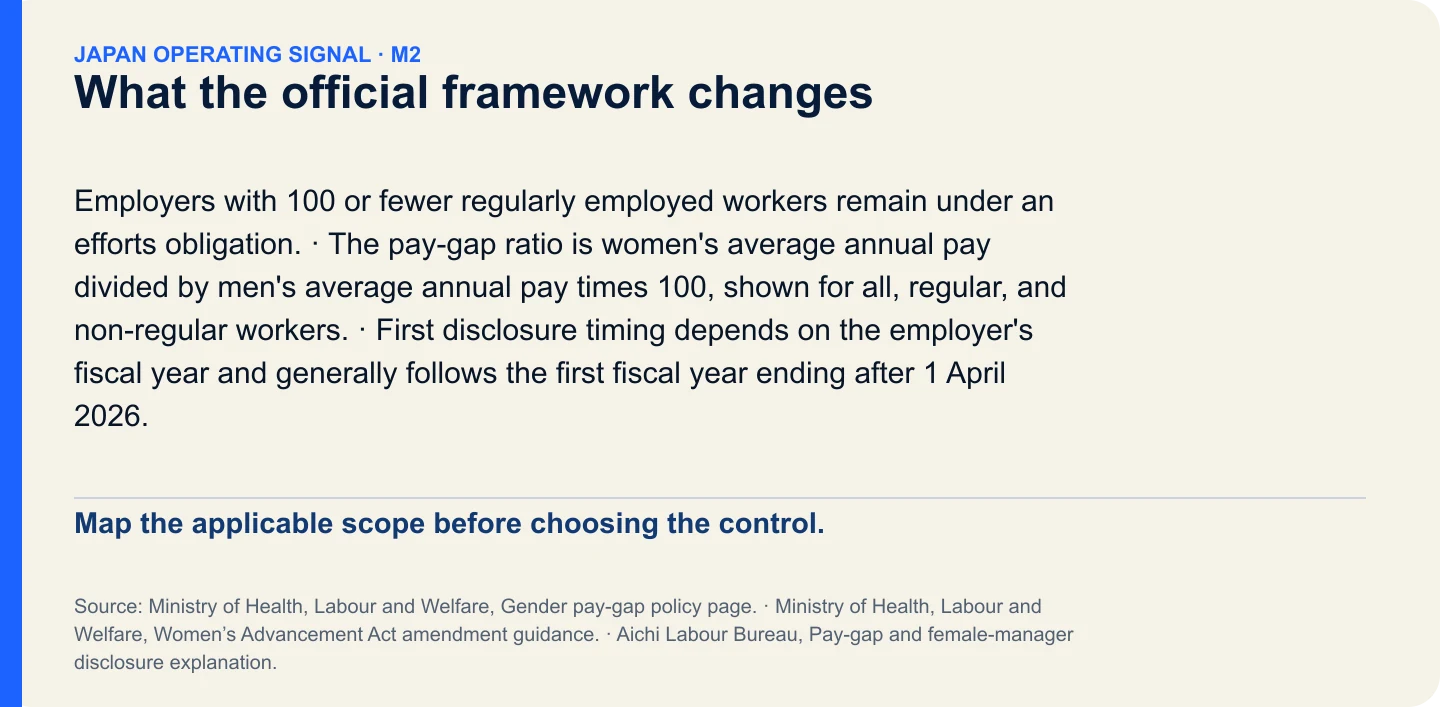
These rules create comparability, but not perfect uniformity. Optional exclusions and lawful methodological choices can affect results. A diligence reader should inspect the calculation note, not copy only the percentage.
Publication timing depends on the business year
April 1, 2026 is the effective date of the expanded obligation. It is not a universal deadline on which every newly covered company had to publish a new number.
For an employer newly covered in the 101–300 category, the first disclosure is based on the first business year ending on or after April 1, 2026. Publication is generally required within approximately three months after the following business year begins.
The official materials illustrate the timing with a July-to-June business year. The period ending June 30, 2026 is the first year ending after the reform took effect, so its result should be published by approximately the end of September 2026.
For a company with an April-to-March year, the year ending March 31, 2026 ended before the effective date. Its first newly required period ends March 31, 2027, with publication approximately by the end of June 2027.
Employers with 301 or more workers should not use this transition as a reason to pause. Their pay-gap obligation predates the 2026 expansion.
Publication can be made on the company's website or through MHLW's Database of Companies Promoting Women's Participation and Advancement. The information should be accessible to job seekers and other readers rather than buried in an internal document.
Why this becomes diligence data
The statutory format supplies three attributes valued in due diligence: a defined population, a repeatable calculation, and public availability.
An investor can compare the direction of the ratio over several years and ask how management composition, hiring, promotion, tenure, and non-regular work affect it. A buyer can use the disclosure as one workforce-governance signal. A job candidate can compare the employer's public number and explanation with its recruitment message. A board can use the same data to test whether advancement policies are producing intended outcomes.
The female-manager ratio adds context. A large difference in average annual pay may reflect, among other factors, the distribution of men and women across seniority, roles, and employment types. Publishing both figures makes it easier to ask a more informed question about the pipeline into management.
That is the appropriate sense in which the pay gap is due-diligence data. The law mandates labor information; the market decides how to use it. The disclosure should not be described as a new statutory merger-and-acquisition, procurement, or investment test.
A company should nevertheless assume that the number will travel beyond its original compliance audience.
The number is not a finding of discrimination
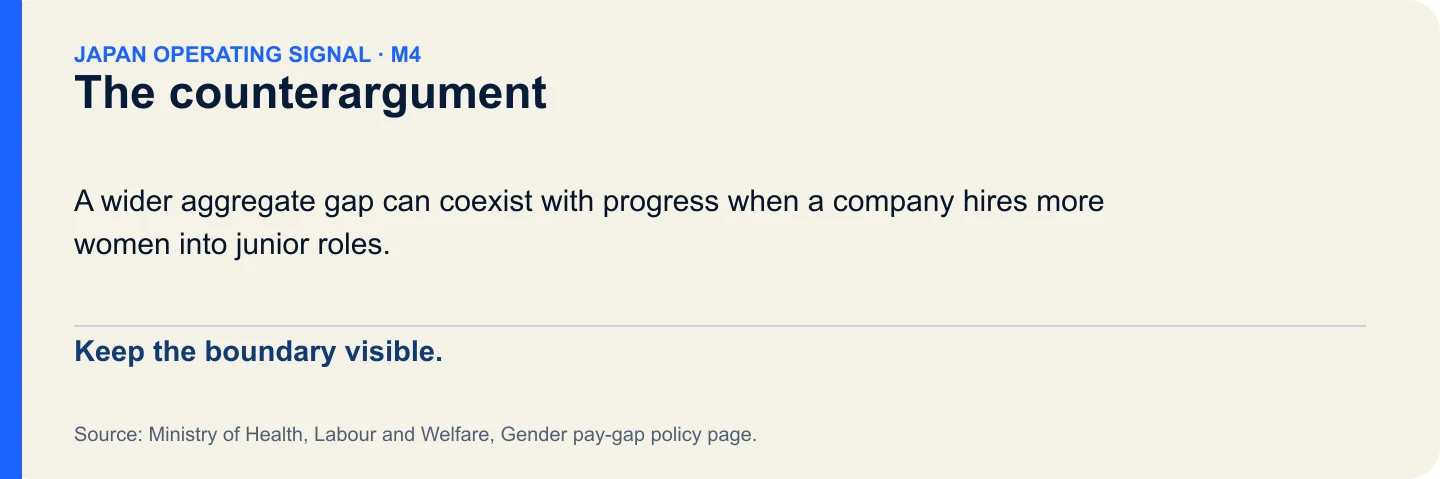
MHLW's guidance emphasizes that an aggregate gender pay-gap ratio can be affected by workforce composition. For example, a company that recruits more women into junior roles can see its unadjusted gap widen even when that hiring supports longer-term advancement.
The statutory ratio does not hold role, grade, location, tenure, working time, or performance constant. It therefore cannot, by itself, determine whether women and men receive equal pay for comparable work. A low ratio can prompt questions, but it is not proof of unlawful discrimination. A high ratio does not prove that the underlying pay system is free of inequity.
The official framework permits an explanatory field. Employers can add information about workforce composition, changes over time, and the actions being taken. They may also publish additional analyses, such as comparisons within employment-management categories or among workers with similar attributes.
The best disclosure preserves the common statutory calculation and then explains it. Replacing the required raw ratio with an adjusted figure would reduce comparability. Publishing only the raw ratio without analysis can leave readers with an incomplete account.
A short legal caution is appropriate: this disclosure obligation sits within the Women’s Advancement Act framework. Equal-pay, discrimination, employment-contract, securities, and procurement questions require their own legal analysis. The published percentage is not a legal conclusion on those matters.
The counterargument
The strongest counterargument is that the statutory pay gap is too aggregated to be useful for serious diligence.
There is force in this view. Two companies with the same ratio may have very different workforces. One may employ many women in part-time roles; another may have a seniority imbalance within the regular workforce. Optional treatment of severance and commuting allowance can create small differences. A one-year movement can reflect hiring or restructuring rather than a durable change in opportunity.
The correct response is not to discard the disclosure. It is to use it as an entry point rather than a verdict.
A diligence process should read all three statutory populations, the female-manager ratio, reporting period, calculation assumptions, narrative, and prior years. It should then request an adjusted analysis that holds relevant work attributes constant. The raw figure answers “what is the average outcome across this workforce?” The adjusted work answers “where do differences remain among more comparable workers?”
These are different questions. Good governance needs both.
What remains unknown
Entity scope can be unclear in complex groups, reorganizations, or workforces using multiple employment entities. The employer should confirm which workers count toward each legal entity's threshold and disclosure.
Comparability is imperfect where companies make different permitted exclusions or use different headcount conventions. Important assumptions should be read before comparing rankings.
The official data does not reveal causation. Role mix, grade, tenure, working hours, leave, location, hiring cohorts, and promotion can each contribute to the aggregate result. A narrative can explain management's view, but external readers may still need evidence.
Market use is also uncertain. There is no official rule saying that a particular ratio triggers failed diligence, exclusion from procurement, or an investment decision. Different counterparties will set different expectations.
Finally, the first newly covered disclosure date varies by business year. A company that does not yet show a post-April 2026 number may be within its lawful first-reporting timetable rather than non-compliant.
A practical operator decision
Assign one accountable owner across human resources, payroll, finance, legal, and communications. The source data should reconcile to payroll and the defined worker populations before the ratio is published.
Build three statutory calculations for all, regular, and non-regular workers. Record the reporting period, included pay elements, any excluded severance or commuting allowance, headcount treatment, and version history. Use the same methodology next year unless a documented change is necessary.
Run a second, internal diagnostic. Break the workforce down by grade, role, tenure, working time, location, hire cohort, promotion, and management pipeline where lawful and analytically appropriate. This analysis does not replace the public ratio; it identifies drivers and potential actions.
Prepare an explanation that separates facts, analysis, and commitments. State the principal observed drivers, avoid implying that composition makes every gap acceptable, and connect planned actions to measurable workforce outcomes. Have the board or an appropriate governance body review material claims.
Finally, prepare a diligence packet. Include the public calculation, methodology note, female-manager ratio, multi-year trend when available, adjusted analysis, and governance actions. This reduces the risk of answering every external request with a new and inconsistent number.
The operator decision is to publish the required raw ratios accurately, explain them without defensiveness, and use a separate adjusted analysis to guide action. Treat the public number as a durable data asset whose provenance and narrative must survive scrutiny.
Source limitation
This analysis relies on MHLW and regional Labour Bureau primary materials available through August 11, 2026, including MHLW's current pay-gap page, its February 18, 2026 reform leaflet, and the Aichi Labour Bureau's implementation explanation. The sources establish the legal disclosure method and timing, but do not establish how every investor, buyer, or candidate will use the data; the due-diligence framing is an operator inference. MHLW content is generally available under its Public Data License 1.0 terms, subject to attribution, modification disclosure, and stated exclusions.
Evidence
Sources
- Gender pay-gap policy pageMinistry of Health, Labour and Welfare · February 18, 2026
- Women’s Advancement Act amendment guidanceMinistry of Health, Labour and Welfare · February 18, 2026
- Pay-gap and female-manager disclosure explanationAichi Labour Bureau · April 1, 2026