Entry Operations
Stability is the offer. FX is the friction.
By Japan Legible
- Published
- Last checked
- Reading time
- 10 minutes

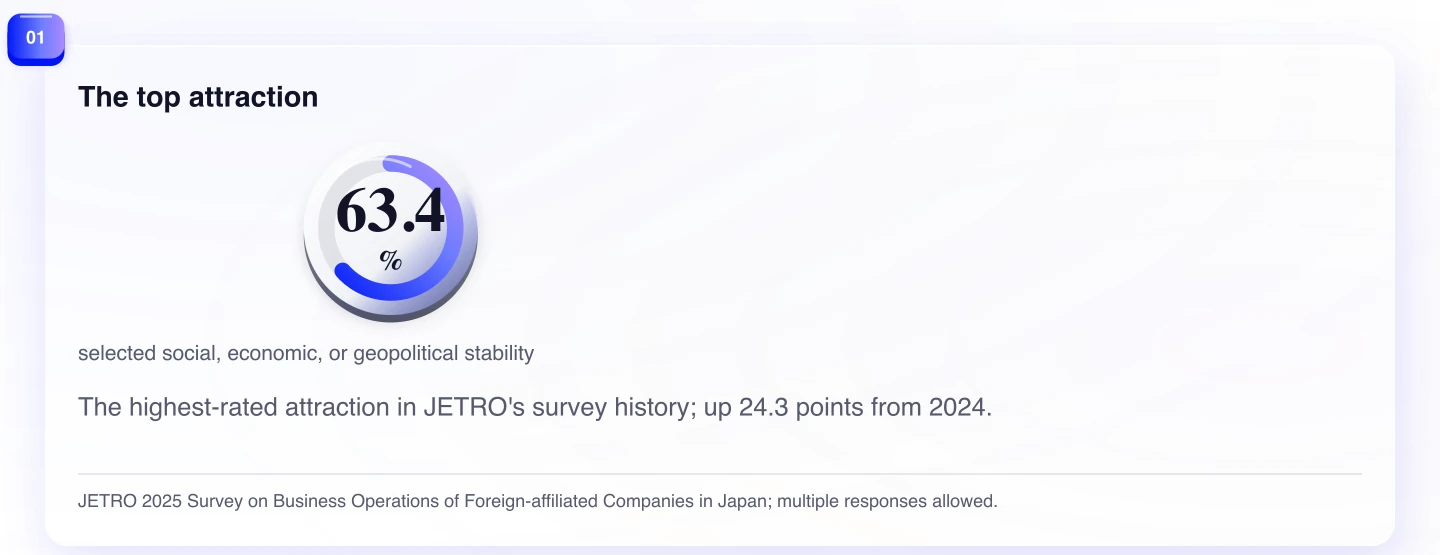
Japan can look compelling precisely when other markets feel hard to read. In JETRO's 2025 survey, 63.4 percent of responding foreign-affiliated companies selected social and economic stability or geopolitical stability as an attraction of Japan's business environment. Yet 52.1 percent also selected exchange-rate fluctuation risk as a challenge. The market can be stable enough to choose and volatile enough to complicate the budget.
That apparent contradiction is useful. It separates the reason to enter from the work of operating after entry. Stability can describe a durable environment in which to make commitments. It does not freeze a currency, write Japanese customer communication, or hire a local commercial team. Treating all of those conditions as one country score produces false comfort.
Why a stable-market story can still produce a volatile budget
Country comparisons often compress several ideas into the word stable. A team may mean low geopolitical disruption, reliable infrastructure, clear institutions, a predictable base for a regional presence, or a large developed market. None of those ideas is identical to the daily exchange rate used to convert headquarters' planning currency into yen.
The separation is visible in what companies already operating in Japan told JETRO. Stability became their top-rated attraction. Exchange-rate risk remained the most frequently selected challenge. The right reading is not that one answer cancels the other. The same firm can value Japan as a place to build while also worrying about the cost of imports, the reporting currency for revenue, the margin on a yen-priced subscription, or the timing of a supplier payment.
This is a planning distinction, not a clever slogan. The investment case should say why Japan is worth committing to. The operating case should say what will move, who owns the exposure, and what information will trigger a decision. When those two cases are merged, a team either mistakes stability for a hedge or lets short-term currency uncertainty obscure a long-term market decision.
What foreign-affiliated companies actually selected
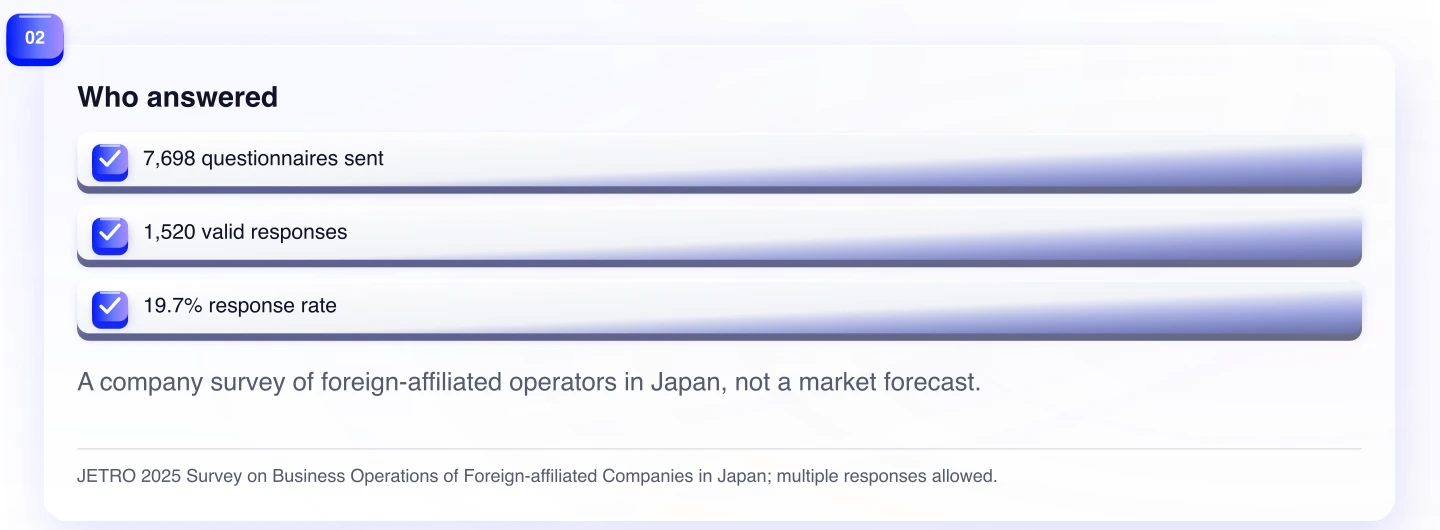
JETRO sent the 2025 questionnaire to 7,698 foreign-affiliated companies in Japan from 25 September to 31 October 2025. It received 1,520 valid responses, a 19.7 percent response rate. For this survey, foreign-affiliated companies include firms with at least 25 percent foreign ownership and companies identified as Japanese subsidiaries of foreign companies.
The survey is therefore a signal from companies already operating in the country, not a poll of all global entrants or a forecast of Japan's economy. That boundary makes it more useful, not less. It tells a prospective entrant which conditions incumbent foreign-affiliated companies noticed while doing business in Japan.
Among attractions, 63.4 percent selected social and economic stability or geopolitical stability. It rose 24.3 points from the 2024 survey, and JETRO says it was the highest-rated attraction since the survey began. This is a strong perception result. It is not a guarantee of a particular return.
Among challenges, 52.1 percent selected exchange-rate fluctuation risk. Numerous language and communication barriers were selected by 40.3 percent, and labour shortage and difficulty recruiting talent by 38.4 percent. These are multiple-response results. They cannot be added as slices of one pie, and their order does not prove that FX caused a particular loss or that language caused a particular failed sale.
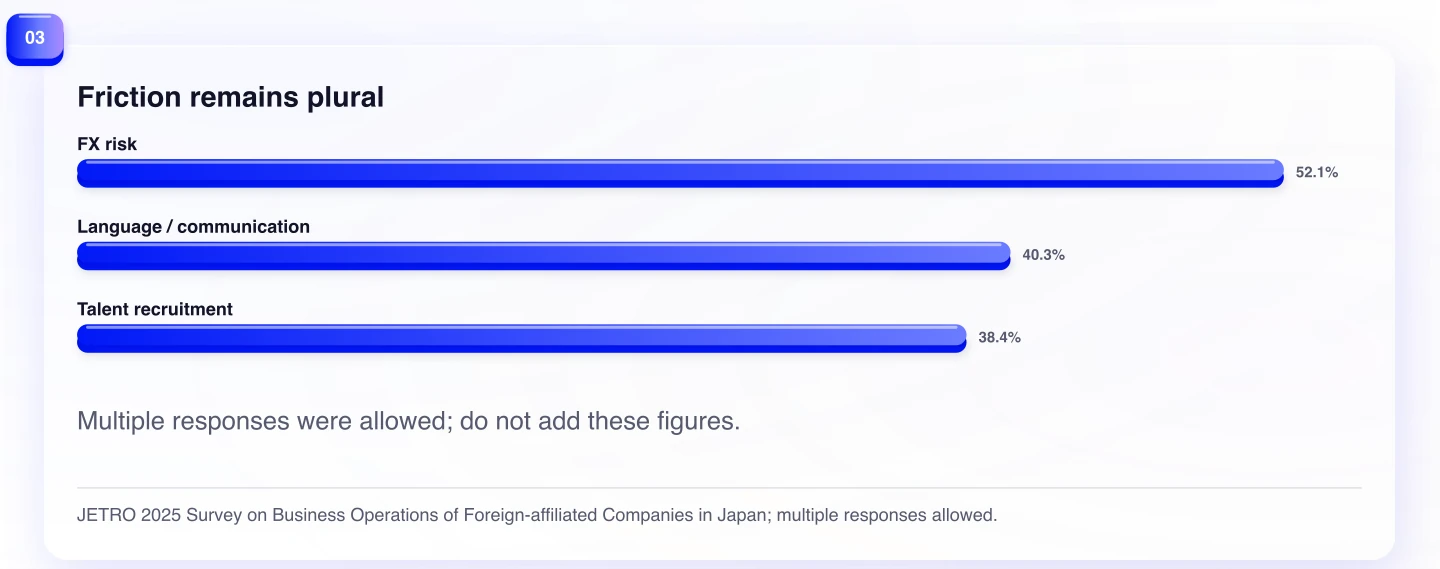
The coexistence matters more than the rank. A country can be attractive because it is stable relative to alternatives, while the day-to-day work still contains price translation, local communication, and scarce capacity. A board can rationally approve the first proposition and still require an operating answer to the other three.
There is also a timing discipline hidden in the data. The answers were gathered in autumn 2025, from companies that had already chosen to operate in Japan, and the survey was published in February 2026. They are a dated management signal, not a live exchange-rate screen. Use the result to frame questions in a current entry discussion; use current commercial data and the Bank of Japan's daily market information for figures that genuinely need to be current. That distinction keeps an executive deck from quietly converting a survey perception into a real-time market fact.
The attraction is not a hedge
The most tempting misuse of the 63.4 percent is to turn it into a financial conclusion: stable country, stable yen, stable budget. The survey does not say that. It records respondents' view of attractions relative to other markets; it does not publish a currency forecast, a hedge policy, or a risk tolerance.
The Bank of Japan's daily foreign-exchange publication provides a useful corrective. It publishes dollar-yen and other rates each business day from market-participant information. Its dollar-yen figures are central mid-rates at 9:00 and 17:00 Japan time. A rate that needs a daily official publication is not an unchanging input to a five-year plan.
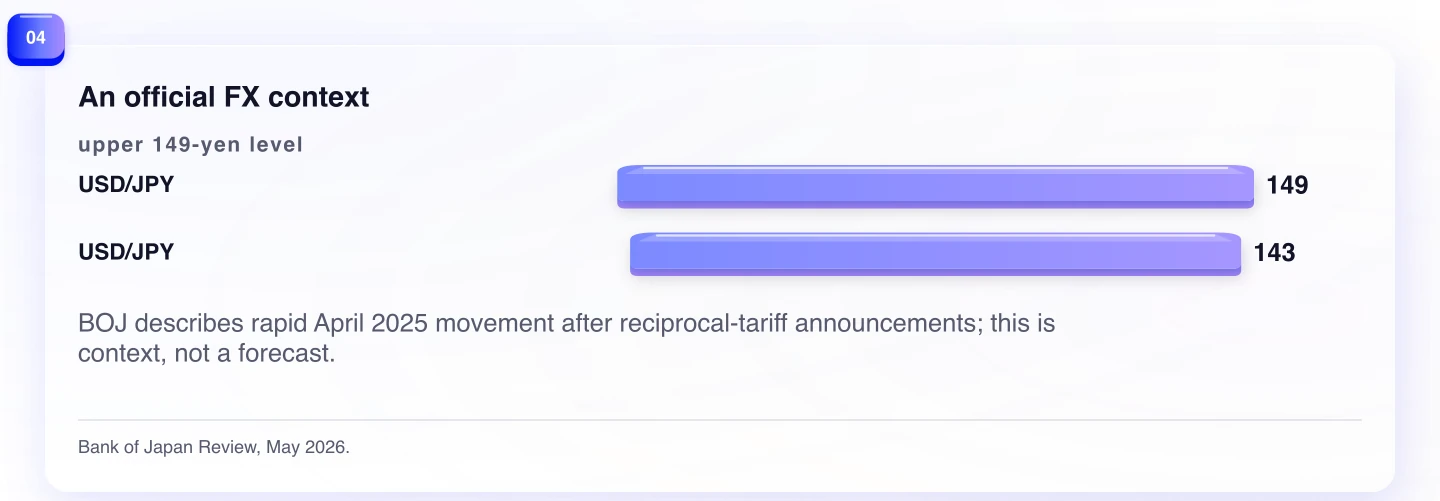
The Bank's 2026 review of Japan's FX market describes rapid fluctuations after the announcement of U.S. reciprocal tariffs in April 2025. In its account, dollar-yen moved from the upper 149-yen level to the lower 143-yen level and market volatility rose significantly. This is context for the survey's FX concern, not evidence that the same move will recur or that any one company should take a particular financial position.
The Ministry of Finance makes the underlying distinction directly. It says exchange rates are basically determined by economic fundamentals and market supply and demand. It also explains that large short-term moves away from fundamentals can be undesirable and are a reason monetary authorities may conduct foreign-exchange intervention. A stable operating jurisdiction and a market-determined currency are different objects.
Three frictions that do not disappear together
It is tempting to make the 52.1, 40.3, and 38.4 figures compete for one budget line. That creates a misleading choice: hedge the currency, translate the product, or hire people. In practice, they attach to different parts of the operating system.
FX exposure belongs to commercial architecture. Identify which costs, supplier commitments, and internal reports are denominated in which currency. Identify where a price is set and when it is changed. The point is not to predict a rate in an article. It is to stop treating currency exposure as an accounting surprise discovered after a local price has already been promised.
Language and communication barriers belong to the interface between a customer, local operator, partner, and headquarters. A translated page can leave unresolved who can approve an exception, what a contract term means in a support case, or how a complaint reaches product leadership. The JETRO response is a reported challenge, not proof of a particular broken workflow. It is enough to prompt an audit of the few handoffs where ambiguity has a commercial cost.
Talent availability belongs to capacity. A business can know its local price and have clear Japanese communication yet still lack the person who can close a sale, implement a product, or maintain a partner relationship. Hiring becomes less fragile when it is designed as part of the revenue path, with a credible local role, quick interview decisions, and documented cover for work that cannot wait for the permanent hire.
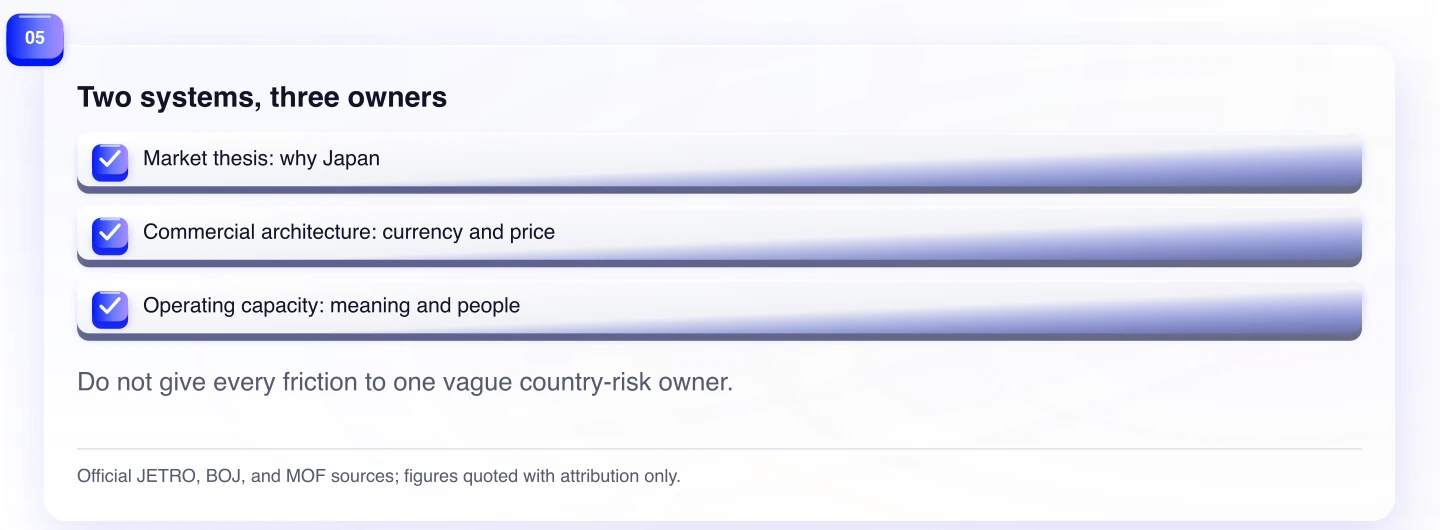
These frictions interact, but they do not resolve through the same intervention. A local hire is not an FX policy. A hedge is not a Japanese support design. A translation budget is not a talent pipeline. Naming the distinction allows the entry team to give each risk an owner instead of giving them all to “Japan.”
The same separation improves decision speed. When a customer quote is delayed, the team can ask whether the issue is an unapproved yen price, an unclear commercial term, or a missing local decision-maker. When a margin falls, it can trace currency and cost assumptions rather than reopening the entire market thesis. When recruitment takes longer than expected, it can decide which customer work is safe to defer and which needs temporary coverage. The plan becomes debuggable: each friction has an evidence trail, an owner, and a next action.
Stability is not a company outcome
The strongest objection is that national stability is not a company result. A stable setting does not guarantee local demand, a stable margin, a successful hire, a reliable distribution partner, or a customer-acquisition cost that makes the plan work. A business can fail in a stable market for reasons entirely within its product, route to market, or execution.
That objection should stay in the plan. It prevents the article from turning a company survey into an endorsement of every Japan expansion. The 63.4 percent result says that a specific respondent population increasingly valued one feature of Japan's business environment in autumn 2025. It does not size an individual opportunity.
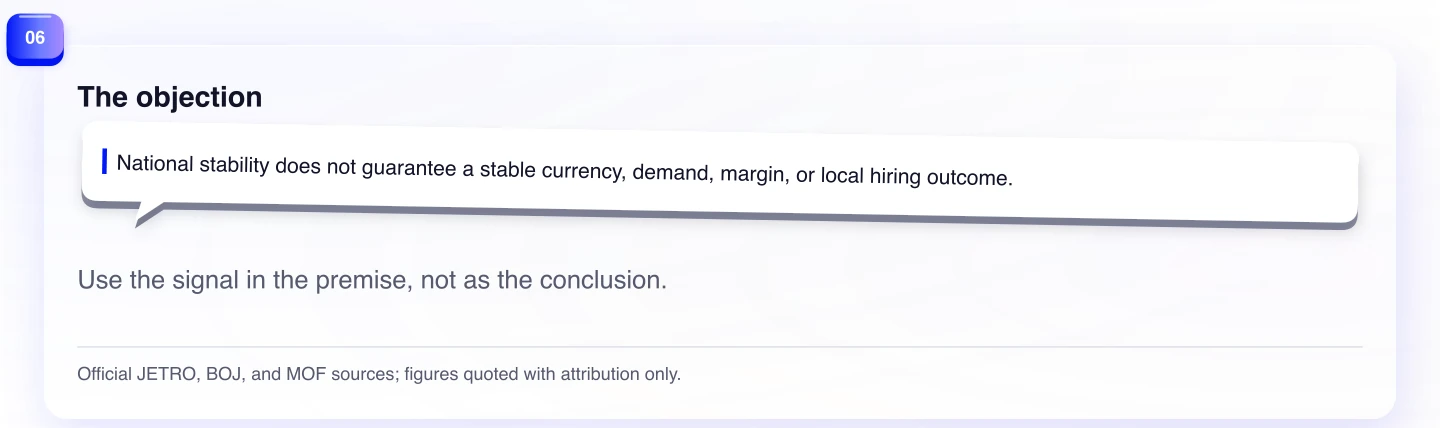
The objection does not erase the value of the signal. Relative stability can make long-lived commitments easier to justify when a company has also done the commercial work: defined the buyer, tested price and channel, identified local obligations, and made its capacity plan credible. The signal belongs in the premise, not the conclusion.
What remains unmeasured
Neither JETRO's survey nor the official FX materials tell an entrant its correct hedge ratio, pricing cadence, recruitment model, or probability of success. They do not identify which segment will buy, whether a Japanese price is viable, or which bilingual hire will be productive fastest.
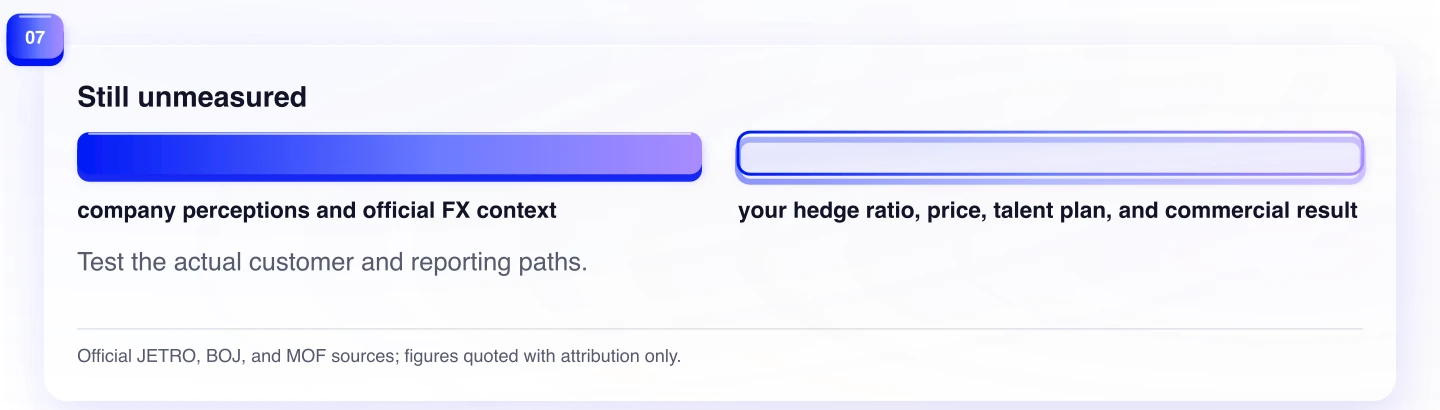
That unknown establishes the next research job. Build a Japan operating model from observable unit economics and handoffs, not a generic stability score. Test a real quote, order, implementation, support case, and month-end report. Record where currency changes margin, where language changes the decision, and where a missing person stops the customer path. Those are the variables the public survey cannot resolve.
Build the entry plan as two separate systems
Start with the offer: why Japan, and why now? The stability result can belong here, alongside the customer, sector, and strategic rationale. Then build a second system for friction: currency exposure, local meaning, and talent capacity. Give each one a named owner, an observable metric, and a point at which the team will reconsider the plan.
For FX, this can mean a clear currency map for price, costs, and reporting before a commercial commitment is made. For communication, it can mean a small set of translated and governed customer, legal, and support handoffs rather than a broad but unowned localisation effort. For talent, it can mean a role design and interim coverage plan linked to the customer work that must happen in Japan.
Japan's stability is not a promise that operating there will be frictionless. The latest foreign-affiliated-company survey says something more usable: stability has become a powerful reason to look closely, while FX, language, and talent still decide how well the company can carry out the decision. Stability is the offer. Friction is the operating work.
Evidence
Sources
- JETRO 2025 Survey on Business Operations of Foreign-affiliated Companies in JapanJapan External Trade Organization · February 26, 2026
- JETRO survey releaseJapan External Trade Organization · February 26, 2026
- BOJ Foreign Exchange RatesBank of Japan · July 27, 2026
- BOJ review of Japan's FX marketBank of Japan · May 22, 2026
- MOF Foreign Exchange Intervention OperationsMinistry of Finance · June 30, 2026