Entry Operations
Overseas sellers need a domestic compliance owner.
By Japan Legible
- Published
- Last checked
- Reading time
- 10 minutes

For a regulated product, a Japanese storefront is no longer the whole Japan entry plan. Since 25 December 2025, an overseas business that sells certain regulated products directly to consumers in Japan can be brought into the product-safety regime and must appoint a domestic administrator. The important shift is operational: someone in Japan has to own the compliance handoff.
This is not a claim that every cross-border seller needs the same structure. The rules concern products covered by four product-safety Acts and the route by which they enter the market. But for a direct-to-consumer business in scope, translation, a local landing page, and a marketplace account do not answer the core question: who can receive an incident, verify the product record, coordinate a response, and act before the platform has to?
The launch plan that stops at translation
An overseas team often turns a Japan launch into a surface problem. Translate the product page. Add a yen price. Make delivery legible. Reply to support in Japanese. Those tasks matter because customers need to understand what they are buying.
They are not, by themselves, an accountability system. A safety obligation is activated after the product has crossed the interface: a defect is reported, a customer is harmed, a regulator needs a notification, or a platform asks what the seller is doing. At that point the difficult question is not whether the page was localised. It is whether a person with recognised authority can make the next decision in Japan.
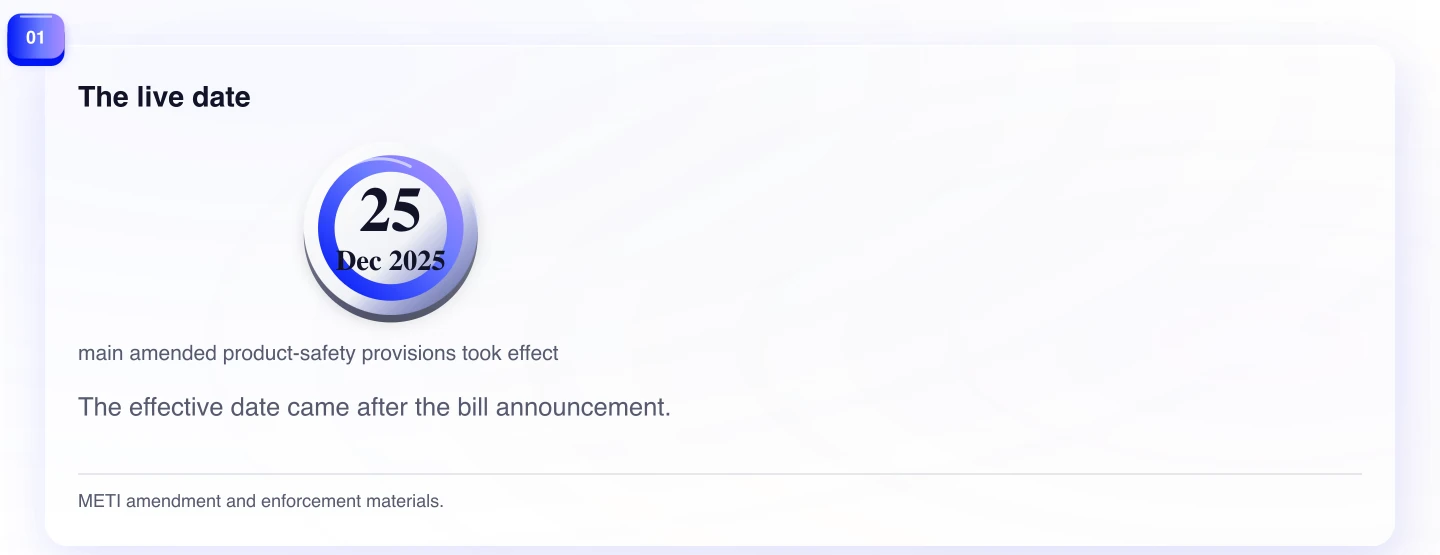
Japan's amended product-safety framework makes that question more explicit. The amendment was promulgated on 26 June 2024. The later Cabinet Order fixed the main effective date at 25 December 2025. The sequence matters because the 2024 announcement describes an intended reform, while the later Order confirms when the new arrangement took effect.
The reform was designed for an environment in which goods can reach a Japanese household from an overseas seller without a domestic importer standing between them. It responds to a gap in who is formally accountable when that direct route is used. That is a business-model issue, not merely a labelling issue.
What changed on 25 December 2025
The change spans four laws: the Consumer Product Safety Act, the Electrical Appliances and Materials Safety Act, the Gas Business Act, and the Act on the Securing of Safety and the Optimization of Transaction of Liquefied Petroleum Gas. The rules differ by Act and product. The common design is that an overseas operator can be treated as a notifying party when it directly sells regulated products to general consumers in Japan without a domestic importer.
METI describes this overseas seller as a specified import business operator when the conditions are met. Where PS-mark regulated products are involved, the overseas operator must satisfy the relevant technical requirements and appoint a domestic administrator in Japan. The administrator is not a decorative mailing address. METI's guidance describes a person responsible in Japan for enforcing the regulations.
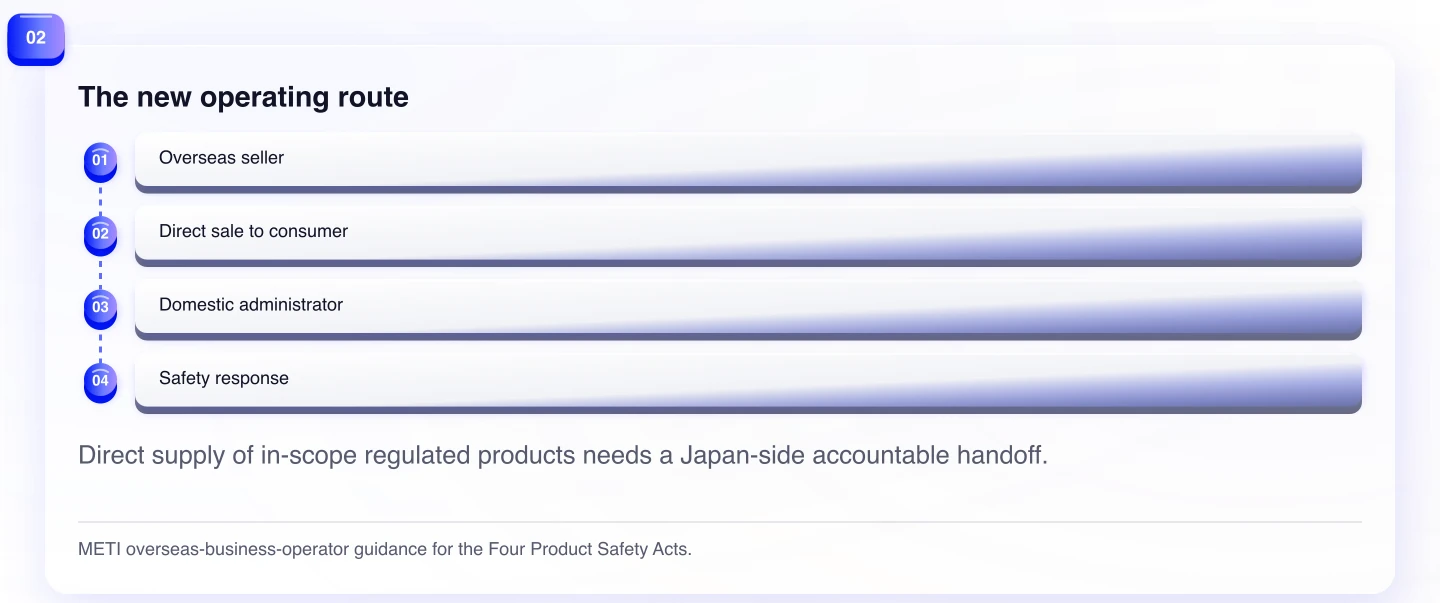
That wording changes the practical entry question. Instead of asking only, “Can we ship this product to Japan?”, the team should ask, “Can our Japan-side responsible person see the same product identity, supplier information, safety evidence, notification status, and customer incident that headquarters sees?” If the answer is no, the business may have appointed a name without creating a usable control point.
The legal boundary: product and route matter
The new regime is not a blanket rule for everything that an overseas retailer can put in a parcel. It concerns products regulated under the four Acts. It also addresses a particular route: an overseas operator directly delivering to Japanese general consumers without a domestic importer, including through a digital transaction platform.
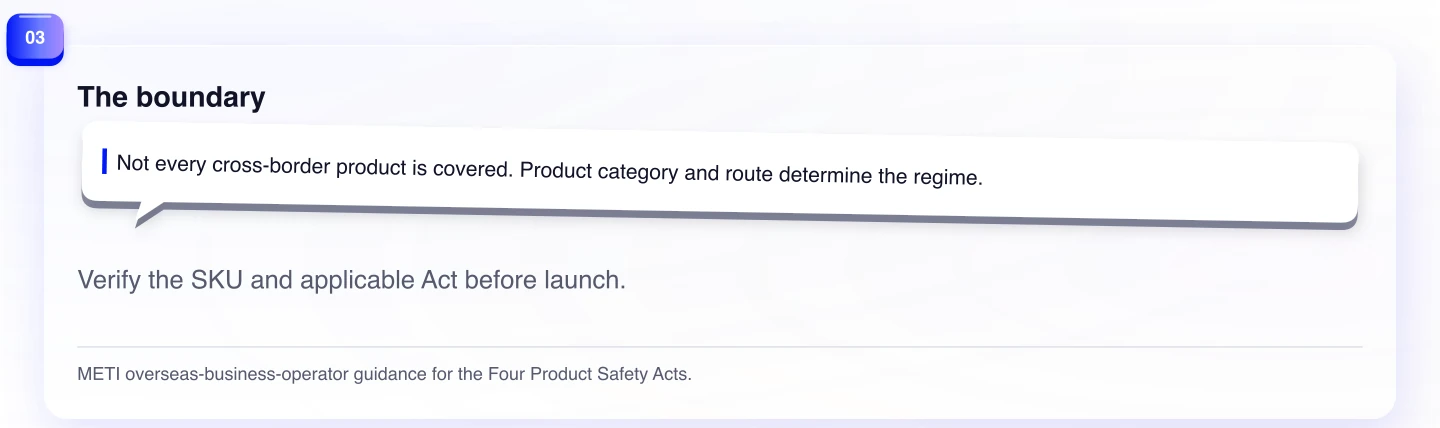
That boundary is not a loophole to guess at. It is a reason to do category-specific verification before launch. A cosmetics brand, a food seller, a software company, and a seller of an in-scope electrical or child product can sit under different regulatory arrangements. The exact product classification, applicable Act, technical standard, marking or notification path, and responsible parties need competent review.
This article is operational guidance, not legal advice. It cannot determine whether a particular SKU is regulated or how an individual company should file. Its point is narrower: once a product and route are in scope, local accountability has become part of the operating model.
The useful sequence is classification before commerce. Build a current list of the intended products, their components and variants, the route by which they will enter Japan, and the party that will appear to the customer as seller. Then ask the responsible regulatory adviser or authority-facing specialist which Act, technical rule, marking, notification, record, and incident obligations apply. Do this before a marketplace catalogue, advertising calendar, or fulfilment promise makes the commercial route hard to change. A late answer can affect product documentation, packaging, logistics, insurance, support scripts, and the country launch date at once.
The domestic administrator is an operating role
The simplest failure mode is to interpret appointment as procurement. Find a Japan-based contact, add the name to a file, and consider the requirement complete. That may leave the person unable to do the job the framework presumes.
An operating owner needs a defined information route. They need to know which products have entered Japan, what evidence supports their compliance, where the notification and product records sit, and whom to call when a serious allegation arrives. They need decision rights: who can pause a listing, tell a fulfilment partner to stop shipping, ask engineering or a factory for a lot trace, approve customer communication, or involve outside counsel. They need an escalation route that works outside headquarters' preferred time zone.
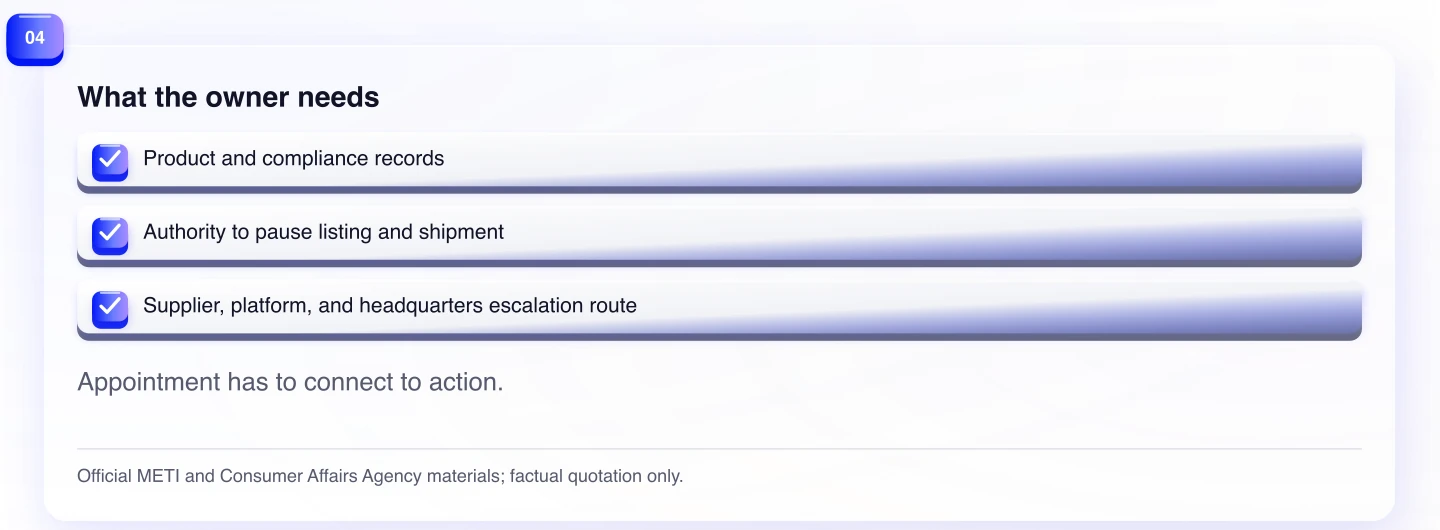
None of that follows automatically from the title domestic administrator. It is a design choice the seller has to make. The useful mental model is a control room, not a translation desk. The local owner must be able to turn a signal into an action and to document what happened.
That control room can be small. A new entrant may not need a large Japanese entity or a separate safety department to create a reliable first response. It does need an unambiguous roster: the domestic administrator, the headquarters product owner, the supplier or manufacturer contact, the person who controls listings, the fulfilment contact, and the decision-maker who can approve consumer communication. Give each person a reachable contact method and a maximum response expectation. Test access to the records rather than assuming a shared drive is usable in an urgent case. A lightweight system that is rehearsed is more valuable than a detailed policy that no one can find.
Why marketplace removal changes the launch model
The amendment also changes the role of a marketplace in the failure path. Where a consumer-safety product sold through a shopping digital platform is considered likely to harm consumers and the seller is not expected to take necessary measures such as a recall, the framework enables a request for measures including removal by the platform operator.
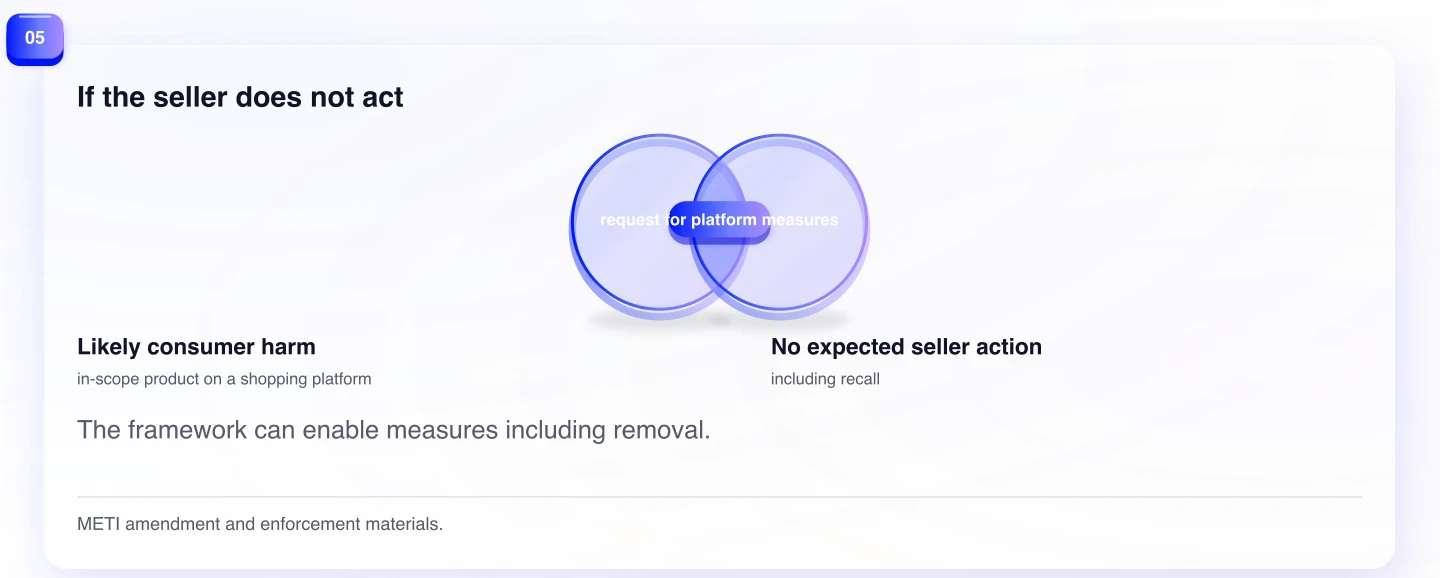
This does not mean every complaint produces an immediate delisting. The official material describes a legal measure for a defined safety situation. It does mean that a seller should not treat the platform as a neutral pipe. The marketplace can become part of the risk-control environment when the seller has not acted.
The commercial implication is straightforward. A launch should have a written response path before the first order. Define the source of truth for product lots and listings. Decide who receives a safety alert and how quickly that person can reach the administrator. Prepare a way to identify affected customers and stop fulfilment. Confirm who is authorised to communicate with the marketplace. The goal is not a theatrical recall plan. It is a credible ability to act when the usual marketing and support workflows are too slow.
The amended framework also provides for publication of names and other information concerning businesses that violate relevant provisions, including information concerning the notifying business and domestic administrator. That is another reason to treat appointment as a real governance connection rather than a nominal service.
The incident clock and the evidence trail
The Consumer Affairs Agency provides the other half of the operating picture. Under the serious-product-incidents system, manufacturers and importers that learn of a serious product incident must report it to the Agency within 10 days, including the day they learn of it. The Agency's guidance also says businesses should endeavour to collect incident information, investigate causes, and take preventive measures, including recall where necessary.
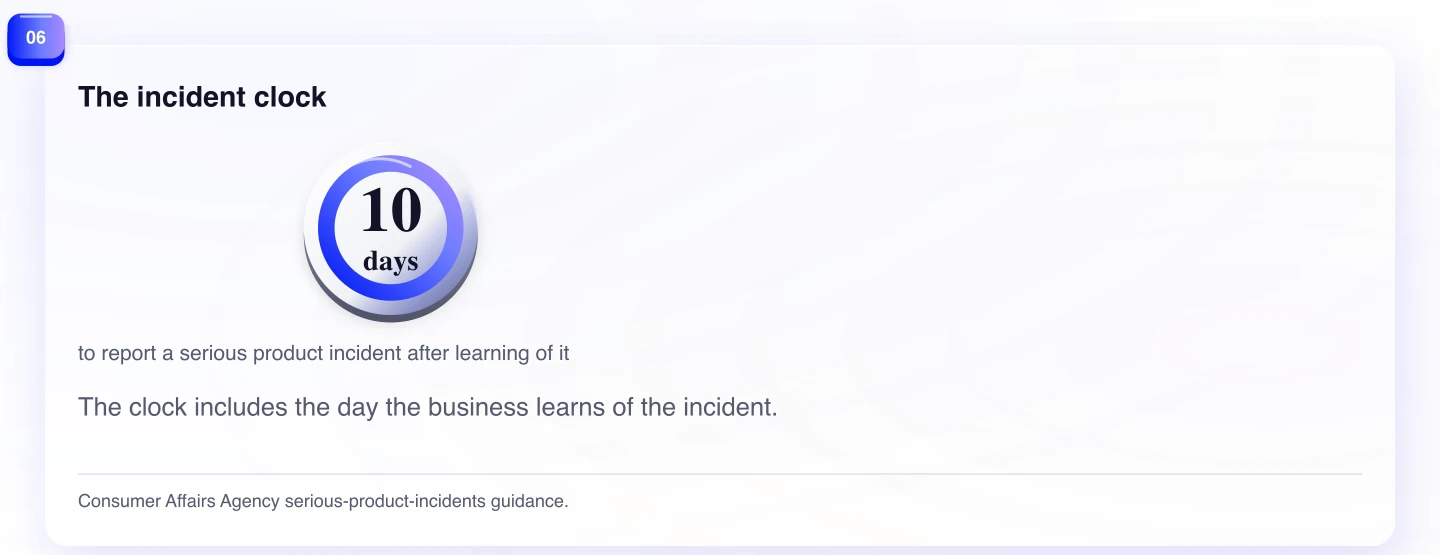
Ten days is not a substitute for an incident process. It is a reason to have one. A company that learns of an event through a customer-support inbox, a marketplace message, a social post, or a distributor needs to preserve the first report, identify the product, and escalate it without making the user navigate a chain of translations and approvals. The evidence trail should make it possible to answer basic questions: when did the business learn of the incident, which item was involved, what information was collected, what immediate step was taken, and who owns the next step?
Appointment is not a whole operating model
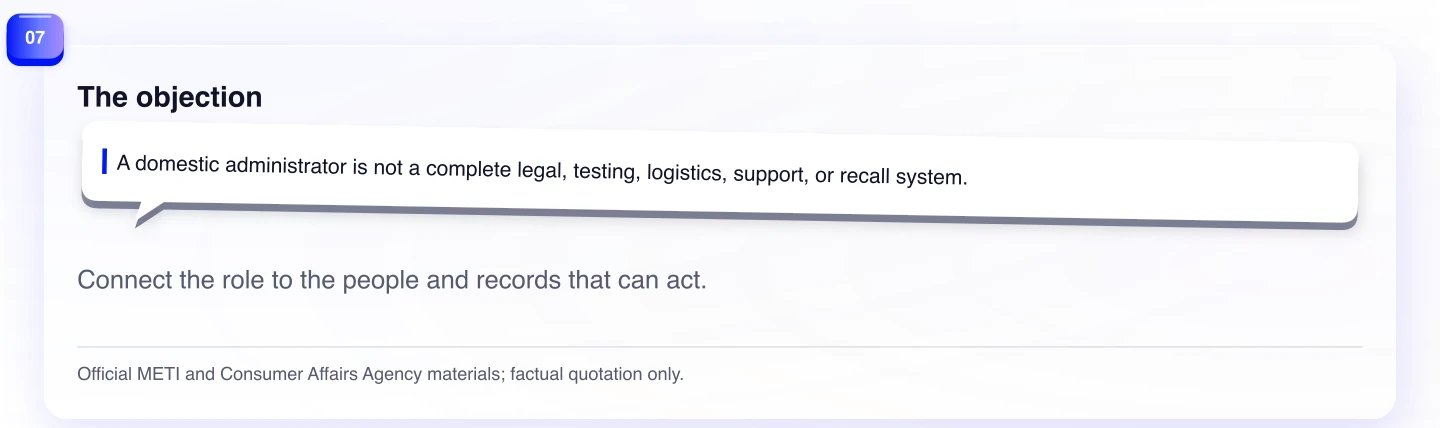
There is an important objection. A domestic administrator is not automatically a substitute for product testing, legal interpretation, warehousing control, Japanese customer support, recall execution, or specialist technical expertise. Appointment by itself cannot guarantee that an overseas seller has a functioning safety system.
That objection is correct. It is why “get a domestic representative” is an inadequate launch plan. The role has to be connected to people and records that can execute the legal and commercial response. The requirements are category-specific, and a qualified adviser may be needed to map them. The article should not pretend that one appointment model is right for every seller.
A practical pre-launch ownership test
Before selling an in-scope product, run one incident tabletop exercise. Use a real product, a real order path, and a plausible safety report. Ask five questions.
First, can the local owner identify the product and its compliance file without waiting for a headquarters handoff? Second, can they reach the people who can pause the listing and shipment? Third, is the marketplace contact and escalation route documented? Fourth, can the team identify potentially affected buyers and create a Japanese-language communication that is legally reviewed? Fifth, can the company show a time-stamped record of the report and the response?
If the exercise reveals a delay, treat that delay as entry work. Do not hide it behind a polished storefront. Japan's amended framework does not say that DTC is impossible. It says that for regulated products, the direct route needs a domestic compliance operating owner. That is not a translation project. It is a responsibility system.
Evidence
Sources
- METI bill announcementMinistry of Economy, Trade and Industry · March 1, 2024
- METI enforcement Cabinet OrdersMinistry of Economy, Trade and Industry · December 10, 2024
- METI overseas-operator guidanceMinistry of Economy, Trade and Industry · December 25, 2025
- Consumer Affairs Agency serious-product-incidents systemConsumer Affairs Agency · January 26, 2026