Operations
Language friction is an operating-system problem.
By Japan Legible
- Published
- Last checked
- Reading time
- 10 minutes

When an overseas company struggles to operate in Japan, the usual diagnosis is language: translate the site, hire bilingual people, then move on. JETRO's 2025 survey puts numerous language and communication barriers at 40.3 percent among reported business-environment challenges, alongside exchange-rate fluctuation risk at 52.1 percent and talent recruiting difficulty at 38.4 percent. The three figures should not be added; respondents could select more than one. Their co-existence points to a more useful question: where does language interrupt the operating system?
The answer is rarely only in hiring. A bilingual colleague can bridge many conversations, but a business becomes fragile when every customer promise, contract exception, approval, support handoff and status update must pass through one person. Language friction is an interface problem: a point where someone has to understand, decide, record or escalate something across languages and organisations.
The translation reflex solves the visible layer
Translation is a necessary operating capability. Customers need to understand what is offered, employees need to understand policies, and counterparties need documents they can rely on. It is also the most visible layer of the problem, so it often receives the entire budget.
That is where the error begins. A translated landing page can lead to an untranslated pricing exception. A sales call can be interpreted while the follow-up terms are ambiguous. A Japanese-language support response can be accurate but lack the authority to approve a remedy. An employment offer can be carefully drafted while the internal policy, manager briefing and escalation path remain unclear.
In each case, the language work exists. The operating interface does not. The failure is not that a word has no translation. It is that responsibility, evidence or a decision has no stable route through the system.
A reported constraint, not a diagnosis of cause
JETRO surveyed 7,698 foreign-affiliated companies in Japan between 25 September and 31 October 2025 and received 1,520 valid responses, a 19.7 percent response rate. Its definition includes companies with at least 25 percent foreign ownership and Japanese subsidiaries of foreign companies.
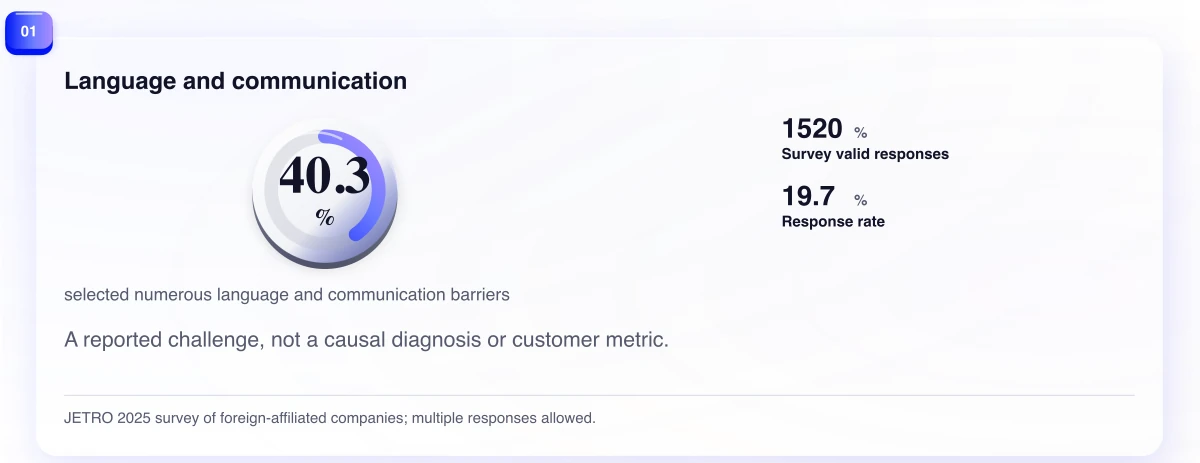
Among reported challenges, 52.1 percent selected exchange-rate fluctuation risk, 40.3 percent selected numerous language and communication barriers, and 38.4 percent selected labor shortage and difficulty recruiting talent. These are a multiple-response ranking, not three parts of one pie and not a causal model. The survey does not say that language created a particular lost sale, legal error, customer complaint or productivity outcome.
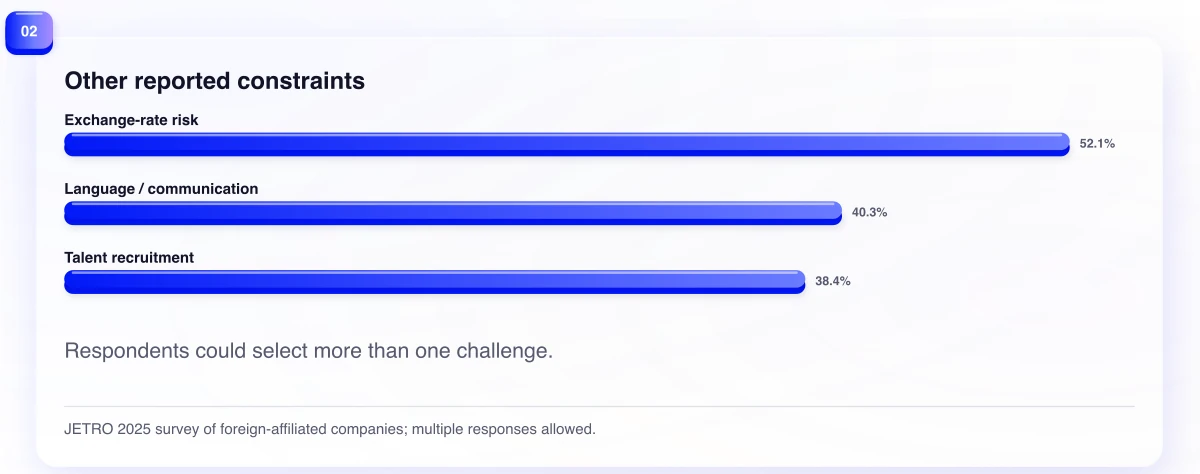
That limit makes the result more useful, not less. It tells an operator that language and communication are sufficiently salient among this respondent population to deserve an explicit system design. It does not say which intervention will work. That is why a generic “improve Japanese” programme is too vague to govern an operation.
Three interfaces make the problem concrete
Start with the customer interface. This is not only product copy. It includes the promise a customer receives before purchase, the evidence that supports it, the price and scope, onboarding instructions, support route, incident communication and renewal conversation. A Japanese version is incomplete if a customer can understand the marketing but cannot tell who owns the consequence when the service differs from expectation.
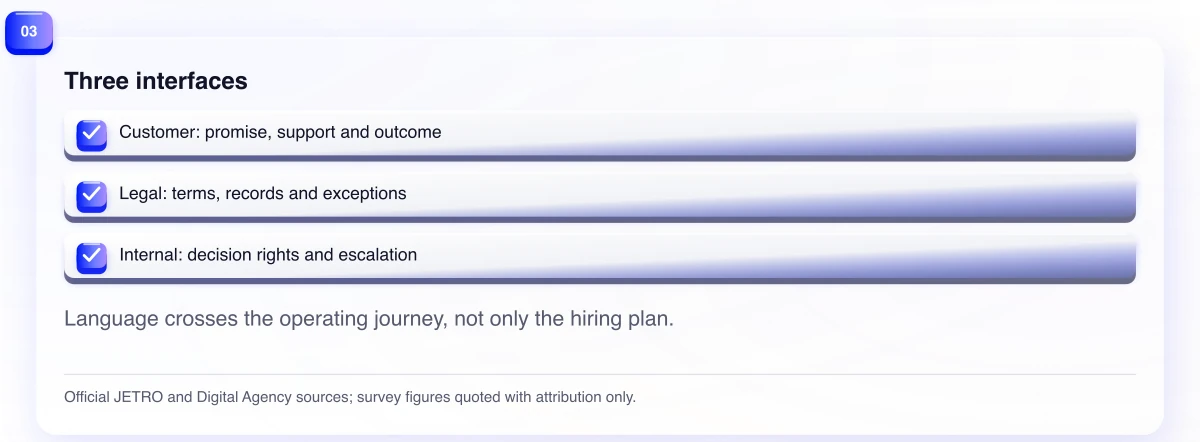
Next comes the legal and commercial interface. Contracts, order forms, privacy notices, procurement questionnaires, invoicing terms, security answers and compliance records often need more than linguistic equivalence. They need a clear owner, an approved source of truth, an update rule and a route for exceptions. A sales representative should not have to improvise a legal interpretation in either language. Nor should a local customer discover that the Japanese document and the headquarters process cannot be reconciled.
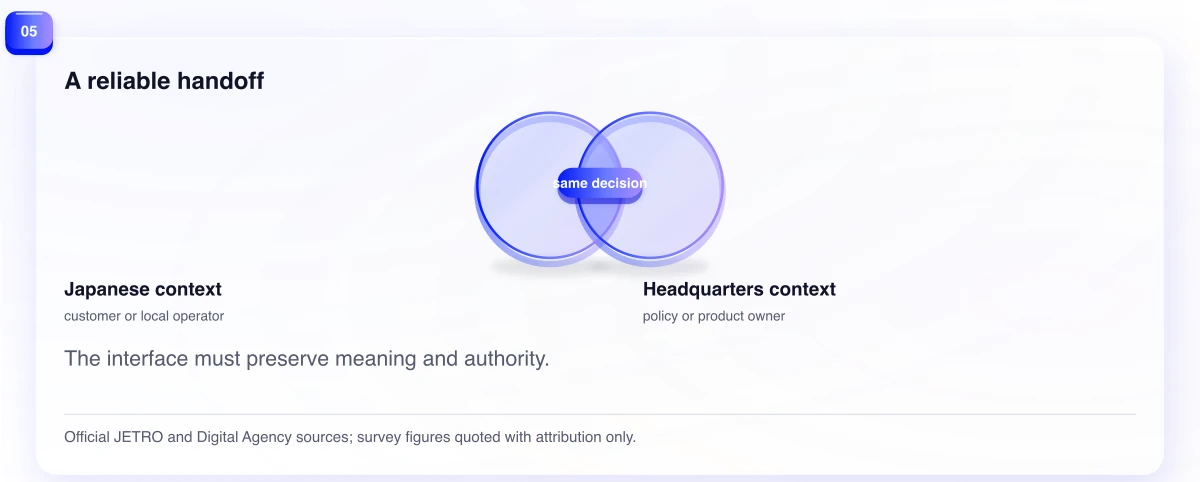
The third is the internal interface. This is where the hiring-only explanation is weakest. A bilingual employee may be asked to translate a product decision, a customer concern, a local regulatory question and a headquarters update. If there is no decision right, no durable record and no agreed escalation path, that person becomes an informal operating system. The company has hired talent but not built the system that lets talent scale.
The interfaces overlap. A support escalation can become a contractual commitment. A product limitation can become a sales claim. An internal decision can change a customer-facing policy. The practical goal is not to make every artefact bilingual by default. It is to identify which points carry material risk and make their language, owner and authority explicit.
The official design lens is broader than words
The Digital Agency's service-design work provides a helpful cross-check on the direction, even though it is not a survey of foreign companies. The Agency describes a user-centered approach and says design and web-accessibility experts participate from the design stage of its services and products. Its web-content guidelines address quality assurance that includes information accessibility and language, sentence structure and expression.
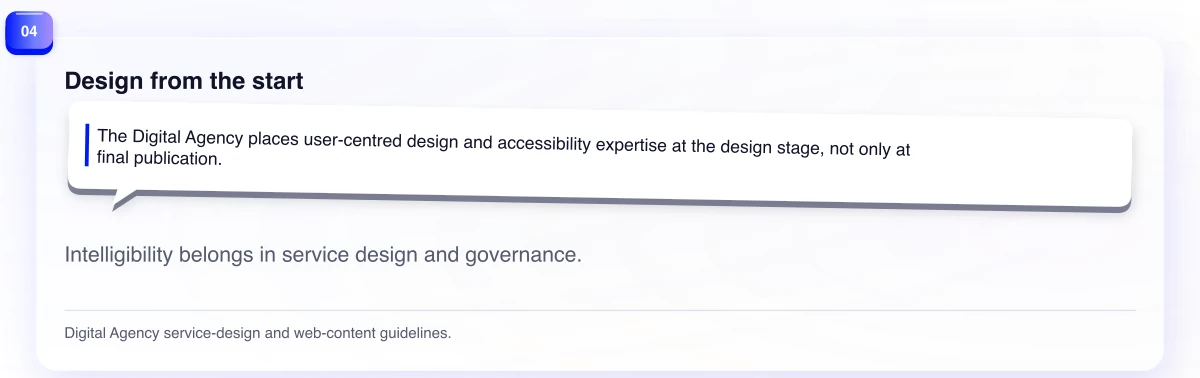
The lesson for a private entrant is not to copy a government template. It is that intelligibility belongs in service design and content governance, not only at the final translation stage. A user cannot benefit from an accurate sentence if the sequence, ownership or interface around it prevents them from completing the task.
This also separates the problem from the next hiring article a team may be tempted to write. Hiring matters. The JETRO survey includes talent difficulty for a reason. But an organisation can add excellent people and still create avoidable friction if its customer records, commercial approvals, support tools and headquarters reports do not preserve the same meaning across teams.
Build an operating-interface map
For each high-risk interface, name five things: the user or counterparty; the moment of decision; the artefact or record; the person allowed to decide; and the escalation route when the standard path breaks. Add the language requirement to each item, but do not make language the only column.
For example, a customer refund request may require Japanese-language acknowledgement, a product record, a contractual rule, a financial approval and a customer-facing outcome. If those elements live in different systems with no owner, a fluent response will only mask the delay. If they are designed as one path, language capability can do its actual job: help people understand and act.
Measure the interface, not an abstract language score. Track where customers abandon an instruction, which questions repeatedly require re-explanation, how long approvals take, how often a Japanese-language case is handed back to headquarters, and whether the final customer record matches the original promise. These are operational signals. They make it possible to distinguish a translation-quality issue from an ownership, workflow or product-policy issue.
The counterargument: a bilingual hire can change a great deal
The strongest counterargument is true. A capable bilingual operator can change an early-stage company's ability to sell, recruit, negotiate and support customers. Some problems really are a lack of local language capability, and hiring or retaining the right person may be the highest-leverage move.
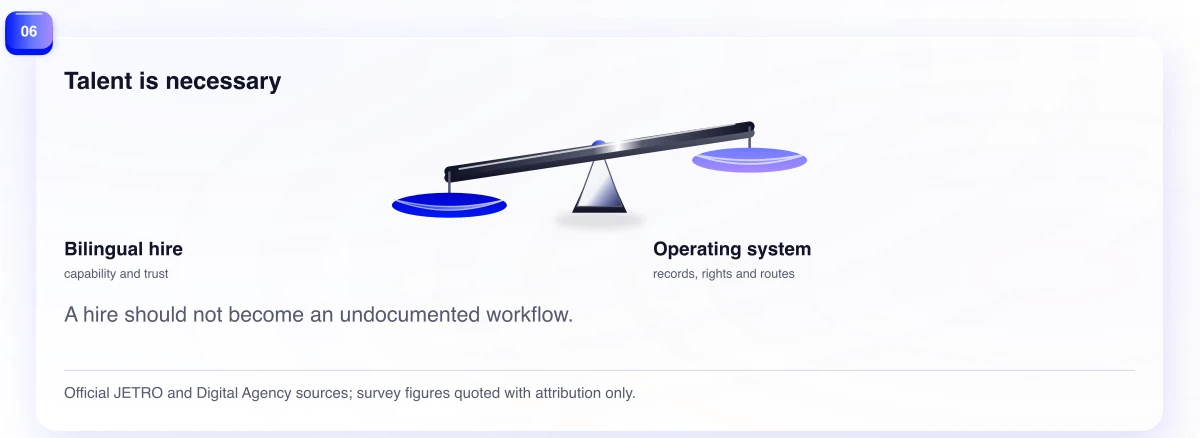
The caution is against making that person the permanent workaround. When every important interface depends on personal memory or ad hoc interpretation, the company has concentrated risk in its best employee. The person cannot be in every meeting, review every change, or safely carry every undocumented exception.
The system view does not diminish the hire. It gives the hire authority, inputs and durable mechanisms. It also lets the business learn which interface needs specialist translation, which needs a product change, and which needs a clearer commercial rule.
What remains unknown
The cited sources do not identify the staffing model, workflow, content architecture or governance change that will improve outcomes for a specific company. They do not rank the customer, legal and internal interfaces by commercial impact. The JETRO survey does not measure conversion, legal accuracy, support quality or employee productivity.
That uncertainty should guide the first experiment. Do not launch a broad language initiative with no observable operating target. Choose one consequential journey, map it end to end, and test whether a redesigned interface reduces rework or gives the local user a clearer decision.
The definition of success should be agreed before the redesign. It might be fewer clarification loops, a shorter approval time, fewer inconsistent records or a higher rate of first-contact resolution. Without that definition, a team can mistake more Japanese-language output for a better operating experience.
Start where meaning changes hands
Pick one customer path, one legal or commercial path and one internal path. For each, identify the exact point at which a Japanese customer, counterparty or colleague must trust a statement or make a decision. Give that point an accountable owner, a current approved artefact, a Japanese-language standard where needed and a known escalation route.
Then run the path with a real user or a realistic case. Watch not only the words but the handoffs. Does the customer receive the same commitment that headquarters records? Can support see the commercial context? Can a local operator make a permitted decision without translating the entire company back to itself?
A narrow website implementation is a useful place to test that separation. The Weglot launch guide shows how crawlable publishing and editorial ownership can be split cleanly.
Language friction is not a cultural mystery, and it is not proof that one country is uniquely hard. It is the cost of meaning changing hands without a reliable operating interface. Translation and hiring are essential tools. The durable advantage comes when the system around them lets the same decision survive the journey.
Evidence
Sources
- 2025 Survey on Business Operations of Foreign-affiliated Companies in JapanJapan External Trade Organization · February 26, 2026
- 2025 Survey on Business Operations of Foreign-affiliated Companies in Japan releaseJapan External Trade Organization · February 26, 2026
- Service designDigital Agency, Government of Japan · January 31, 2025
- Standard Guidelines for the Promotion of a Digital SocietyDigital Agency, Government of Japan · September 30, 2025