Commerce and Infrastructure
Japan tax-free shopping changes on 1 November 2026: retailers must collect tax first.
By Japan Legible
- Published
- Last checked
- Reading time
- 9 minutes

For eligible sales from 1 November 2026, Japan's tax-free shopping flow changes its commercial order. The traveler pays the tax-inclusive price first. The retailer submits the purchase record. Customs confirms export within the required period. Only then does the retailer refund an amount equivalent to consumption tax.
That sequence turns tax-free shopping from a counter discount into a delayed service. Checkout, data submission, customs status, refund, treasury, customer communication, and record retention must agree about the same purchase over time.
This article is operational guidance, not tax advice. Eligibility, registration, records, systems, and individual transactions require review against current National Tax Agency material. Technical specifications and notices were still being updated at the time of this review.
The tax-inclusive price comes first
The refund method applies to eligible sales made from 1 November 2026. Under the National Tax Agency's described flow, the traveler buys at the tax-inclusive price and the tax-free shop sends a purchase record through the required system.
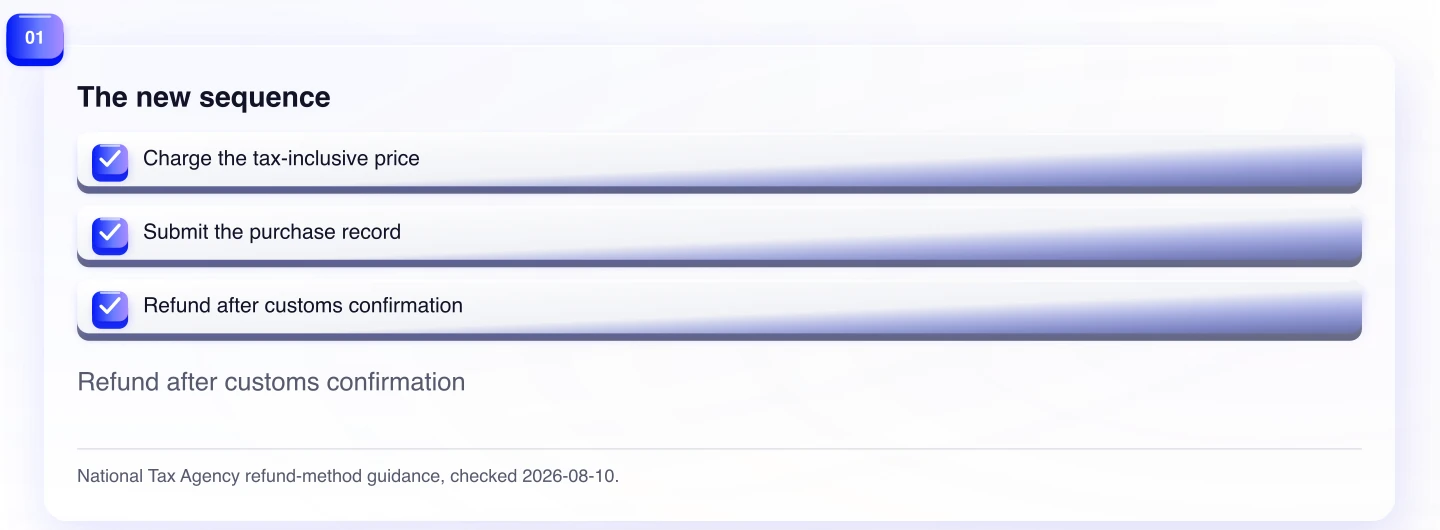
The change is easy to explain in one sentence and difficult to operate in one system. The point of sale records payment. A tax-free application captures identity and transaction information. A government-facing connection transmits the record. Customs later confirms export. A refund process sends value back. Finance reconciles the original tax-inclusive sale and later refund.
If each team treats its event as final, the customer receives contradictory states. The receipt can say paid, the tax-free interface can say submitted, the store employee can say approved, and the refund service can still be waiting for customs confirmation. The journey needs one vocabulary that distinguishes those events.
A useful status model begins with eligibility checked, tax-inclusive payment completed, purchase record submitted, customs confirmation received, refund eligible, refund instructed, refund settled, and exception closed. Exact implementation should follow current technical specifications. The management principle is to prevent “tax free” from hiding several unresolved states.
Ninety days creates an expiry state
Customs confirmation must occur within 90 days counted from the day after purchase. Without confirmation within that period, the sale remains taxable.
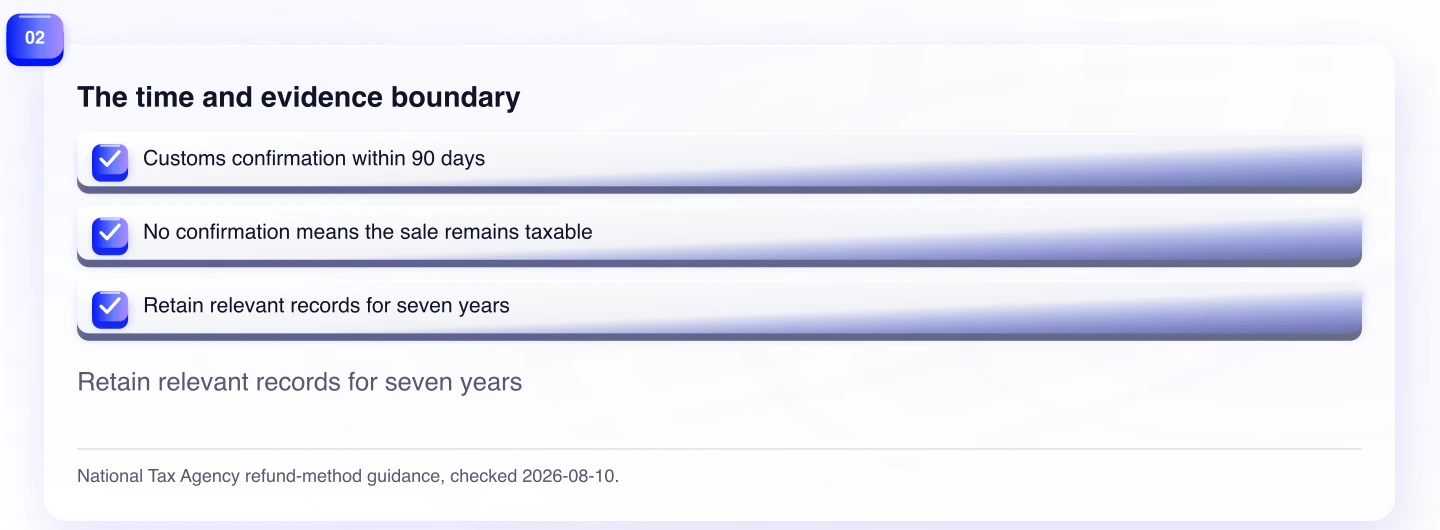
The 90-day rule changes customer communication. At the counter, staff should not present the consumption-tax equivalent as money the traveler has already received or an unconditional future credit. The refund depends on later confirmation. The customer needs to know what must happen, how long eligibility can remain open, how status is checked, and what happens if confirmation does not arrive.
It also creates operational timers. The retailer needs to distinguish a traveler still within the window, a record awaiting confirmation, a confirmed record awaiting refund, and a record that has expired. A generic pending label cannot tell support which action remains possible.
The failure journey deserves as much design as the success journey. A purchase record can be incomplete, delayed, mismatched, or not confirmed. A traveler may leave through a different airport, change plans, or contact the store after departure. Public guidance defines the framework, not every service response a retailer should offer. The business needs rules for investigation, correction where allowed, communication, and closure.
Do not invent a manual refund when the required confirmation is absent. Do not tell support to interpret tax eligibility from a screenshot. Create a controlled escalation to the tax operations owner and qualified adviser.
The refund channel is a product choice
After obtaining and retaining customs confirmation, the shop refunds an amount equivalent to consumption tax. The NTA guidance does not prescribe one refund channel.
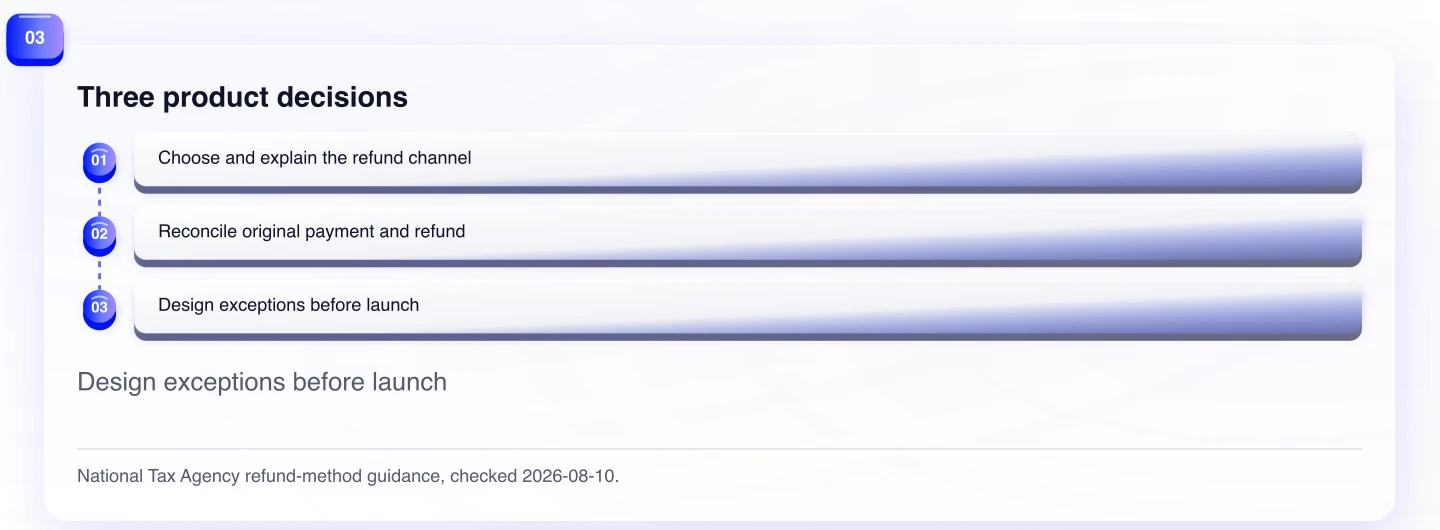
That flexibility creates product decisions. A retailer may use a route connected to the original payment or another permitted method. Each option differs in speed, fees, supported countries and cards, currency handling, customer identification, failed-payment recovery, and reconciliation.
The amount also needs clear language. The customer paid a tax-inclusive price and later receives an amount equivalent to consumption tax under the qualifying process. If a service fee or foreign-exchange effect applies through the chosen experience, it must be communicated accurately and reviewed. Marketing copy should not imply that every traveler receives exactly the headline amount in the same time.
Finance needs a ledger that ties the refund to the original sale, purchase record, confirmation, customer-facing status, payment instruction, settlement result, and accounting treatment. A refund marked complete by an internal job is not complete if the payment failed.
Customer support needs visibility without access to unnecessary passport or payment data. A status lookup can expose the minimum needed state and next action while protected systems retain regulated records.
Some old counter rules disappear; new data work remains
The new method removes the general-goods and consumables distinction, the 500,000-yen consumables cap, and special packaging requirement described in the prior framework. The stated minimum eligible purchase is 5,000 yen excluding tax under the applicable conditions.
Those changes can simplify selection and packing at the counter. They do not eliminate item-level control. Goods costing at least 1 million yen excluding tax require identifying details in the purchase record. The system must know which items cross the threshold and capture the required information reliably.
The retailer must also retain relevant records for seven years. Retention is not the same as keeping every screen capture forever. The implementation needs a documented record set, access control, integrity, retrieval, and deletion rule for related data that is not required.
For a chain or marketplace, master data becomes important. Tax status, price, product identifier, high-value detail, store registration, and purchase-record fields cannot be reconciled through staff memory. A product introduced after launch needs the same rules as the initial catalog.
Training should follow roles. Counter staff need the customer explanation and exception route. Support needs status and communication. Finance needs settlement and reconciliation. Engineering needs interface, retry, and audit behavior. Tax specialists need oversight and change control. A single long manual is less effective than a shared state model with role-specific actions.
The objection: collecting tax first can simplify the store
A reasonable objection is that the new flow may reduce work at the moment of sale. The traveler pays the normal tax-inclusive amount, and some distinctions and packaging requirements disappear. That can make the counter interaction more familiar.
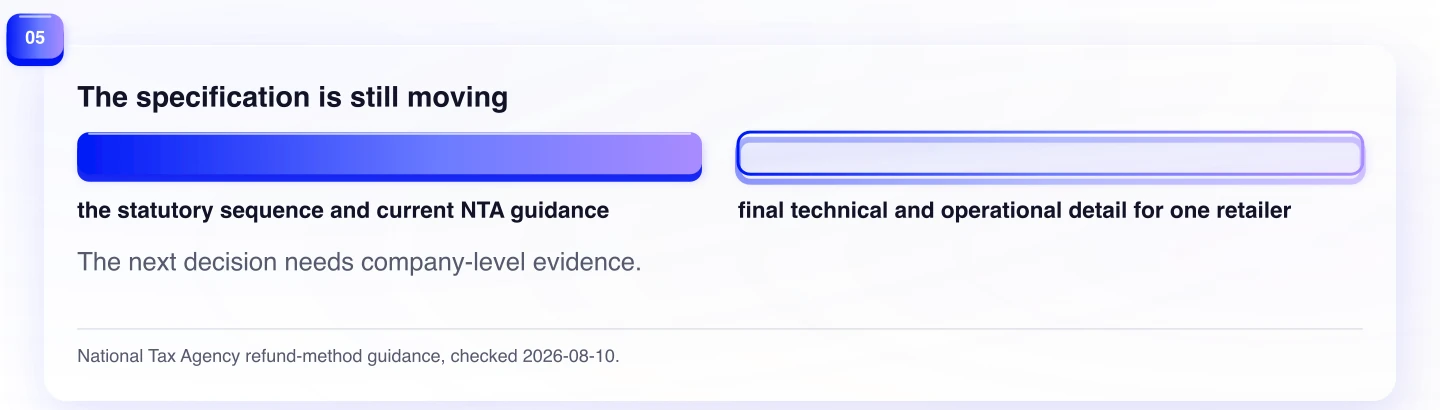
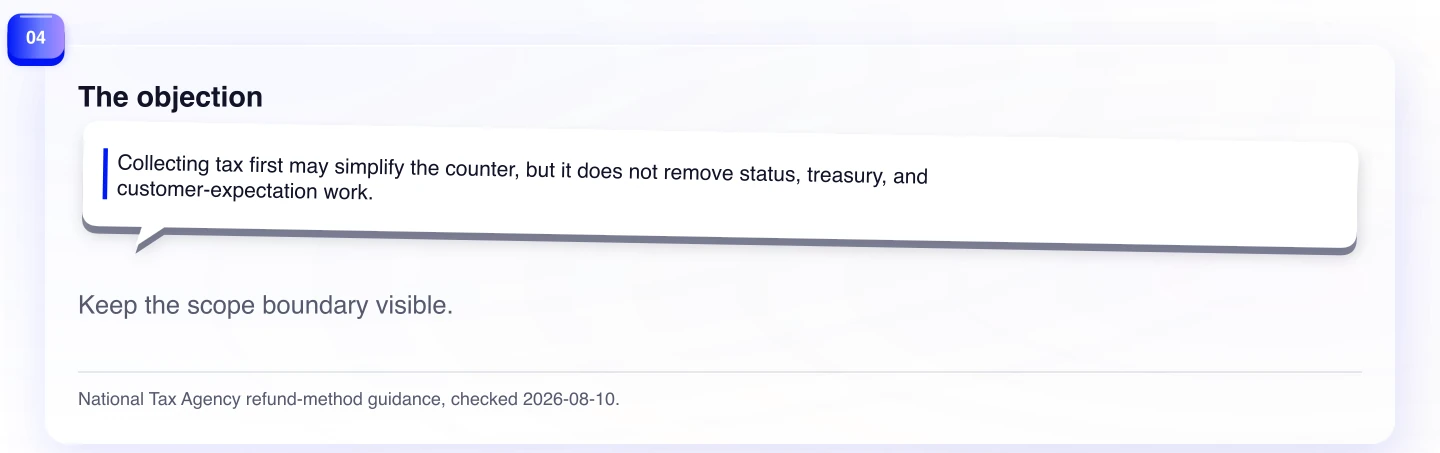
The objection is valid. The article does not claim every part becomes harder. It says the work moves. Immediate exemption gives way to later confirmation and refund. Simpler checkout can coexist with more post-purchase status, treasury, and communication work.
The public sources do not determine which refund provider, integration, fee, staffing model, or customer promise is right for one retailer. Current NTA specifications must be checked before implementation, especially while notices continue to evolve.
Start with a transaction-state workshop. Put store operations, commerce product, tax, finance, support, payments, and engineering in the same room. Walk an eligible purchase from tax-inclusive payment through record submission, customs confirmation, refund instruction, settlement, and seven-year retention. Assign one owner to every transition.
Then walk four exceptions: confirmation does not arrive before 90 days; a high-value item's identifying detail is missing; the refund payment fails; and the traveler asks for status without exposing unnecessary sensitive data. The purpose is not to improvise tax judgments. It is to find the handoffs where a qualified judgment or controlled correction must enter.
Finally, test the language. Can a traveler understand at the counter that tax is collected first? Can they distinguish submitted from confirmed? Do they know when the refund becomes eligible, how it will arrive, and whom to contact? Translate only after the state model is accurate.
Cutover planning should cover transactions on both sides of the date. A store may need to support the prior method for earlier purchases while using the refund method for sales from 1 November 2026. Training, receipts, customer messages, and support tools should identify the applicable regime from the sale date rather than relying on staff memory. Rehearse the final day before cutover and the first day after it.
Monitor the system with business and customer measures. Track submission failures, time to customs confirmation, confirmed records awaiting refund, refund failure, time to settlement, contacts per purchase, and expired cases. Reconcile counts and value, not only API success. A technically successful interface can still leave money or customer expectations in an unresolved state.
Change control remains part of readiness. Assign someone to watch NTA updates, assess their impact, update specifications and scripts, and record the effective version. A screenshot of guidance captured during initial development should never become the permanent source of truth for a live tax operation.
Treat vendors as part of the state model. A point-of-sale provider, purchase-record intermediary, or refund service may own an interface without owning the customer promise. Contracts and runbooks should define retries, evidence, service incidents, data access, reconciliation, and the exit path if the provider changes. The retailer remains the place where the traveler expects an answer.
The deadline is 1 November 2026, but the real unit of readiness is not the date on a project plan. It is a completed exception journey. Japan's refund method can make the point of sale simpler. To make the customer experience legible, the retailer must build what happens after the customer walks away.
Evidence
Sources
- Refund-method tax-free sales guidanceNational Tax Agency
- Outline of refund-method changesNational Tax Agency · June 1, 2025
- Tax-free refund-method FAQNational Tax Agency