Operations and Supply Chain
Your Japanese supplier may be profitable—and still disappear.
By Japan Legible
- Published
- Last checked
- Reading time
- 9 minutes

A supplier can be profitable, precise, and essential to your Japan business—and still be approaching its last generation. Japan recorded 67,949 business closures or dissolutions in 2025. In the official analysis, 49.1 percent of those businesses were profitable. The risk is not simply insolvency. It is continuity without a successor.
That distinction changes supplier due diligence. Revenue, margin, defect rate, and on-time delivery describe the business that exists today. They do not tell you whether its know-how, licenses, tools, customer relationships, or owner decisions can cross into tomorrow.
This is not a prediction about any named Japanese company. National data cannot produce a closure probability for a particular supplier. It can show why an overseas buyer should ask a second set of questions before one small firm becomes a single point of failure.
Profit is not continuity
Closure is often discussed as the endpoint of a failing company. That story encourages a buyer to look for financial distress and assume that a sound supplier is safe. The 2026 White Paper overview breaks the shortcut. Japan's 67,949 closures or dissolutions in 2025 followed 69,019 in 2024 and 59,105 in 2023. Almost half of the 2025 businesses covered by the profitability measure were profitable.
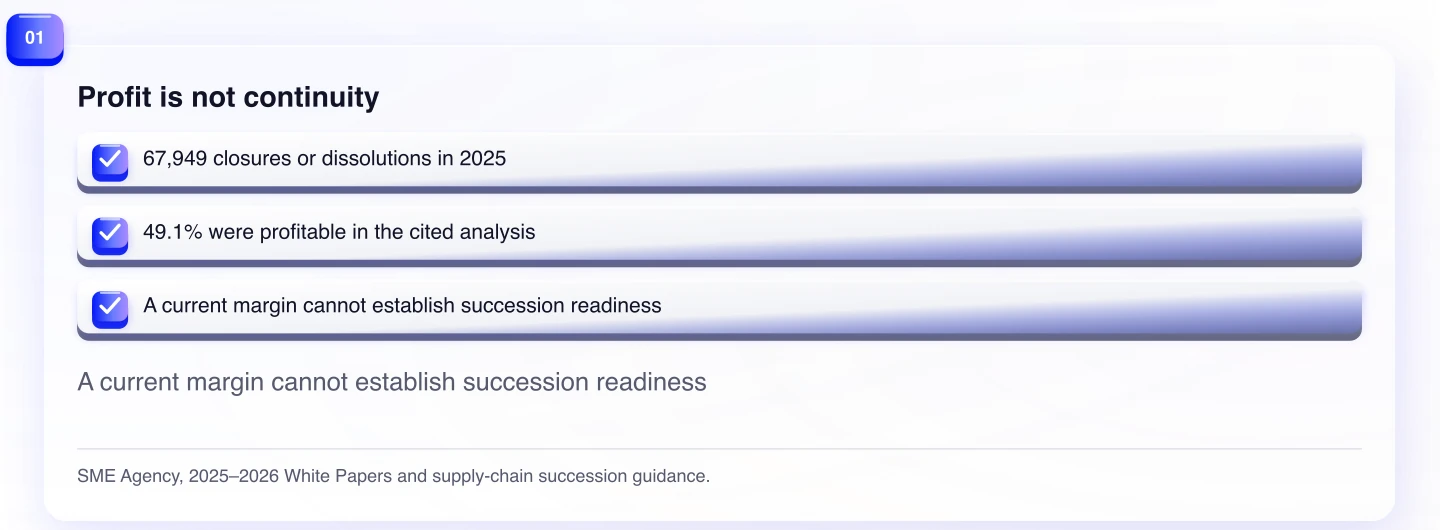
The figures do not say that profit caused closure, or that all closures came from succession failure. They do show that continuing economic value and continuing legal existence are not the same outcome. An owner may decide not to hand over a business even while orders remain, customers are satisfied, and the workshop earns money.
For a foreign company, the most exposed supplier may not be the one with the weakest balance sheet. It may be the small specialist whose founder personally holds the process together: calibrating a machine, interpreting a drawing, approving a batch, introducing a subcontractor, or deciding which exception is acceptable. The financial statements can look stable while the continuity mechanism remains informal.
The first operating question is therefore not, “Is this supplier healthy?” It is, “Which capabilities survive if the current owner leaves?” Those questions overlap, but they are not substitutes.
The succession rate is improving—and the clock is still real
The 2025 White Paper reports progress. The measured successor-absence rate fell from 57.9 percent in 2022 to 54.5 percent in 2023 and 52.7 percent in 2024. That direction matters. It would be wrong to portray every Japanese SME as frozen in an inevitable succession crisis.
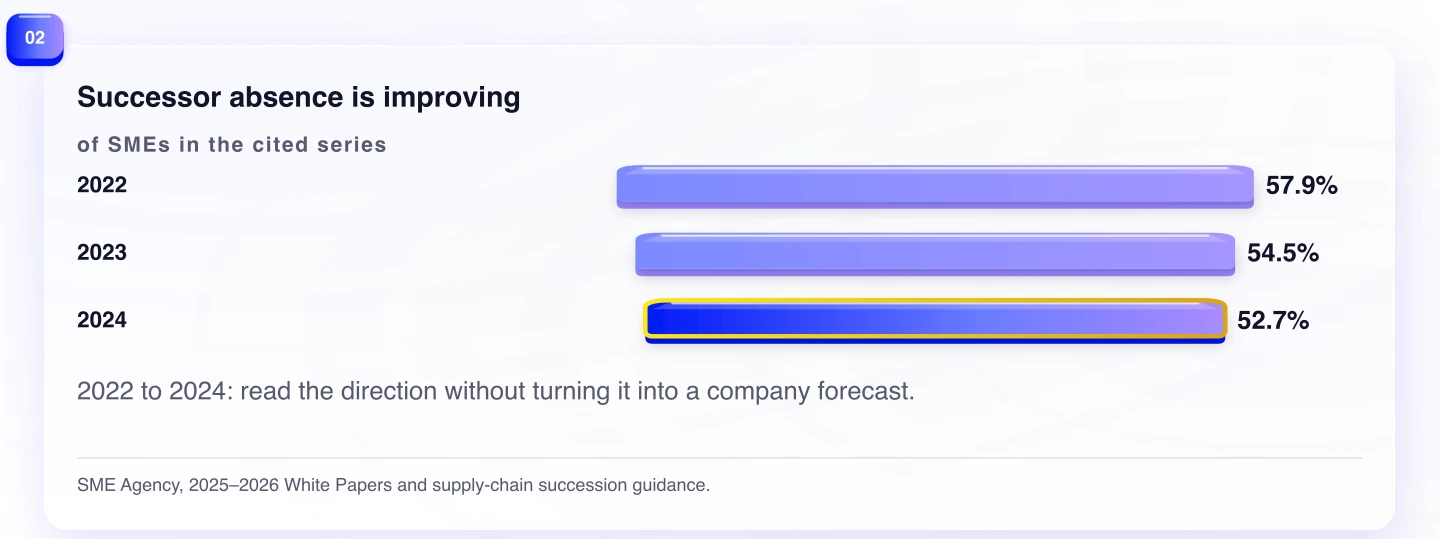
The same evidence preserves the urgency. More than half of SME managers were aged 60 or older in the cited analysis, and average manager age was 60.7. The Agency also says succession preparation often takes three years or more. A buyer that first asks about continuity after an announced retirement has entered the process late.
Preparation takes time because succession is not a signature. A successor needs authority, operating knowledge, staff confidence, customer trust, financing, and sometimes ownership of facilities or intellectual property. A transfer that preserves the company name but loses the one technician who can make the product may satisfy a legal checklist and still break a buyer's supply.
That is why the conversation belongs in routine relationship management. It should not arrive as a sudden interrogation about the owner's age. A buyer can ask who approves production when the owner is absent, how technical knowledge is documented, which roles are hard to replace, and what the supplier wants the relationship to look like in three years. Respectful operational questions reveal more than a blunt demand for a succession plan.
A closure can travel through the chain
The Small and Medium Enterprise Agency explicitly describes “supply-chain business succession.” Its premise is that the closure of an SME supporting a regional supply chain can affect the continuity of its counterparties and create wider negative effects for regional industry.
The phrase matters because it moves succession out of the owner's private sphere. A buyer may depend on a supplier's machinery, people, know-how, approvals, or upstream relationships. When those resources disappear, the buyer does not merely lose a vendor code. It may lose a manufacturing route.
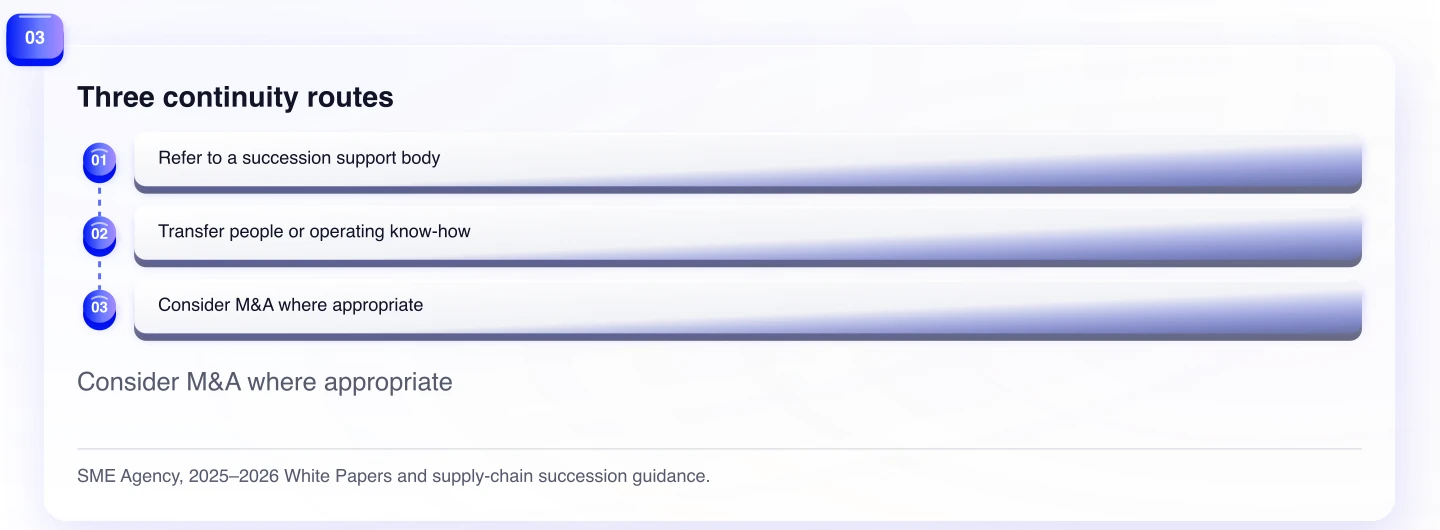
The Agency's guidance describes three broad ways a connected company can respond: introduce the supplier to a support body; help transfer people or know-how; or consider an M&A route. It also points to Business Succession and Handover Support Centers in all 47 prefectures.
Those routes are not recommendations for a foreign buyer to acquire every critical workshop. They show that continuity has more than one architecture. Sometimes the contribution is an introduction to a qualified support organization. Sometimes a worker, process, tool, or training relationship can be preserved without buying the company. Sometimes ownership transfer is the appropriate path. The right route depends on facts that public statistics cannot reveal.
An overseas business should also be careful about leverage. A small supplier may see a powerful customer asking about succession as a threat, a prelude to price pressure, or an attempt to appropriate know-how. The conversation needs a reason, confidentiality, a named senior owner, and a clear boundary around what information is actually required.
What a continuity map should contain
A supplier register often contains commercial fields: spend, lead time, quality score, contract date, and payment terms. A continuity map needs a different layer.
Start with dependency. Identify which components, services, certifications, molds, recipes, datasets, or relationships cannot be replaced within the promised customer recovery time. A low-spend supplier can be highly critical if it controls one irreplaceable step.
Then map concentration. Record whether the process depends on one owner, one engineer, one site, one machine, one subcontractor, or one undocumented judgment. Ask what happens during an ordinary two-week absence before asking about permanent departure. The answer reveals whether the business already has working delegation.
Next map transferability. Who owns the tooling? Can drawings and specifications be used elsewhere? Is quality evidence portable? Are there restrictions on moving work? How long would qualification of a second source take? A theoretical alternative is not resilience if it requires twelve months to approve and the customer promise allows six weeks.
Finally, map the relationship. Name the person who can raise continuity without damaging trust. Define what evidence the buyer may store, who can see it, and when the assessment will be refreshed. Succession data is sensitive. More collection is not automatically better governance.
The output is not a red flag called “old owner.” It is a set of recovery decisions. A critical supplier with documented processes, delegated authority, a credible successor, and a rehearsed outage plan may be more resilient than a larger company with opaque dependencies. Age is context, not a risk score.
The objection: aggregate data cannot rate a supplier
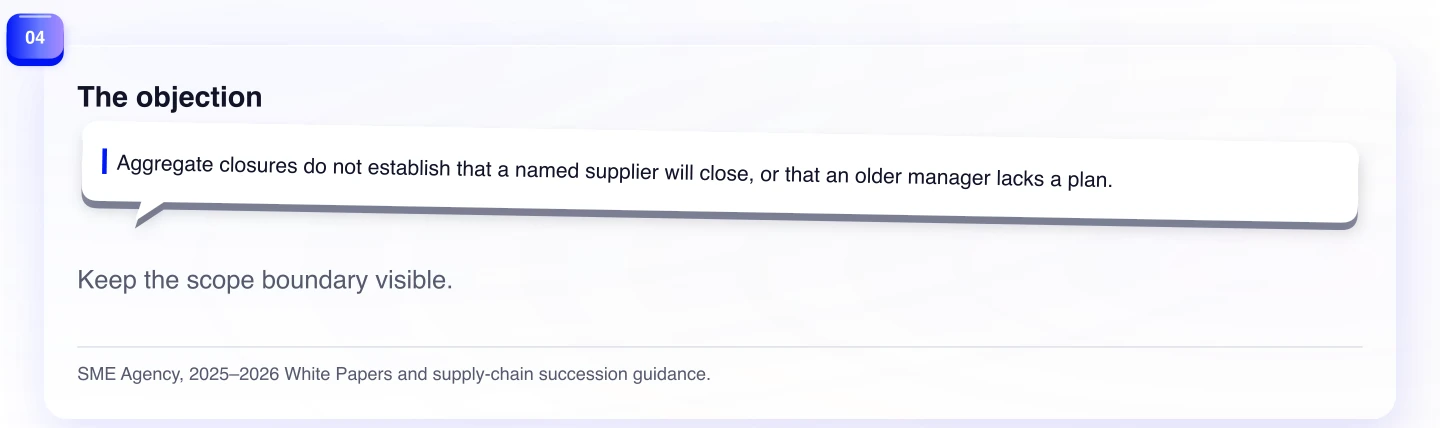
The strongest objection is correct. Closure totals cover different businesses and causes. A 52.7 percent successor-absence rate is not a probability that your supplier will fail. An older manager may have an excellent internal successor. A younger founder can close abruptly. A profitable business can be acquired; an unprofitable one can continue.
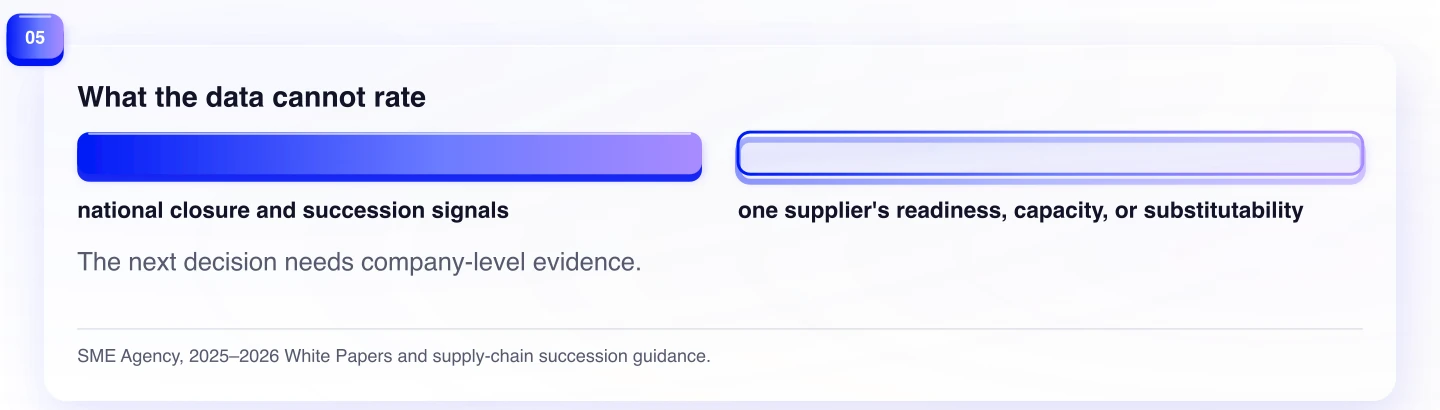
The sources do not show the financial condition, succession readiness, capacity, recovery time, ownership intentions, or substitutability of a particular company. Using the national figures to label an individual supplier would be poor analysis and could harm the relationship.
But that limitation does not justify silence. It defines the right use of the evidence. The figures are a trigger to ask company-specific continuity questions, not an answer to them. They tell procurement teams that a bankruptcy-only model misses a real route to supply loss.
The operator action is small enough to begin this month. Take the ten Japanese suppliers whose loss would most disrupt the customer promise. For each, write the irreplaceable capability, current concentration, earliest warning signal, recovery-time objective, alternative source, relationship owner, and next respectful question. Do not request private succession details that are unrelated to continuity. Do not turn a scorecard into a threat.
Then choose one intervention that improves both parties' position: document a specification together, qualify a backup material, cross-train a second contact, clarify tooling ownership, introduce a public support center, or make a longer demand commitment that gives the supplier room to plan.
Review the map twice a year and after any material change in ownership, key staff, site, or process. A continuity review should not become a one-time onboarding form whose answers age quietly. Track whether the agreed mitigation actually reduces recovery time: whether the second contact can make a decision, the backup tool can produce to tolerance, and the alternative source has completed a real qualification batch. Evidence from a rehearsal is stronger than a promise in a spreadsheet.
Commercial behavior also matters. A buyer that demands chronic price cuts, volatile quantities, and last-minute changes can make succession harder by reducing the supplier's ability to invest in people. Continuity is not something to demand from the supplier while preserving every risk on the buyer's side. Forecast quality, payment discipline, and a credible commitment can become part of the succession environment.
The durable lesson is not that Japanese SMEs are disappearing. It is that present performance and future transfer are different systems. Profit tells you that a supplier creates value today. Succession design tells you whether that value can still reach your customer tomorrow.
Evidence
Sources
- 2026 White Paper on Small and Medium Enterprises — overviewSmall and Medium Enterprise Agency · April 24, 2026
- 2025 White Paper, Section 9: Business successionSmall and Medium Enterprise Agency · April 25, 2025
- Supply-chain business successionSmall and Medium Enterprise Agency