Service Design and Trust
Accessibility in Japan is now a private-business duty, not just good practice.
By Japan Legible
- Published
- Last checked
- Reading time
- 9 minutes

Since 1 April 2024, providing reasonable accommodation has been a legal duty for private businesses in Japan, not merely an effort they are encouraged to make. That change reaches beyond ramps, captions, or a compliance page. It requires a business to receive a need, discuss the barrier, decide what is workable, offer an alternative when necessary, and learn from the request.
The duty is fact-specific. It does not mean every requested measure must be accepted regardless of burden, and it does not provide one universal checklist for every service. It does mean that “our standard process has no option for that” is no longer a complete operating answer.
This article explains a management pattern from official public guidance. It is not legal advice. A specific request, sector, employment issue, or dispute may need review under the applicable law and sector guidance.
The change is from intention to operating duty
Japan's amended Act for Eliminating Discrimination against Persons with Disabilities took effect on 1 April 2024. For private businesses, reasonable accommodation moved from an efforts obligation to a legal duty. Unjustified discriminatory treatment remains separately prohibited.
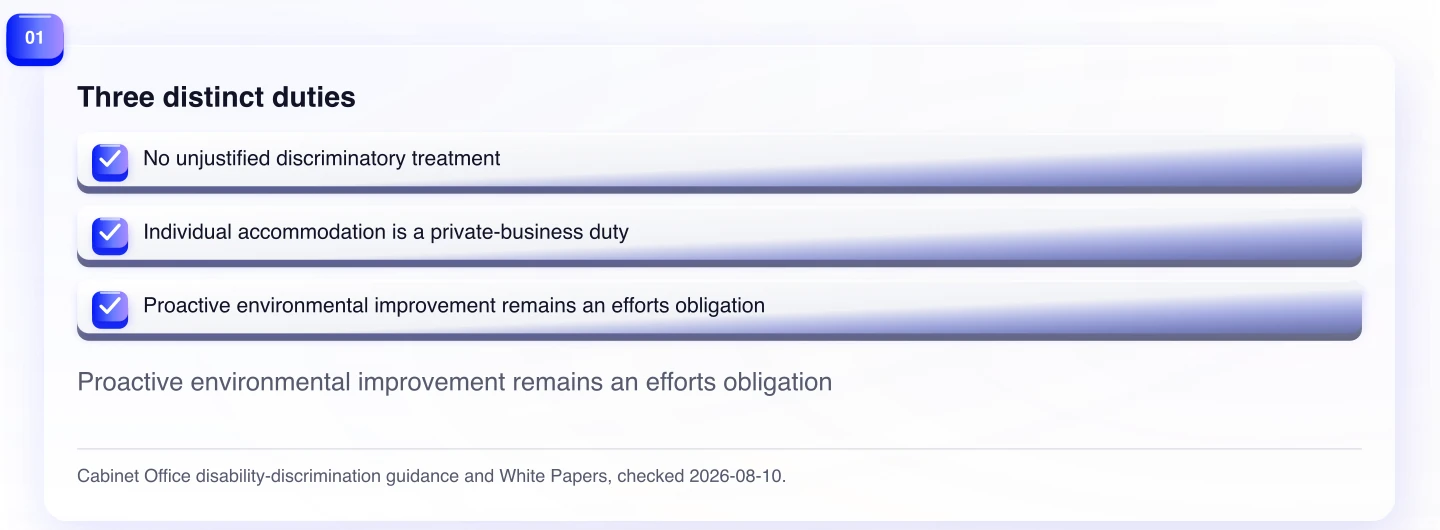
The distinction matters. A company can avoid an explicit refusal based on disability and still have a service process that leaves a barrier untouched. Reasonable accommodation addresses the practical adjustment needed when a person faces a social barrier in the specific interaction.
The Cabinet Office describes business broadly. The category can include companies, shops, sole proprietors, and nonprofit groups that repeatedly conduct the same kind of activity. A foreign brand should not assume that the rule begins only after it establishes a large Japanese subsidiary. The relevant operational question is how the activity is provided in Japan and which entity or partner controls the customer journey.
The duty also should not be collapsed into employment compliance. Employment discrimination and accommodation sit under a separate legal framework. A customer-service workflow and an employee-accommodation process may share design principles, but they are not the same legal procedure.
A request does not always arrive in the expected form
Teams often imagine a formal request: a customer identifies a disability, cites a rule, and asks for a named adjustment. Real interactions are less orderly. A person may describe the barrier rather than the diagnosis. Communication may come through a family member or supporter when it is difficult for the person to communicate the need directly. Official guidance recognizes that possibility.
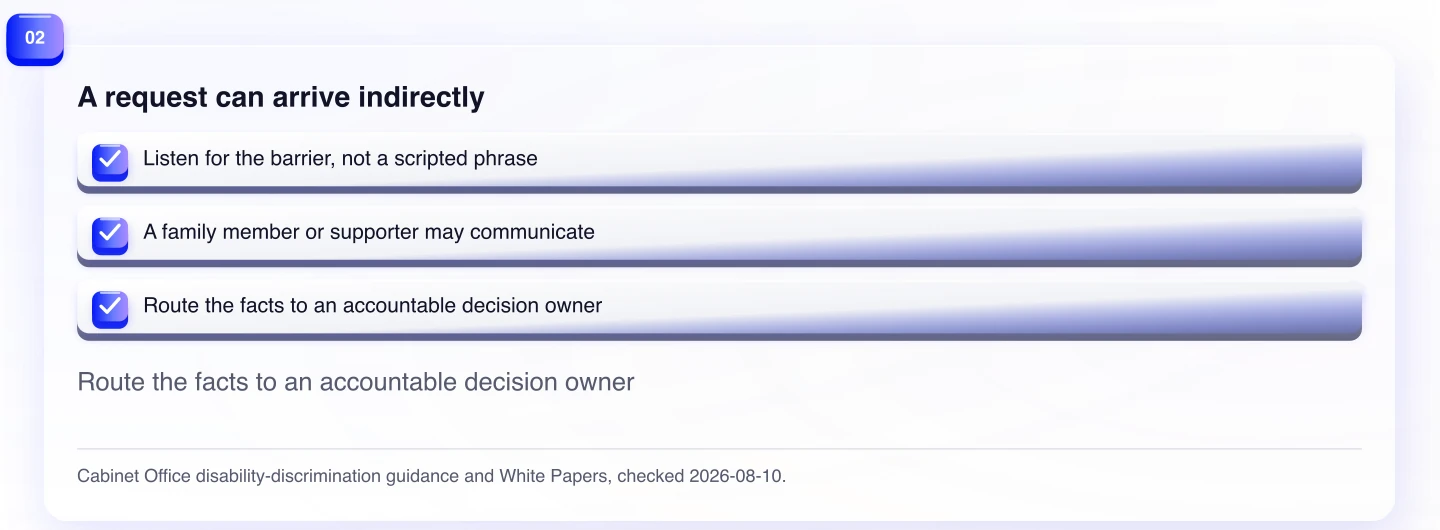
That makes front-line listening part of the control. A call-center script that accepts only a narrowly phrased request can fail before the company even considers an accommodation. A store employee who sees a supporter speaking may incorrectly insist that only the customer can explain. A digital support form may offer no accessible channel for a person who cannot use the required interface.
The useful intake question is concrete: “What barrier is preventing you from using the service, and what change would help?” It does not require a front-line employee to diagnose disability or promise a legal outcome. It opens the facts needed for dialogue.
The business then needs a route. Who can approve an alternative document format? Who can change an appointment method? Who can decide whether a support person may join? Who can replace a voice-only step with text? If every answer requires an improvised escalation, the company has a policy without an operating system.
Reasonable does not mean unlimited
The duty is not a command to perform any requested action regardless of cost, safety, staffing, or the nature of the business. Official guidance frames reasonable accommodation around the absence of an excessive burden and emphasizes constructive dialogue. When a requested measure is difficult, the business should explore alternatives rather than end the exchange with a rejection.
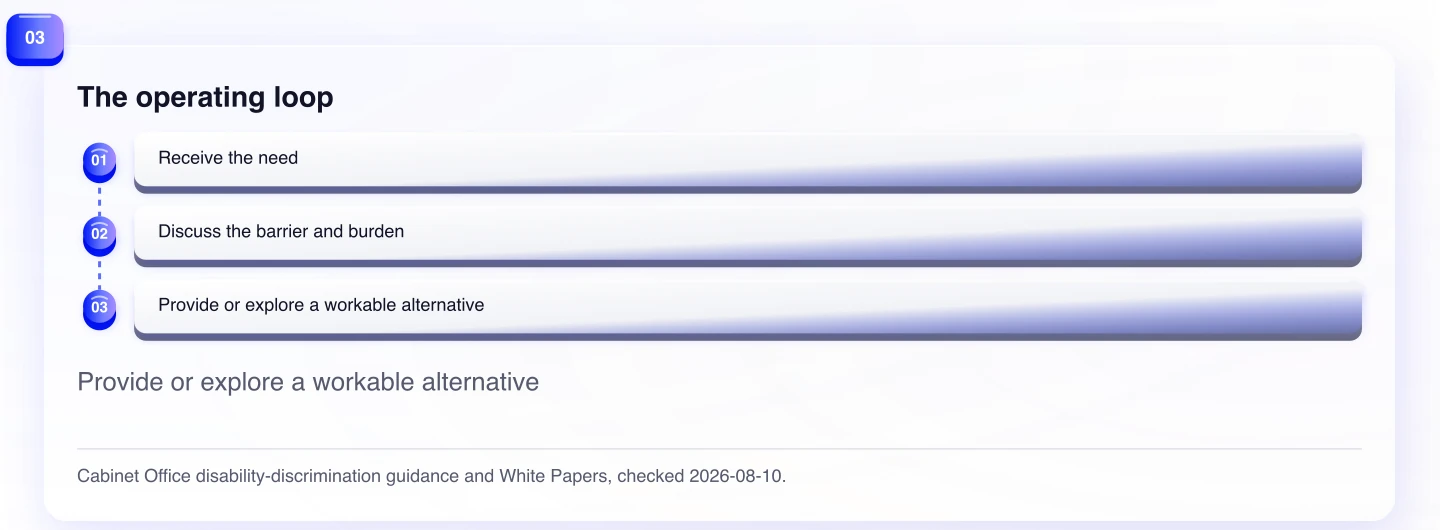
This is where a binary ticket status becomes dangerous. “Approved” and “denied” omit the most valuable part: what barrier was identified, what constraint made one option difficult, what alternative was discussed, and whether the person could use the service in the end.
Consider a service that normally requires an in-person explanation at a fixed counter. The customer may request a different channel. The exact answer depends on the service, identity and safety requirements, available technology, and burden. But the operating pattern is stable: identify the essential purpose of the step, separate it from the default method, and search for another way to preserve the purpose.
The record should be proportionate. Store the request, the barrier, the dialogue, the decision, the alternative, the owner, and the outcome. Avoid collecting diagnostic or sensitive information that is not needed to solve the barrier. Access should be limited, and retention should have a purpose.
Individual accommodation and environmental improvement reinforce each other
The law's individual duty does not make proactive accessibility work obsolete. Official guidance treats environmental improvement as an efforts obligation. A business that improves its physical, digital, information, and training environment can reduce the number of times a customer must request an exception.
This is the product insight. Individual requests are not merely exceptions to close. In aggregate, they identify where the standard service creates repeated barriers. If customers repeatedly need text alternatives for a voice process, accessible documents, more time, clearer directions, or a different handoff, the pattern belongs in the product backlog.
The team should not wait for a request to fix an obvious inaccessible state. But it also should not believe that an accessibility audit will anticipate every interaction. Standards and testing improve the baseline; dialogue handles the person and context that the baseline did not capture.
For an overseas company, the work crosses translation. A Japanese-language accessibility statement is useful only if the service behind it can respond in Japanese, route a request to someone with authority, and preserve the decision across store, website, call center, delivery, and partner systems. Translating the promise without assigning the work can increase the gap between expectation and experience.
The objection: every case is different
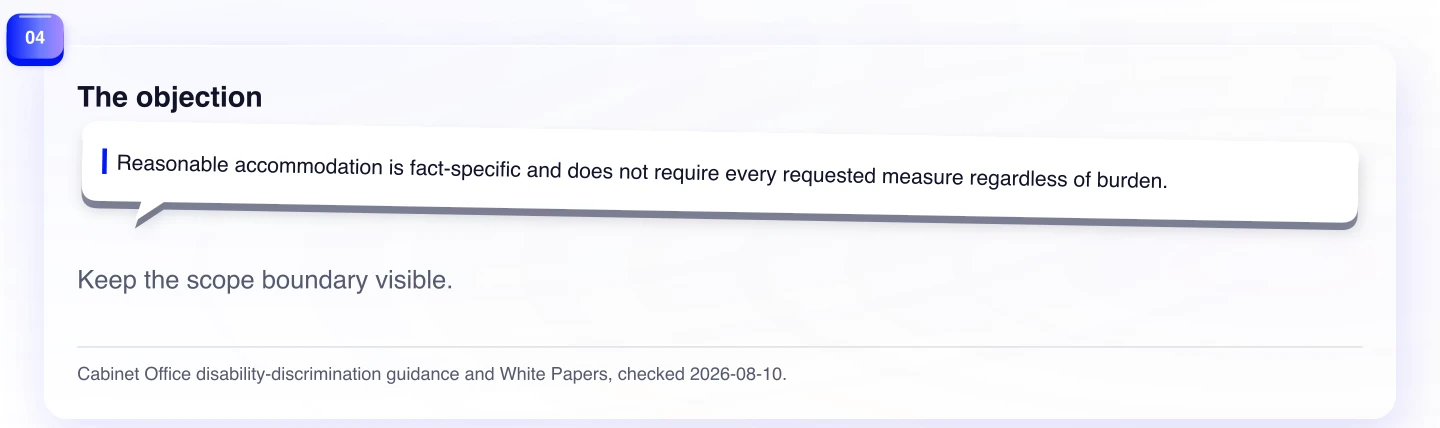
A strong objection is that reasonable accommodation is fact-specific. A small business and a large platform may face different burdens. A change that is simple in one service can alter safety, privacy, or the essential nature of another. A rigid central checklist could encourage front-line staff to stop listening.
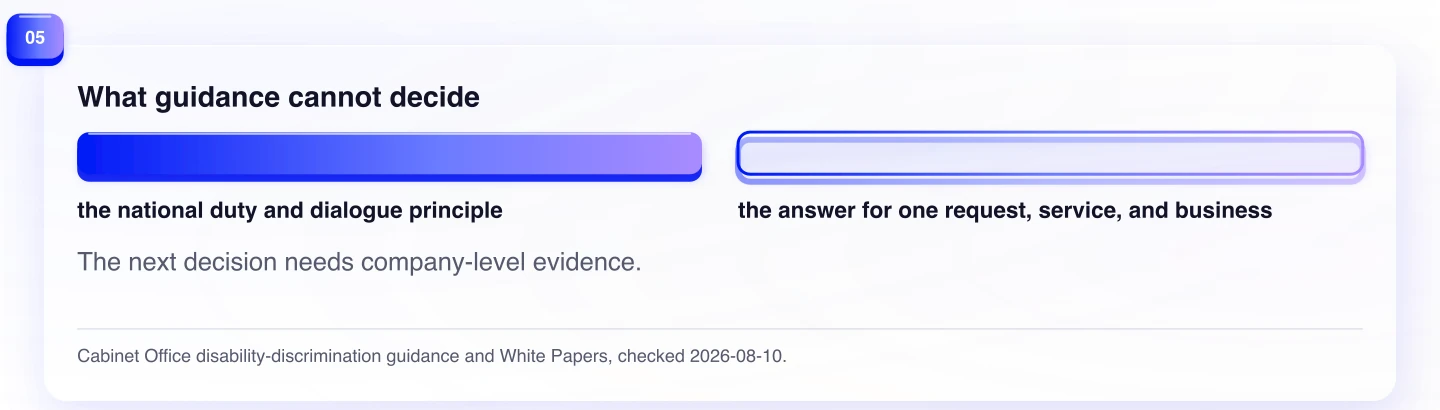
That objection is correct. Public guidance does not decide whether a particular adjustment is required in a particular case. The duty is not identical to an unlimited catalog of customer preferences. A company may need qualified advice when the facts are difficult.
But “case-specific” does not mean “process-free.” The company can standardize how it receives a request, starts dialogue, evaluates burden, documents reasons, proposes alternatives, and escalates uncertainty. It can train people to distinguish the service's essential purpose from its habitual method. It can review recurring barriers without treating personal information as product analytics.
Start with three real journeys: finding information, completing a transaction, and receiving support after purchase. For each, ask where a person might be blocked by vision, hearing, mobility, cognition, communication, or the interface itself. Then identify the fastest channel for requesting an adjustment and the employee who can act.
Run one tabletop test. A customer cannot use the default channel and asks through a supporter for another route. Follow the request from first contact to completed service. Note every handoff where the explanation must be repeated, every approval with no owner, and every system that cannot record an alternative. Those are operating defects whether or not a complaint has reached them yet.
Add a review cadence. Once a month, a small cross-functional group can examine anonymized patterns: which barriers recur, which alternatives succeed, where resolution takes too long, and which decisions front-line teams still cannot make. The group should include service operations and product, not only legal or compliance. Its purpose is to improve the standard journey while preserving escalation for hard cases.
Partners need the same operating contract. A booking platform, delivery provider, outsourced call center, or venue may control the moment when an adjustment is needed. Define which party receives the request, how consent and necessary information travel, who decides, and who tells the customer. A partner logo does not transfer ownership of a broken handoff.
Procurement can make that responsibility observable. Include accessibility escalation, response ownership, accessible communication channels, incident learning, and change notification in partner onboarding. Test the route before a customer needs it. The aim is not to make every vendor interpret the law; it is to ensure that the person encountering the barrier is not stranded between contracts.
Finally, publish only what the service can deliver. Explain how to request accommodation, which channels are available, and what information helps the dialogue. Do not promise every outcome in advance. Do promise that a person will reach a process capable of listening and responding.
Accessibility is often presented as kindness or design quality. It can be both. In Japan, it is also a private-business duty. The practical unit is not the statement on the footer. It is the next customer encounter—and whether the organization can turn a barrier into a workable path.
Evidence
Sources
- 2024 White Paper: enforcement of the amended disability discrimination actCabinet Office · June 21, 2024
- Reasonable accommodation became mandatory for businessesCabinet Office · May 20, 2024
- Government and sector response guidelinesCabinet Office