Technology and Competition
Japan mobile app distribution is now a design choice.
By Japan Legible
- Published
- Last checked
- Reading time
- 9 minutes

For a mobile product launching in Japan, distribution is no longer a single inherited setting. It is now an operating-model choice.
Japan's Mobile Software Competition Act became fully effective on December 18, 2025. The law does not require an app developer to abandon Apple's or Google's store, payment system, or default commercial model. It changes the option set. Subject to the law's justification provisions, designated platform operators may not prevent developers from distributing through alternative app stores, using alternative payment-management services, or directing users to related web pages, including through link-outs.
That makes the practical decision larger than “which checkout should we add?” A team must decide which channel or combination of channels produces the best result after fees, conversion, fraud, tax handling, customer support, refunds, release management, and platform-specific implementation are included.
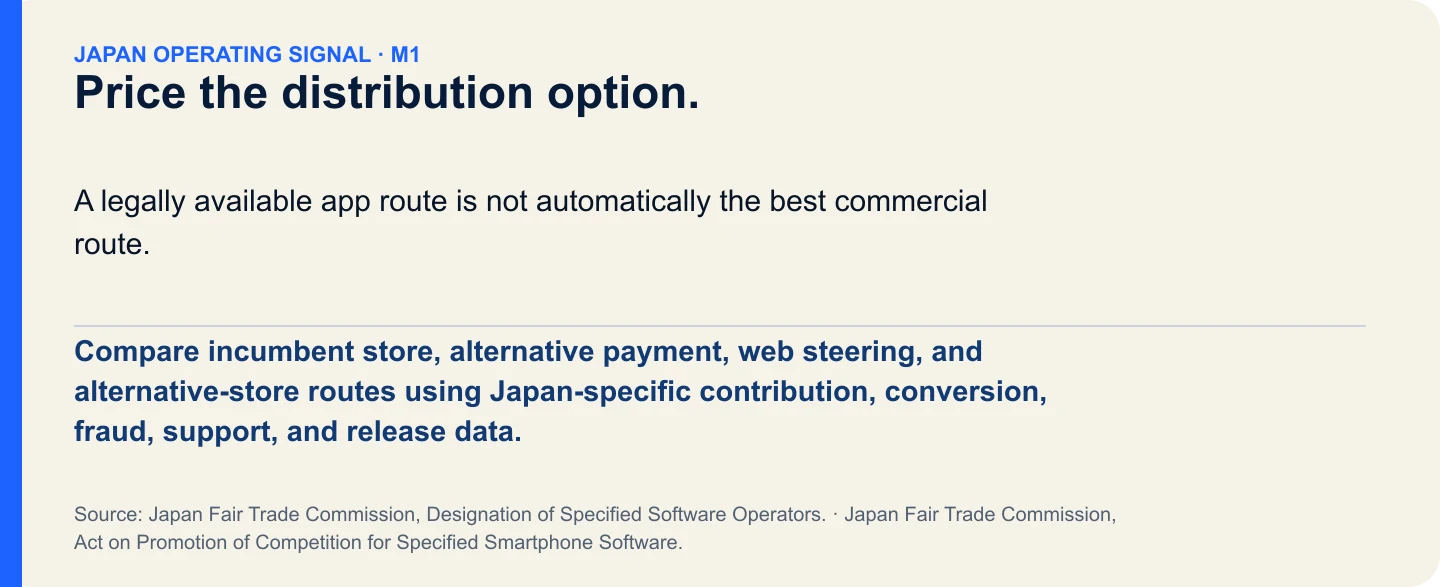
The default store may remain the best answer. The difference is that this answer should now be tested rather than assumed.
What changed, and who is regulated
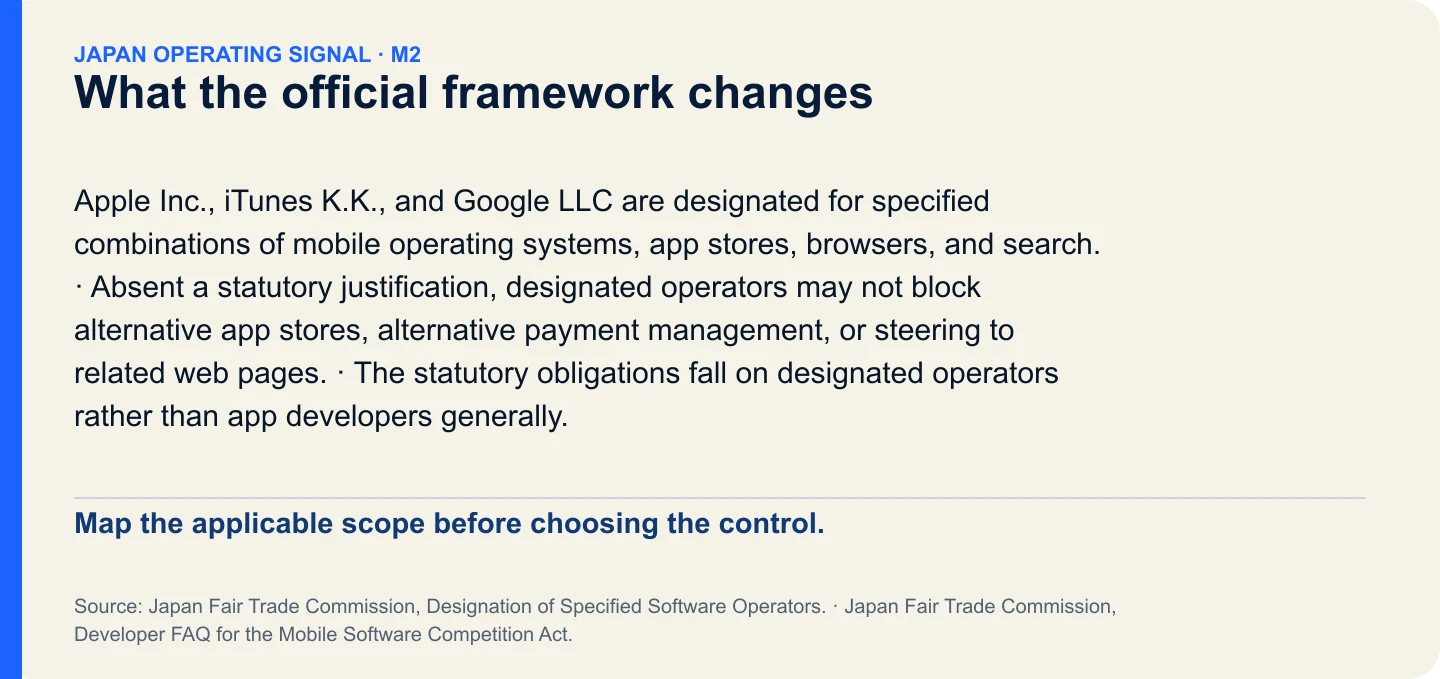
The Japan Fair Trade Commission, or JFTC, designated Apple Inc. for its mobile operating system, app store, and browser; iTunes K.K. for its app store; and Google LLC for its mobile operating system, app store, browser, and search engine. The designation press release is dated March 31, 2025 and states that the designations were made on March 26.
The law's prohibited-conduct and compliance provisions became fully effective on December 18, 2025. The JFTC's July 2026 developer FAQ makes an important scope point: the statutory duties fall on the designated operators, not on app developers generally.
For developers, the most direct commercial consequences are the protected ability, absent a valid justification, to:
- offer an app through an alternative app store;
- use an alternative payment-management service; and
- direct users to a related web page, including an external web store.
These possibilities sit alongside other parts of the law, such as restrictions on certain uses of non-public developer data and obligations relating to operating-system functions, default settings, and choice screens. They do not amount to a general deregulation of mobile software. The Act applies to specified software and designated operators within its definitions.
The legal text is available from the JFTC's consolidated Act page. Teams should use that text and the JFTC guidance for scope, rather than importing assumptions from the European Union's Digital Markets Act or another country's app-market rules.
Four routes, not one answer
A Japan launch can now be assessed as four related routes.
The first is the incumbent app store with the incumbent payment system. This offers familiar discovery, installation, billing, refunds, and user trust. It also keeps the product within the platform's established review and commercial framework.
The second is the incumbent app store with an alternative payment system. This may change payment cost and customer ownership, but it can also transfer work to the developer. Payment authorization, fraud controls, customer inquiries, refunds, receipts, and reconciliation do not disappear when the payment rail changes.
The third is the incumbent app store with steering to a web offer. A link-out can create a direct commercial relationship and enable web pricing or packaging. It also adds a transition between app and browser. That transition can reduce conversion, especially when sign-in, authentication, or product entitlement is not designed as one continuous journey.
The fourth is distribution through an alternative app store. This can alter release control, commercial terms, or access to a particular audience. It may also require a separate approach to discovery, user assurance, updates, incident response, and support.
These routes can coexist. A developer might retain the incumbent store for broad reach, use web steering for an established subscriber base, and test an alternative store for a defined segment. The law makes that portfolio possible; it does not establish which allocation is profitable.
Compliance reports are evidence, not approval
The Act requires designated operators to submit annual reports describing measures taken to comply. The JFTC published the first reports submitted at full enforcement in February 2026. It then published reports for fiscal 2025 on July 27, 2026, covering the period from December 18, 2025 through March 31, 2026.
The July publication notice contains two methodological cautions.
First, the JFTC publishes the reports after removing business secrets, as required by Article 14. Public readers therefore do not see every underlying operational detail.
Second, the JFTC states expressly that the published contents represent the designated operators' views, not the JFTC's views. A report's description of a fee, workflow, security measure, or restriction is useful evidence of how the operator says it is complying. Publication is not regulatory approval of that approach.
Operators should read the reports as implementation documents. Compare stated rules with developer terms, technical documentation, observed user journeys, and actual commercial results. When an apparent inconsistency matters, the JFTC provides routes for information and suspected-violation reports. A report alone should not be treated as the final interpretation of the Act.
Security remains part of the rule
The law does not say that every alternative store, payment method, link, or operating-system access request must be accepted without controls. It includes justification provisions connected to cybersecurity, privacy, protection of young users, and other specified purposes. The statutory structure asks whether the conduct is needed for such a purpose and whether achieving that purpose through other conduct is difficult.
That means two opposite overclaims should be avoided.
It is incorrect to say that Apple or Google must allow anything presented as an alternative distribution method. It is also incorrect to treat a platform's use of the word “security” as automatically resolving the legal analysis. The scope, design, and proportionality of a restriction can matter.
For an app operator, security is also an internal economic variable. Moving billing or distribution can move responsibility for payment fraud, malicious copies, signing and release controls, entitlement recovery, update delivery, vulnerability response, and customer education. The correct comparison is not simply platform commission against payment-processor fee. It is the total operating cost and risk of the channel.
A short legal caution is warranted: this is a competition-law framework governing designated operators. It does not replace consumer protection, privacy, payments, tax, content, or sector-specific obligations that may apply to the app developer's own business.
The counterargument
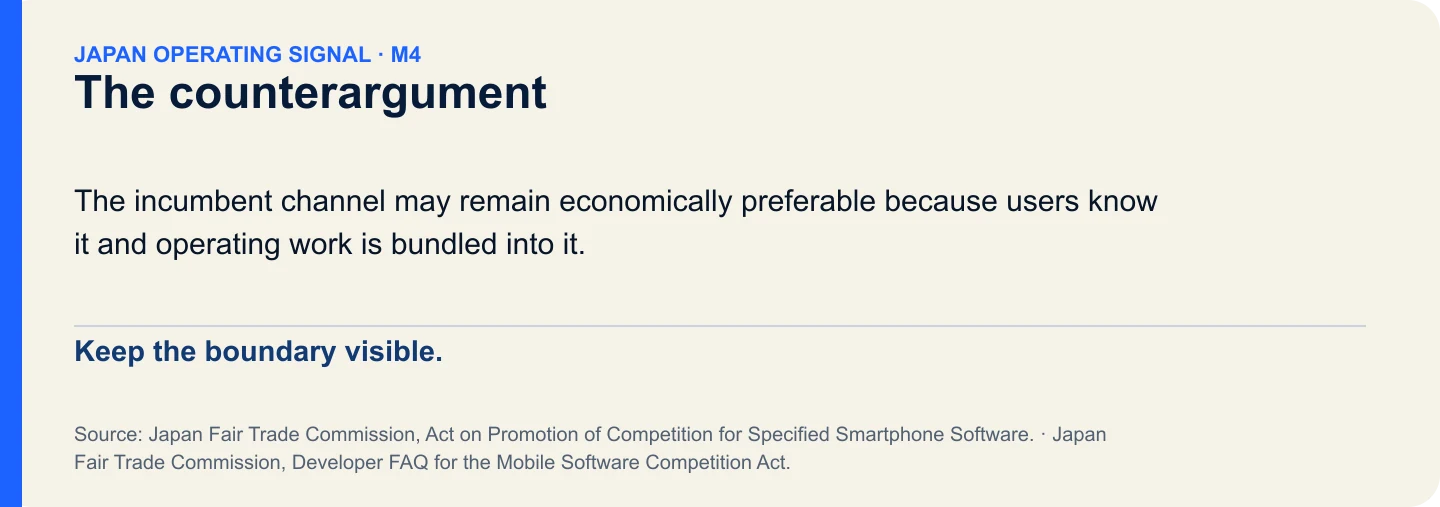
The strongest counterargument to the claim that distribution is now a meaningful design choice is that a legal option can remain commercially weak.
Users may continue to prefer the incumbent store because it is preinstalled, familiar, and integrated with their existing account and payment method. An external purchase journey may convert less well. An alternative store may have limited reach. Platform fees associated with alternative routes may reduce the expected saving. The developer may inherit support, refund, and fraud costs that were previously bundled into the platform relationship.
This counterargument is credible. It is also testable.
The Act should not be translated into a recommendation to fragment distribution. It should be translated into permission to compare routes with real numbers. For some products, especially early-stage consumer apps, the integrated store may remain the lowest-risk path. For a service with strong direct demand, existing web accounts, or high transaction volume, alternative payment or steering may be more material. For a specialized audience, an alternative store may support a distinct proposition.
The neutral conclusion is not “go alternative.” It is “price the option.”
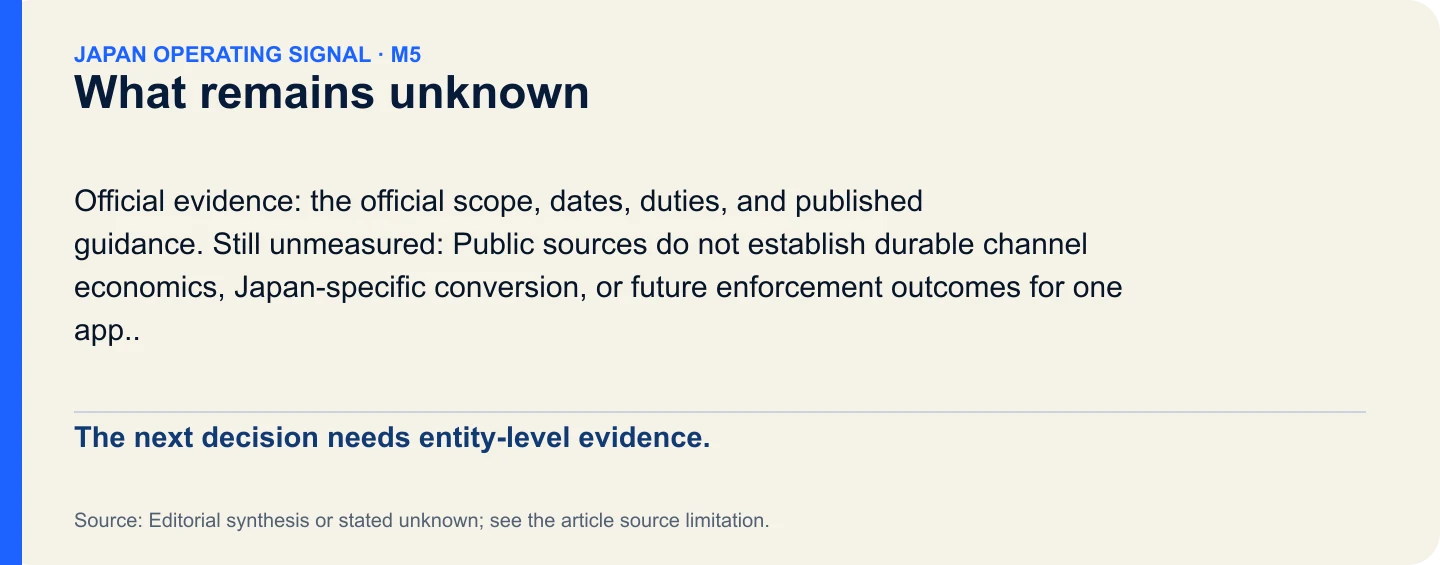
What remains unknown
Several questions cannot yet be answered confidently from the statute or the first reporting cycle.
There is not yet a mature body of public enforcement decisions showing exactly how the JFTC will assess each form of friction, fee, warning, review process, or technical restriction. The durable economics of alternative channels are also unsettled. Terms can change, and a route that looks attractive before support and fraud data are available may not remain so.
User behavior is another unknown. Japan-specific conversion rates for link-outs, willingness to install alternative stores, trust signals, and response to choice screens will differ by product and audience. Results from the EU, the United States, or a global experiment should not be treated as Japan evidence without validation.
The public compliance reports are incomplete by design because business secrets are removed. They are also operator statements rather than JFTC determinations. They can reveal implementation choices, but not every negotiation, technical exception, or future change.
Finally, product teams cannot assume that one global binary will fit. A Japan route may require separate commercial terms, user education, payments operations, analytics, and release controls. Whether that complexity is justified is a product-specific unknown until modeled and tested.
A practical decision process
Begin with a channel ledger, not a legal summary. For each viable Japan route, record expected acquisition, conversion, gross payment cost, platform charges, fraud loss, refunds, support contacts, tax and receipt work, release overhead, security controls, and time to recover a customer account or entitlement.
Next, classify capabilities as common or channel-specific. Identity, entitlement, pricing, customer support, and analytics should remain coherent even when the transaction or installation path changes. If a web purchase cannot reliably unlock the app, the theoretical distribution option is not ready.
Then define a bounded test. A team might test web steering with existing signed-in customers, or offer an alternative payment method for one product tier. Measure completed purchases and post-purchase costs, not click-through alone. Avoid forcing every user through a new path before reliability and support consequences are known.
Finally, maintain a regulatory evidence file. Preserve the relevant JFTC guidance, current platform terms, user-flow captures, fee schedules, and the assumptions behind the chosen route. Revisit the decision when terms, enforcement guidance, or customer behavior changes.
The operating decision
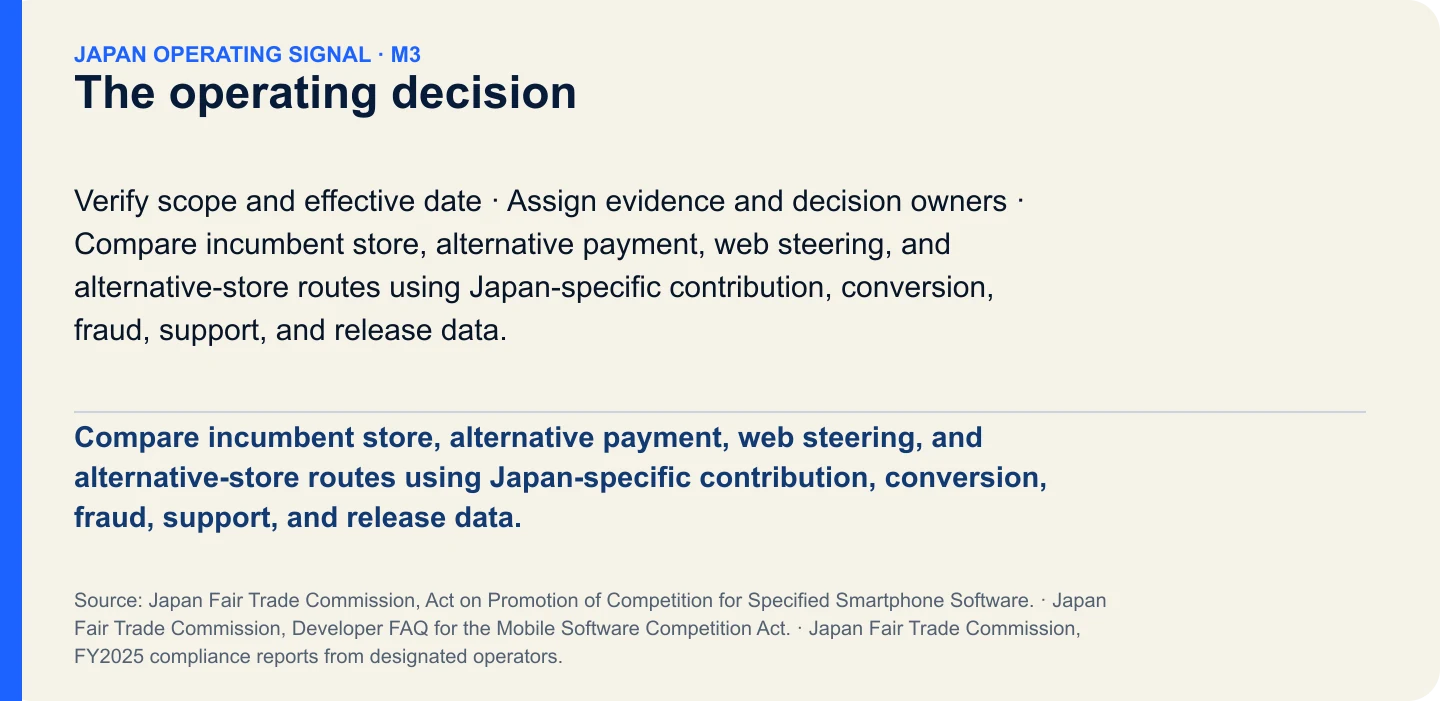
For a Japan launch, keep the incumbent store as the baseline and require each alternative route to beat it on risk-adjusted contribution, customer experience, or strategic control. Do not choose an alternative merely because the Act permits it, and do not reject one merely because the incumbent path is familiar.
The Mobile Software Competition Act has turned distribution architecture into a decision that product, finance, security, legal, and support teams should make together. Its immediate value is not a guaranteed reduction in fees. It is a wider, legally protected design space.
The official sources support that narrower conclusion. They do not support claims that platform commissions have disappeared, that every restriction is unlawful, that published compliance reports are JFTC approvals, or that every app should use multiple channels.
Source limitation
This analysis relies on JFTC primary materials available through August 11, 2026: the Act, designation release, developer FAQ, and compliance-report notices. Guidance and implementation remain live, and the public record does not yet provide mature enforcement precedent or complete commercial data. JFTC web content is generally available under its stated Public Data License 1.0 terms, subject to attribution, modification notices, and listed exclusions.
Evidence
Sources
- Designation of Specified Software OperatorsJapan Fair Trade Commission · March 31, 2025
- Act on Promotion of Competition for Specified Smartphone SoftwareJapan Fair Trade Commission
- Developer FAQ for the Mobile Software Competition ActJapan Fair Trade Commission · July 27, 2026
- FY2025 compliance reports from designated operatorsJapan Fair Trade Commission · July 27, 2026