Commerce and Infrastructure
Japan e-commerce returns: no general cooling-off, but disclosure controls the outcome.
By Japan Legible
- Published
- Last checked
- Reading time
- 9 minutes

Japan does not give mail-order buyers the general unconditional cooling-off right that applies to certain other transaction types. That does not make online returns a blank space. For qualifying goods sales, the seller's clearly displayed return terms—and where the buyer sees them—can control the route after delivery.
The operational mistake is to treat returns as a warehouse setting copied into a footer. Under Japan's mail-order framework, information about withdrawal or cancellation belongs in the advertisement and the final confirmation screen. A return promise is part of the purchase interface before it becomes a parcel moving backward.
This is an operational reading of official public guidance, not legal advice. The result can differ for services, subscriptions, digital content, nonconforming goods, and the facts of a particular dispute. A business should have qualified Japanese review for its actual offer and flow.
No general cooling-off is not the end of the analysis
Cooling-off is widely used as a shorthand for any right to change one's mind. The Consumer Affairs Agency's guidance is more specific: mail-order sales do not have the general unconditional cooling-off system that exists for certain forms of door-to-door, telemarketing, and other regulated transactions.
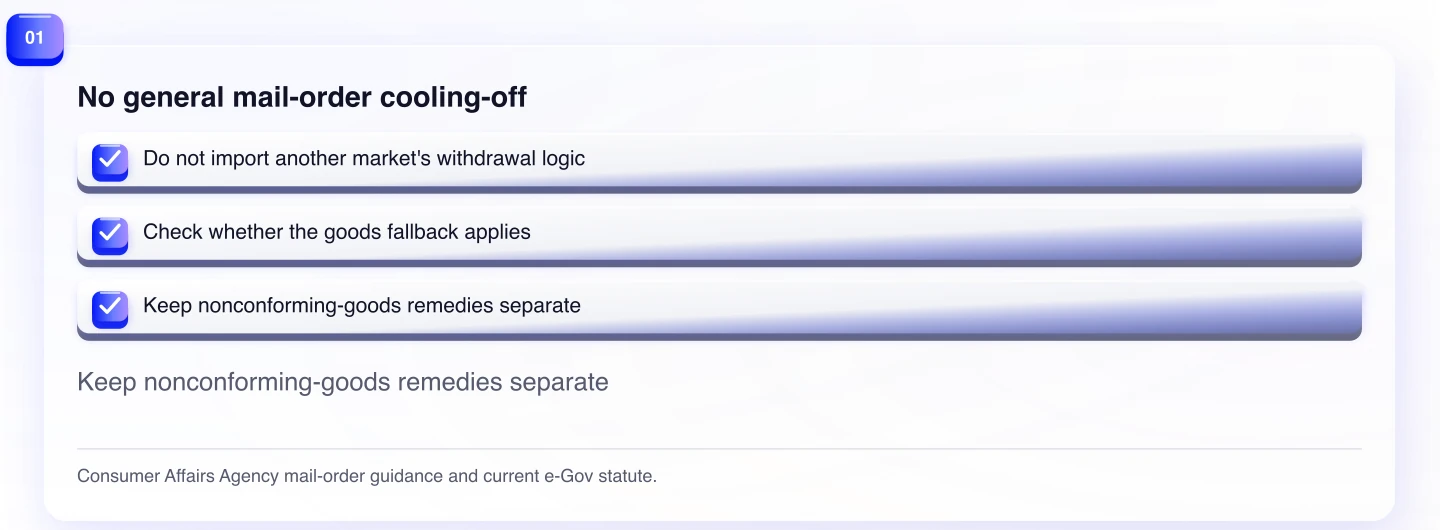
That distinction matters to a foreign operator because a translated global policy can carry the wrong legal logic. A team may import a fourteen-day consumer rule from another market, remove it because it believes Japan has no cooling-off, or describe every return as cooling-off. Each shortcut blurs the actual contract being offered.
For a qualifying goods sale, when no validly displayed special return agreement applies, the statute provides a fallback route: withdrawal or cancellation within eight days counted from delivery, with the consumer bearing the cost of returning the goods. A seller may establish different return terms when they are clearly displayed in advance within the applicable framework.
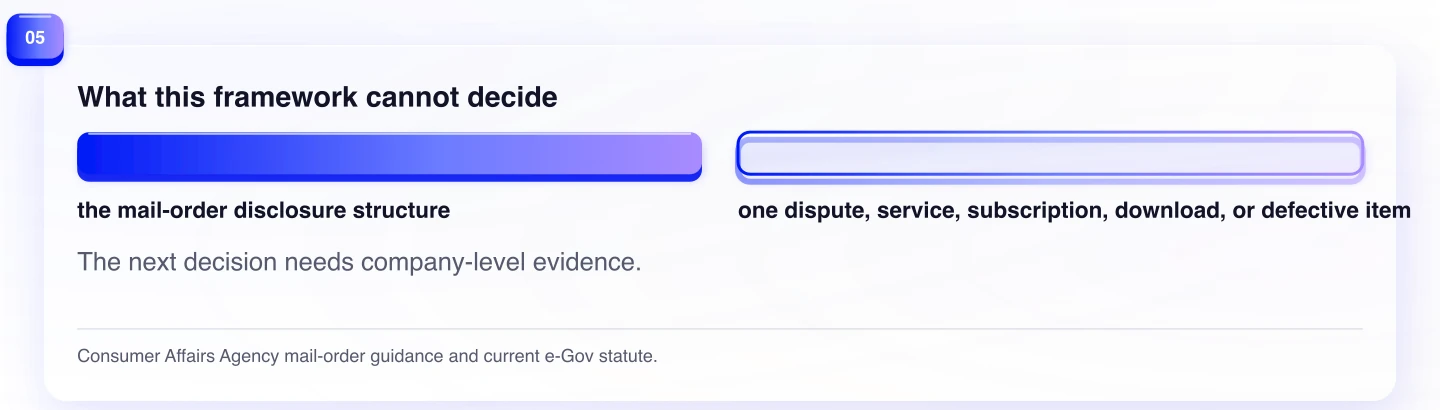
The fallback is not a universal eight-day cooling-off promise. Its scope and conditions matter. It should not be extended by analogy to every service, subscription, download, defective-item dispute, or business-to-business transaction. The precise offer needs precise review.
Disclosure controls the commercial reality
The Consumer Affairs Agency's return-display guidance identifies the information a return term should make clear: whether returns are accepted, the period and conditions, and who bears return costs. Indefinite wording such as “case by case” does not clearly state the rule.
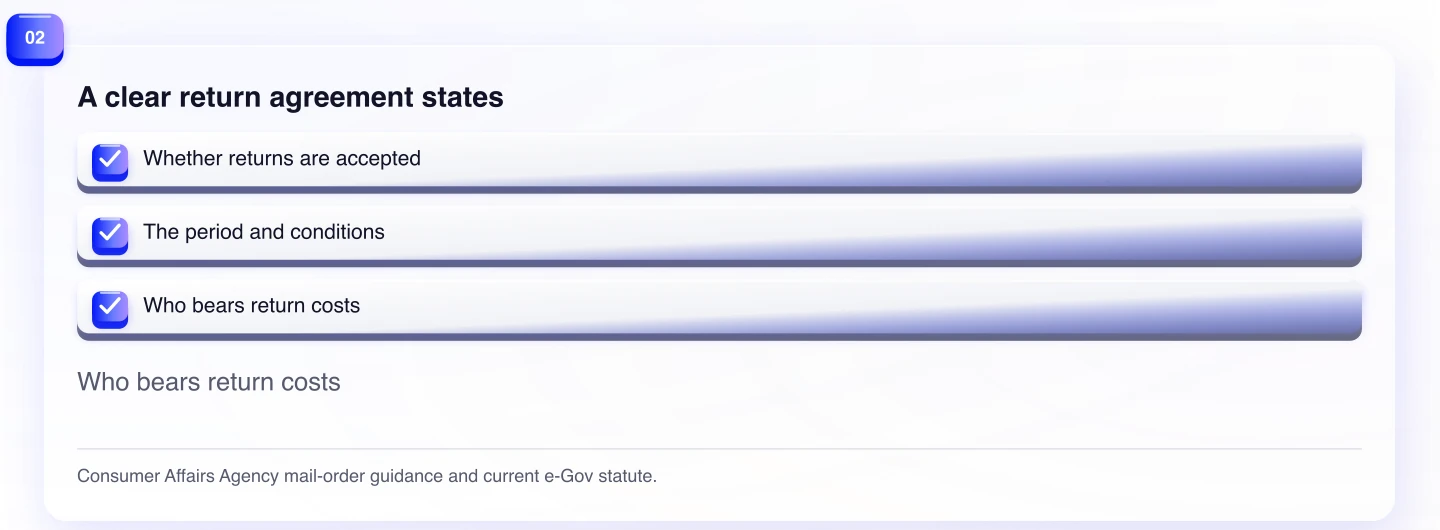
Clarity is not achieved by placing a complete policy somewhere on the site. A buyer needs the material term in the purchase journey. For online contracts, information about withdrawal or cancellation must appear in the advertisement and the final confirmation screen.
This is a product requirement. The team must decide which screen counts as the final confirmation, whether the term remains visible on mobile, what happens when a marketplace or embedded checkout controls the layout, and whether the buyer can return to edit the order after seeing the term.
A link can be useful, but a link label that says “details” without identifying returns may not communicate the consequence. A policy rendered below an endless order summary may be technically present and functionally absent. A final-screen screenshot created during legal review is not proof of what a real buyer saw six months later after a checkout release.
The safest operating pattern is to version the return rule and the interface together. Every order should be traceable to the applicable policy version and confirmation-screen design. That record helps support answer the customer, helps product reproduce the journey, and helps counsel assess the actual representation.
The final screen has six jobs
Since 1 June 2022, the online final confirmation screen must clearly present six categories identified in official guidance: quantity; total price; payment timing and method; delivery timing; withdrawal or cancellation; and any application deadline.
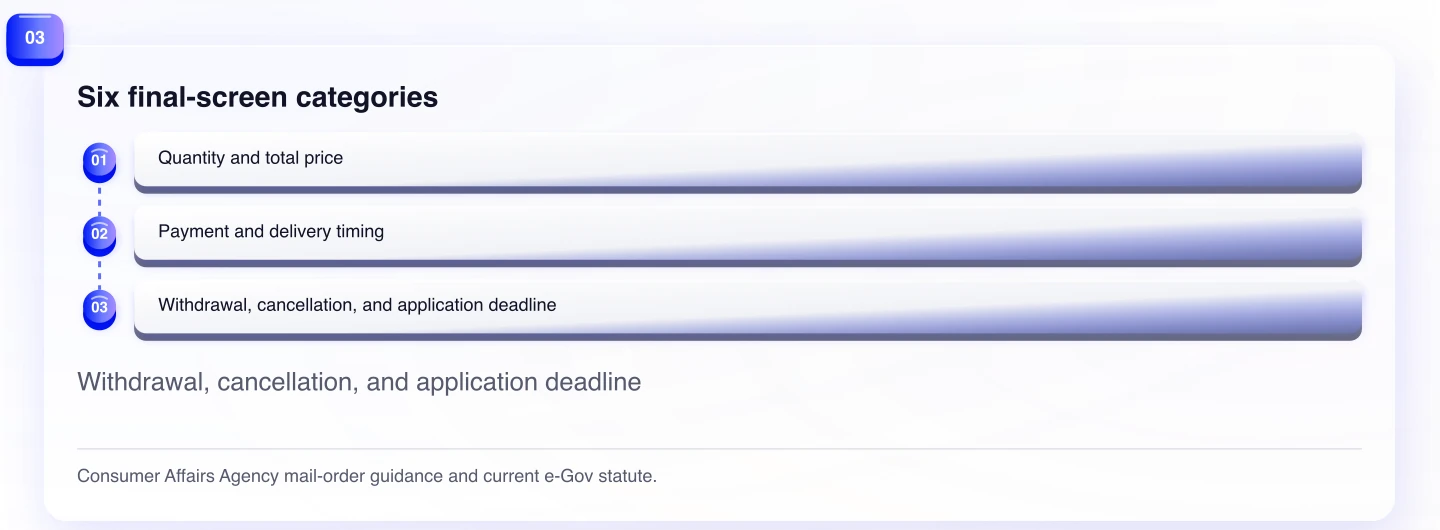
Returns cannot be evaluated in isolation from the other five. A customer deciding whether a return is worthwhile needs to understand the original price and extra charges. A subscription cancellation term depends on quantity and timing. A limited application window can affect whether the buyer believes there is time to reconsider.
For an international stack, the risk often sits between systems. The product page belongs to the commerce platform, tax and shipping totals arrive from services, the payment method opens a separate surface, and the order is recorded in another system. The final screen still has to present one coherent decision.
Test the six categories as a buyer would. Use the smallest supported screen. Increase text size. Select multiple variants. Add shipping and discounts. Choose a recurring offer if one exists. Verify that withdrawal or cancellation information remains intelligible before the action that completes the order.
Then preserve evidence from the production path. Record the policy version, locale, checkout version, order timestamp, and relevant rendered terms. Do so with privacy and security controls; the goal is evidence of the offer, not a new archive of unnecessary customer data.
The policy must survive delivery
Pre-checkout clarity determines the promise. Operations determines whether the promise can be kept.
Customer support needs a decision tree that distinguishes a preference return, a delivery problem, a product that does not conform to the contract, a cancellation before shipment, and a service or digital-product issue. Those paths may carry different rights, evidence, costs, and escalation.
The warehouse needs the same policy version. A team should know whether an item can be opened, which condition evidence is required, how return shipping is arranged, where the parcel goes, and when the refund begins. The customer should not discover an internal contradiction after paying to send the item back.
Finance needs the event model. “Return accepted” is not the same as “parcel received,” “inspection completed,” “refund instructed,” or “refund settled.” If support promises a date based on the wrong state, a legally careful policy can still create a poor customer experience.
The return reason also belongs in product learning. A high share of “not as expected” may point to photography, measurement, translation, or variant design. Returns are not only a cost to suppress. They are evidence about whether the pre-purchase representation was legible.
The objection: a better policy can exceed the floor
A strong objection is that legal minimums do not define good commerce. A merchant can offer a generous voluntary return policy, pay return shipping, extend the period, or simplify the procedure. Trust and conversion may improve when customers have more confidence in the purchase.
That is correct. Nothing in this analysis argues for the narrowest possible return. It argues for an intentional and operable promise. A generous policy that the warehouse cannot execute is not customer-friendly. A restrictive policy hidden until after purchase is not a reliable conversion strategy.
The official sources do not resolve a particular customer's dispute. They do not tell a merchant which voluntary return window will maximize contribution margin or repeat purchase. They set a legal and information-design context for the experiment.
Start with one product journey. Write the customer-facing rule in plain language: availability, period, condition, cost, method, exceptions, and refund timing. Have qualified counsel check the scope. Place the material term at the product offer and final confirmation. Capture the version attached to the order.
Then run four scenarios end to end: change of mind under the displayed term; no special term found; damaged or nonconforming goods; and cancellation before dispatch. Watch where support, warehouse, carrier, finance, and the customer disagree about state.
Measure return initiation, completion, contact rate, days to refund, reason, recovery value, and repeat purchase. Separate voluntary-policy outcomes from statutory or defect routes. Otherwise the business cannot tell whether a change improved trust or merely moved cost between teams.
Localization governance matters after launch. When headquarters changes a global return window or checkout component, Japan-specific terms and evidence can drift. Make return policy a release dependency: product, legal operations, support, and fulfillment approve the same version; automated checks confirm the required final-screen elements; and a production order verifies the evidence trail. A quarterly review is too late if every deploy can change the promise.
Marketplace sales need an explicit responsibility map. The marketplace may control the page, payment, or buyer messaging while the merchant controls fulfillment and inspection. Record who displays each material term, who stores the order-time version, who authorizes a return, and who sends the refund. The customer should not have to determine the contractual architecture in order to get an answer.
Use plain Japanese review, not translation review alone. A sentence can be grammatically correct and still make the availability, period, condition, or cost hard to find. Ask a reviewer to answer those four questions from the mobile offer and final screen without opening an internal policy. If the answers differ from operations, stop the release.
Japan's mail-order framework does not give online buyers a general cooling-off right. The practical conclusion is not “no returns.” It is that the seller must design the return promise before checkout, display it where the decision happens, preserve what was shown, and operate the same rule after delivery. Disclosure controls the starting point. The business still has to make the outcome work.
Evidence
Sources
- Mail-order advertising Q&AConsumer Affairs Agency
- Mail-order advertising dutiesConsumer Affairs Agency
- Guideline for displaying special return agreementsConsumer Affairs Agency
- Act on Specified Commercial Transactionse-Gov