Workplace Safety and Operations
Heatstroke prevention is now an escalation system.
By Japan Legible
- Published
- Last checked
- Reading time
- 9 minutes

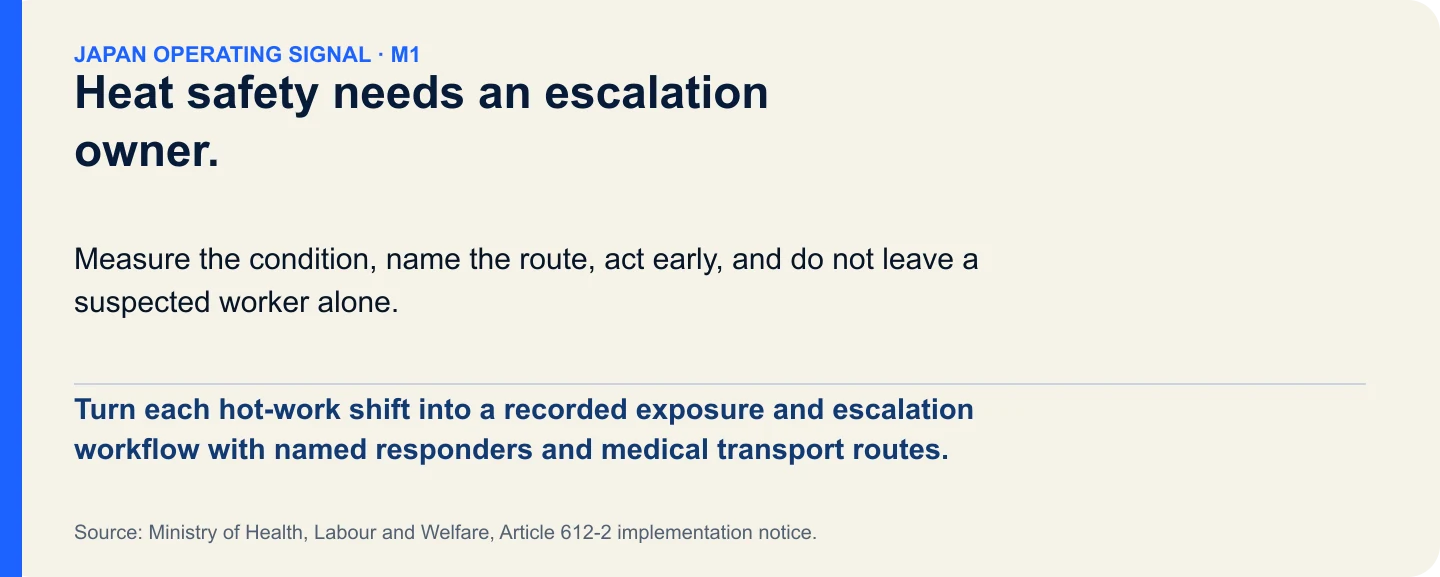
The operator decision is to convert workplace heat controls into a pre-arranged escalation system. Measuring temperature or handing out water is not enough. For work meeting the regulatory heat and duration thresholds, the employer must establish a reporting route, define steps to prevent deterioration, and communicate them before the work begins.
Japan's strengthened rule has applied since June 1, 2025. The Ministry of Health, Labour and Welfare's March 2026 guideline adds a broader prevention framework around that mandatory core.
The legal trigger combines heat and expected duration
MHLW's implementation notice explains the new Article 612-2 of the Industrial Safety and Health Regulations.
It applies to work expected to occur where either:
- the wet-bulb globe temperature, or WBGT, is at least 28°C; or
- the air temperature is at least 31°C;
and the work is expected to continue for at least one hour or exceed four hours in one day.
The inequalities matter. One hour is included. Four hours is expressed as "more than," not "four hours or more." Operators should preserve those distinctions rather than simplifying the rule into a general "28-degree limit."
WBGT is an index that incorporates not only air temperature but also humidity, wind, and radiant heat. A weather forecast or nearby public reading may support planning, but the worksite needs a method appropriate to its actual conditions.
The trigger is based on expected work. The company should therefore assess the day and task before exposure, not wait until a worker becomes ill.
The first mandatory control is a reporting route
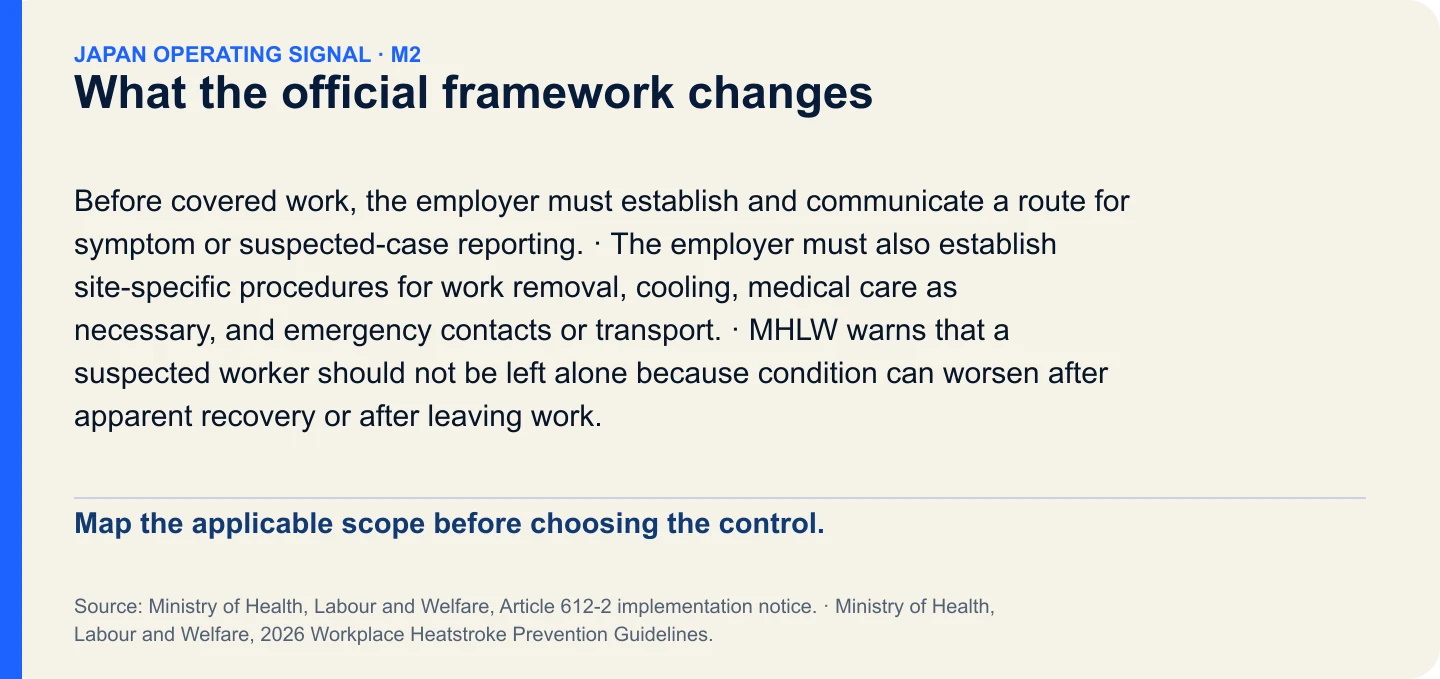
Before qualifying work begins, the employer must establish a system through which a worker with heatstroke symptoms, or another person who observes suspected symptoms, can report the situation.
MHLW says the system includes identifying the responsible recipient, the contact method, and the ability to receive reports while the work is underway. Communication can use posting, email, written material, or oral instruction such as a morning briefing. More than one method may be necessary where oral communication alone is unreliable or some workers do not attend the briefing.
A telephone number on a wall is not enough if nobody is monitoring it. The operating design should identify a primary responder, substitute, communication channel, and coverage period. Contractors, temporary staff, and workers outside the ordinary briefing need to know the same route where relevant.
MHLW also recommends active detection. Examples include supervisor patrols, a buddy system, regular two-way contact, and wearable devices. The ministry cautions that a wearable may not accurately identify a person's condition and should be combined with other methods.
The second mandatory control is an action procedure
The employer must also determine, in advance and for each worksite, the actions and procedure needed to prevent symptoms from worsening. MHLW identifies removal from work, body cooling, medical examination or treatment as necessary, and emergency contacts and transport information.
The procedure should be operational. It needs to answer:
- who stops the work;
- where the worker is moved;
- what cooling equipment is available;
- who observes the worker;
- when medical advice is sought;
- who calls emergency services;
- which medical facility or transport route is used; and
- how the employer follows up after apparent recovery.
MHLW warns that a suspected worker should not be left alone because the condition can change suddenly. Cooling examples include removing work clothing, applying water, using an ice bath, moving to a sufficiently cool rest area, using a mist fan, or providing an ice slurry where appropriate.
The ministry also warns that symptoms may worsen after time has passed, including after the worker returns home. The process should not define "able to speak" or "feels better" as automatic clearance. It should include cautious recovery assessment and instructions for later deterioration.
The system must exist before the workday
MHLW says the reporting system and procedure must be prepared by the start of a day when qualifying work is expected. Where the same workers perform the work continuously over a period and the system has already been established and communicated, the employer does not need to repeat the entire measure every day.
That flexibility should not remove the daily operational check. Roles, contact details, work location, medical destination, and heat conditions can change. A short pre-shift confirmation can verify that the existing system remains usable without pretending to recreate it.
The rule does not require retention of a record proving every communication at the worksite. MHLW nevertheless notes that the employer must respond appropriately if a labor standards inspection asks how the requirement was met. A light record of briefing, posting, and responder assignment is therefore sensible evidence.
The 2026 guideline adds prevention around escalation
MHLW adopted the Workplace Heatstroke Prevention Guidelines on March 18, 2026. The related notice replaced the 2021 basic prevention outline.
The guideline is broader than Article 612-2. It covers management responsibilities, work planning, WBGT measurement and evaluation, heat acclimatization, rest, work reduction or stoppage, cooling facilities, hydration and salt, clothing, health checks, patrols, education, and emergency response.
It gives particular attention to new workers and people returning after an absence because insufficient acclimatization can increase risk. It calls for pre-shift checks of health and acclimatization and for work plans to consider adequate rest and work-stoppage arrangements based on WBGT.
The guideline also recognizes that industries and worksites face different constraints. MHLW's adoption notice says a single uniform control package would be inappropriate and that businesses should choose suitable measures from multiple options according to their work.
This distinction matters. The reporting route and deterioration-prevention procedure are mandatory for work meeting the trigger. The broader guideline informs prevention and official expectations, but not every recommended option has the same legal status.
Health information requires a careful process
The 2026 Cool Work Campaign highlights special consideration for people with conditions such as diabetes or high blood pressure, informed by medical opinion. It also emphasizes WBGT-based controls, early-detection systems, procedures, and communication.
An employer should not turn that instruction into informal diagnosis by a supervisor or unrestricted sharing of medical information. Occupational-health and privacy processes should identify necessary work accommodations while limiting access to sensitive details.
The daily check can focus on fitness for the planned work, recent absence, sleep, illness, or medication concerns through an appropriate health channel. The response may include modified work, more frequent rest, closer observation, or medical advice.
The 2025 statistics support urgency but need careful wording
MHLW's preliminary December-end figures for 2025 record 1,681 workplace heatstroke deaths or injuries involving at least four lost workdays, including 15 deaths. The total case count rose by about 41 percent from the prior year, while deaths fell by half.
These figures do not show that every case involved noncompliance, and they do not prove that the June 2025 rule caused the reduction in deaths. They are preliminary, not final statistics. They do show that severe occupational heat illness remained widespread after the strengthened rule took effect.
MHLW's 2026 campaign runs from May through September. It uses the new guideline to reinforce preparation before peak heat and implementation throughout the season.
Counterargument: WBGT 28°C is not an automatic shutdown rule
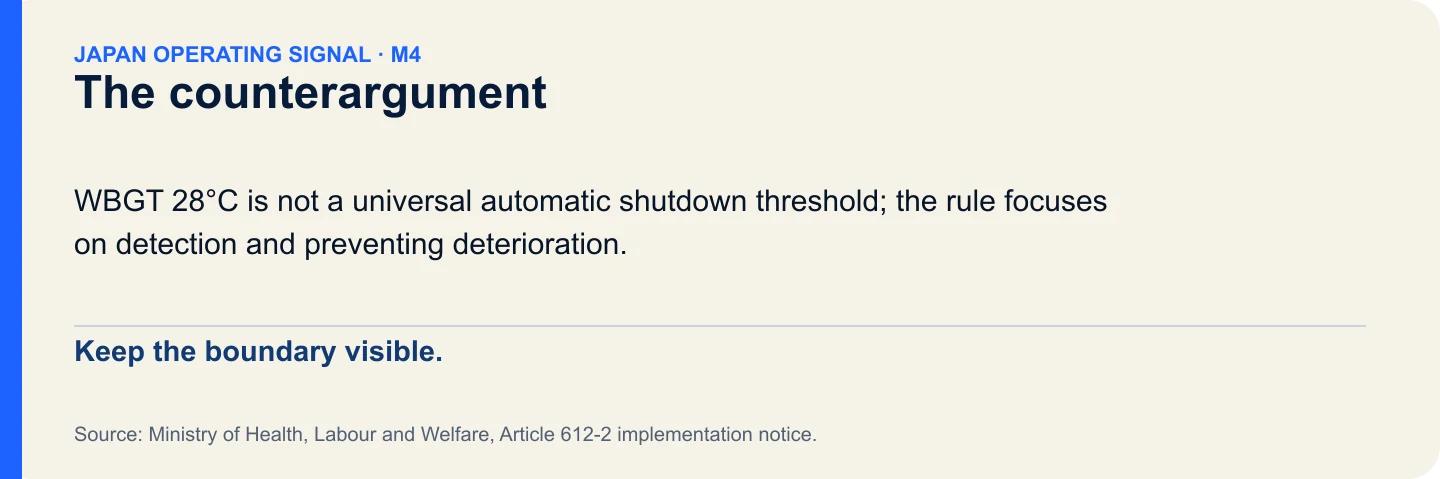
The strongest counterargument is that the regulatory threshold is often described too broadly. Article 612-2 does not say all work must stop whenever WBGT reaches 28°C. The heat or temperature condition must combine with expected duration, and the specific mandatory measures concern reporting, communication, and deterioration prevention.
That correction is important. It prevents an inaccurate legal claim and lets the operator design proportionate controls.
It does not mean work should always continue below a separate, higher number. The 2026 guideline calls for WBGT evaluation, rest, work reduction, and stoppage planning based on the task, clothing, facilities, worker condition, and controls. A site may decide to stop earlier than the regulation's reporting-system trigger requires.
Unknowns and source limitation
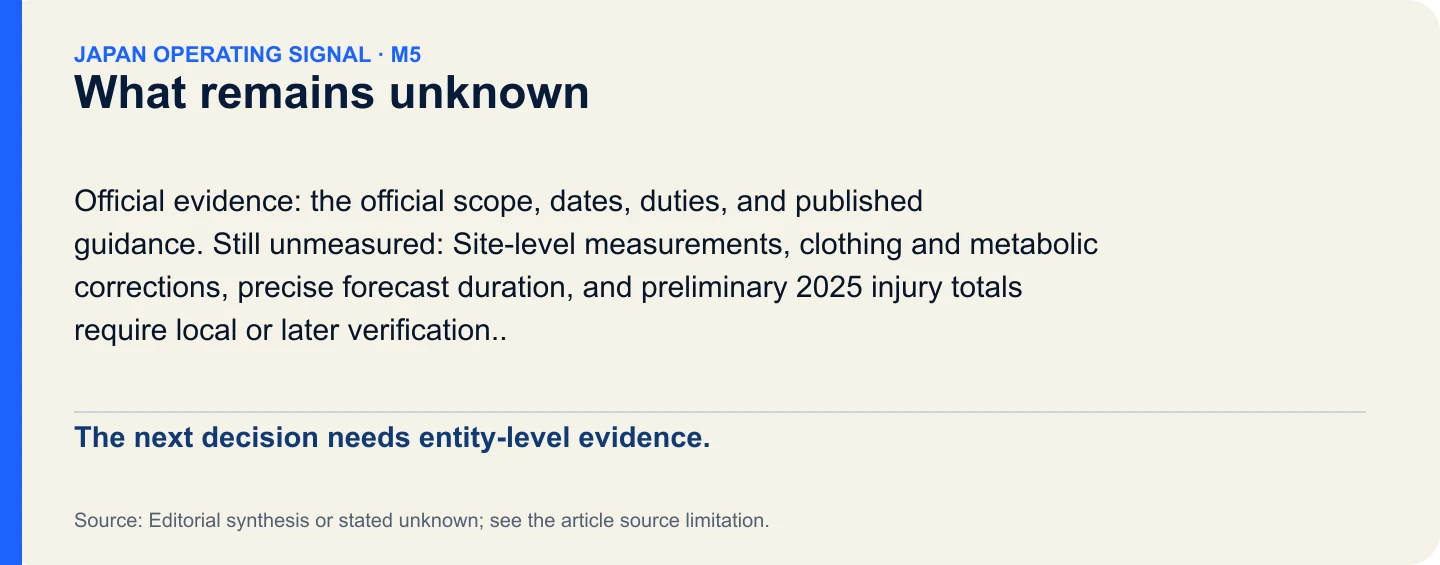
Actual risk depends on workload, radiant heat, airflow, humidity, protective clothing, acclimatization, health, and the reliability of measurement. The national materials cannot determine the safe plan for every site.
The 2025 injury statistics are preliminary. Site-level measurements, clothing and metabolic corrections, and the precise forecast duration require local verification. They should not be inferred from a national campaign page alone.
The official sources explain the national rule and guideline. Industry-specific requirements, collective arrangements, local emergency capacity, and site conditions may add constraints.
Legal and program-scope caution
Do not describe WBGT 28°C as a universal legal shutdown threshold. Do not present every 2026 guideline recommendation as a newly mandatory regulation. A wearable device alone should not be represented as satisfying detection, and a worker who temporarily improves should not be assumed safe to leave unobserved.
Practical operator decision
For every heat-exposed shift, run one pre-work control:
- measure or reliably assess WBGT and air temperature;
- classify expected exposure duration;
- confirm worker health and acclimatization;
- name the report recipient and substitute;
- verify cooling, rest, and communication equipment;
- identify medical and transport contacts;
- state the pause, removal, and escalation actions; and
- preserve a brief record that the system was communicated.
During work, use patrols, buddies, or regular contact rather than waiting for self-report alone. If symptoms are suspected, remove the worker, begin cooling, keep the person observed, and escalate without hesitation where the condition is uncertain or worsening.
The central control is not a poster or a single sensor reading. It is a live route from detection to action, with a responsible person and a decision that can be executed immediately.
Evidence
Sources
- Article 612-2 implementation noticeMinistry of Health, Labour and Welfare · May 20, 2025
- 2026 Workplace Heatstroke Prevention GuidelinesMinistry of Health, Labour and Welfare · March 18, 2026
- 2026 Cool Work CampaignMinistry of Health, Labour and Welfare · March 19, 2026
- Guideline adoption noticeMinistry of Health, Labour and Welfare · March 18, 2026