Capital Markets and Communications
English disclosure is now part of Prime Market timing.
By Japan Legible
- Published
- Last checked
- Reading time
- 9 minutes

The operator decision is to put English preparation inside the disclosure process, before the Japanese release is final. For a domestic company listed on the Prime Market, English disclosure of financial-results information and timely-disclosure information has been mandatory since April 2025 and simultaneous in principle. A translation queue that begins after Japanese approval no longer matches the operating requirement.
The rule does not demand a full English copy of every corporate document. It does demand a reliable way to identify mandatory material, produce an adequate English version, approve both versions, and release them through TDnet without slowing the Japanese disclosure.
The mandatory scope is specific but consequential
The Tokyo Stock Exchange rule amendment took effect on April 1, 2025. It applies to domestic issuers listed on the Prime Market and covers financial-results information and timely-disclosure information.
For financial results, TSE's official guidance includes earnings reports, quarterly earnings reports, and supplementary explanatory materials prepared to communicate the results to investors. The English obligation can be met with part or a summary of the Japanese disclosure. The rules do not require every document and every line to be translated.
For timely disclosure, the practical control starts with the information the company has decided to release through TDnet. The disclosure team should decide at intake whether an item is:
- mandatory financial-results information;
- mandatory timely-disclosure information;
- other corporate information for which simultaneous English is encouraged; or
- ordinary public-relations material outside the mandatory English rule.
The classification should happen before drafting begins. Otherwise, translation becomes a late surprise rather than part of the release plan.
Simultaneous means a common production clock
JPX's TDnet English disclosure page states that covered English material must be disclosed through TDnet simultaneously with the Japanese material. No separate enrollment or extra TDnet use fee is required.
The practical meaning is not that two completed documents happen to be uploaded together. It is that the underlying facts, figures, and approval decisions move through a coordinated bilingual workflow.
A workable release calendar identifies:
- when the factual content is stable enough for translation;
- which sections can use approved standard language;
- when numerical updates are frozen;
- who resolves differences between the versions;
- what constitutes the minimum adequate English package;
- who has TDnet authority; and
- what happens if the Japanese content changes immediately before release.
The final question is especially important. A late Japanese change can leave an apparently polished English version substantively wrong. The release gate should require a last comparison of material facts, numbers, dates, party names, and decision language.
English work should not delay Japanese disclosure
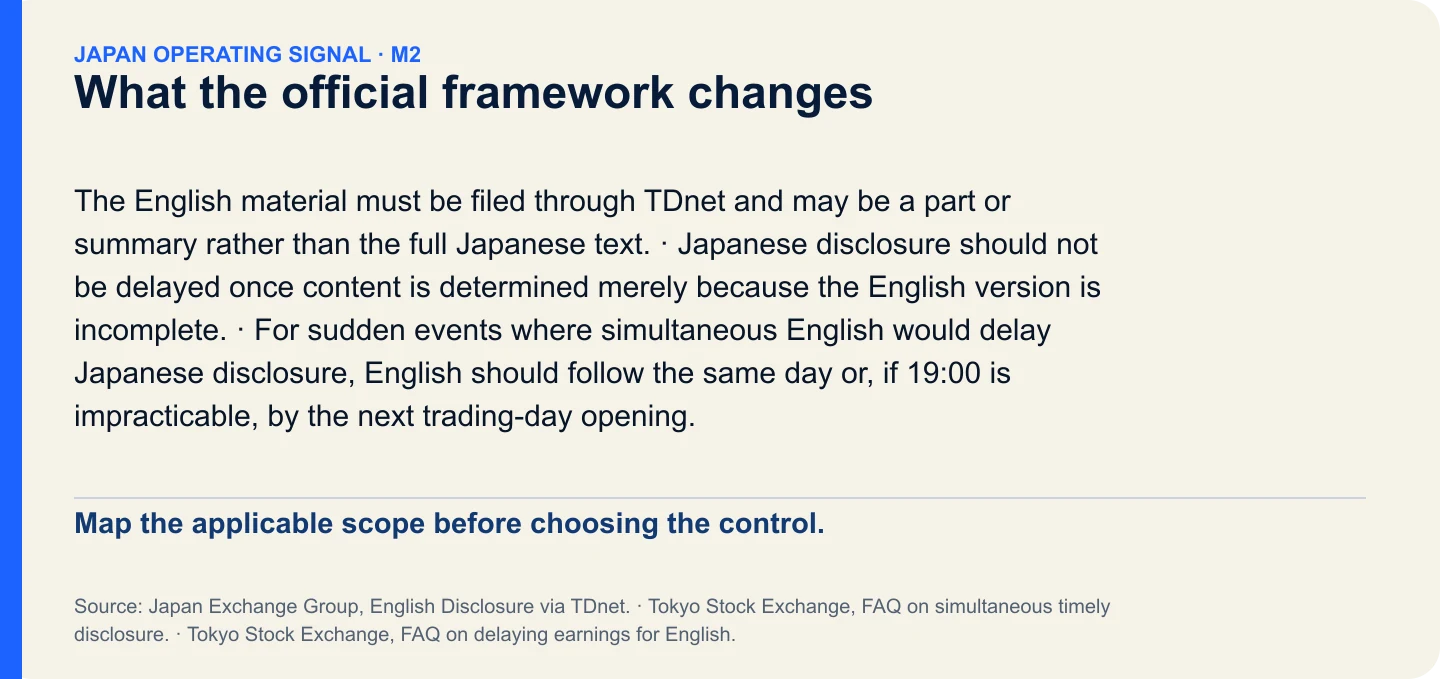
TSE's earnings-timing FAQ states that financial results must be disclosed immediately once their content is determined. TSE also records investor concern that English preparation could delay Japanese disclosure. Its guidance is to redesign the process so that the announcement date is not pushed back.
This is why the rule changes timing governance rather than merely translation capacity. The company may need earlier drafting, bilingual board materials, pre-approved terminology, translation memory, parallel review, and a smaller simultaneous English package.
If full translation cannot be completed, TSE permits an English part or summary. For example, the company can release summary information and financial statements in English at the same time, then consider adding other English material later. The rule does not always require a later full translation.
That flexibility should be designed in advance. A rushed team should not decide at the release deadline what can be omitted. The company can create content-specific minimum packages that preserve the central facts an overseas investor needs to understand the event.
The urgent-event exception is narrow and speed-preserving
TSE recognizes that some events arise suddenly or remain under negotiation until immediately before disclosure. Its updated simultaneous-disclosure FAQ says simultaneous English is not required where preparing it would delay Japanese disclosure in those circumstances.
The instruction remains fast. Japanese disclosure comes first, and English should follow on the same day. If English cannot be filed by the ordinary 19:00 nighttime limit, TSE says it should be disclosed by the next trading-day opening at 09:00. The English version may still be a part or summary.
This is an escalation route, not a routine translation service level. The company should record why the exception applied, who authorized Japanese-first release, the English delivery owner, and the filing deadline. Repeated use for predictable events would indicate a process problem.
The workflow should also keep the Japanese disclosure moving. "We are waiting for translation" is not an acceptable reason to hold material information whose Japanese content has already been determined.
The transition period is over
The rules included a limited transition for eligible domestic Prime issuers already listed before the effective date. Companies that filed the prescribed notice could receive application deferral until April 1, 2026.
That was not an indefinite exemption. The TSE material states that covered deferred companies became subject uniformly from April 1, 2026. As of August 2026, a current operating model should not treat that transition as available.
The ended transition also changes benchmarking. A company can no longer justify a delayed implementation plan merely because some peers previously had an extra year. The relevant question is whether its current release controls can satisfy the rule now.
Summary translation still needs substantive control
Permission to publish an English summary reduces production burden, but it creates a selection risk. A summary can be grammatically correct and still omit the fact that changes an investor's understanding.
TSE says that where a single Japanese document contains multiple disclosure items, the English material must also cover those items; an issuer cannot simply translate the easiest one. A company should therefore define adequacy by investor significance, not by word count.
A review checklist can ask whether the English package includes:
- the event or decision;
- the affected party, asset, or business;
- the key amount and period;
- the expected financial effect, if stated in Japanese;
- material conditions and uncertainty;
- effective dates and next steps; and
- a clear link to the Japanese source where appropriate.
If the English material contains an error, correction analysis should be performed in English as well. A process that corrects only the Japanese version can leave overseas investors relying on information the issuer already knows is wrong.
Tools do not change accountability
Templates, translation memory, external specialists, and machine assistance can reduce latency, especially for recurring language. They do not transfer responsibility for the filed content.
High-risk terms include transaction status, conditions precedent, forecast direction, accounting treatment, legal effect, and negative qualifiers. These should be controlled through an approved glossary and human review proportionate to the disclosure.
The aim is not literary equivalence. It is accurate, timely, and decision-useful communication. The team should reserve its most intensive review for passages where a small wording change can reverse meaning or alter the investor's understanding of timing and uncertainty.
Counterargument: the rule is not "translate everything"
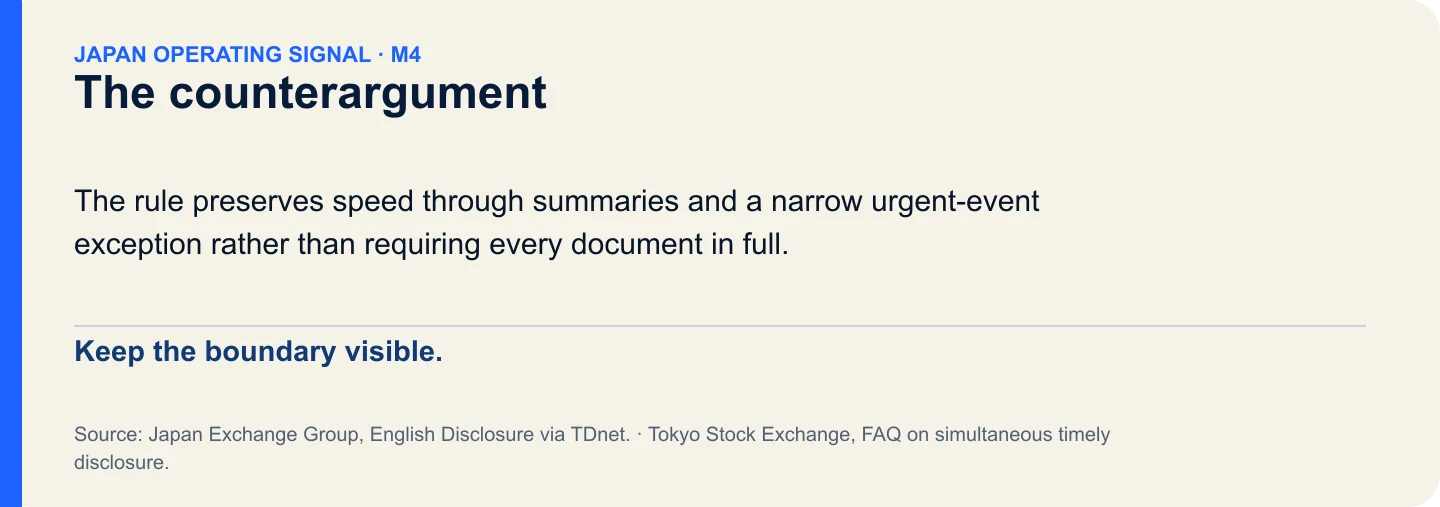
The strongest counterargument is that many descriptions of the requirement overstate it. Prime issuers are not required to publish a full simultaneous English version of every Japanese investor-relations or corporate document. The mandatory rule focuses on financial-results and timely-disclosure information, permits part or summary disclosure, and includes a narrow exception where simultaneous English would delay an urgent Japanese release.
That counterargument should shape the control design. A company does not need an unlimited translation operation. It needs accurate classification, reusable content, a minimum simultaneous package, and a disciplined exception route.
The flexibility does not support a translation-after-release default. It is intended to preserve timely disclosure while making material information available to overseas investors.
Unknowns and source limitation
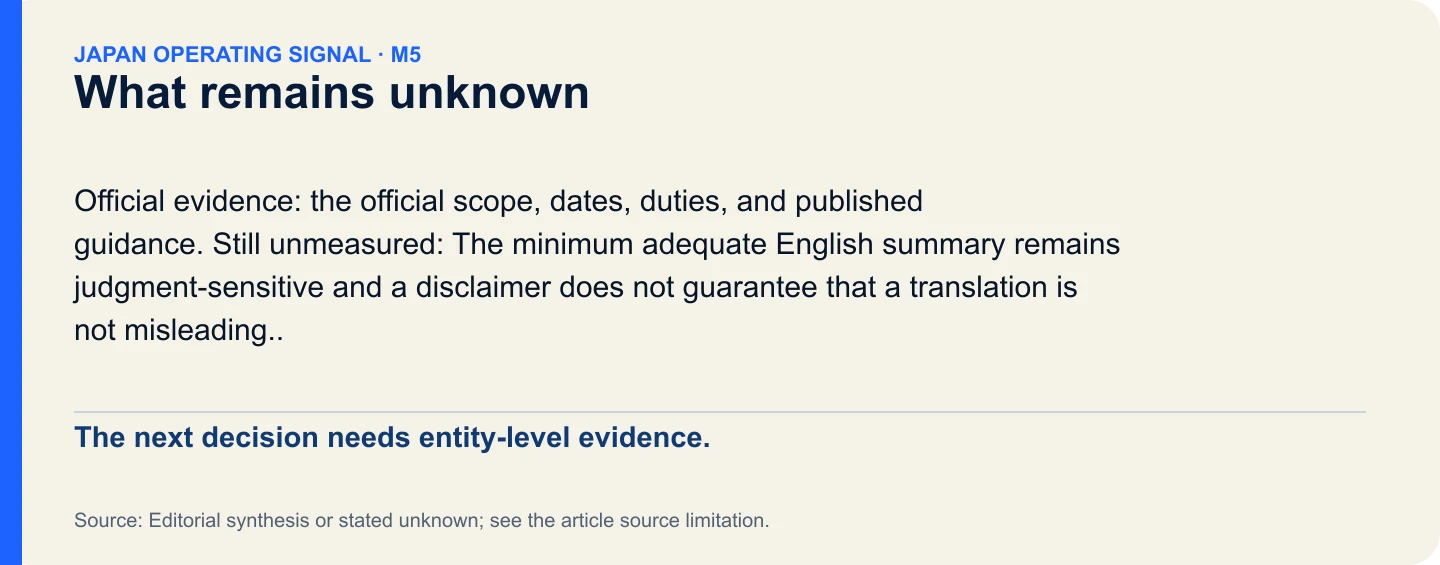
The rules do not prescribe one universally adequate summary. The appropriate content depends on the event, the Japanese material, and what is necessary for investor understanding. Difficult cases may require consultation with TSE.
The official sources explain the listing-rule requirement and operational FAQs. They do not establish that a particular translation, disclaimer, or internal approval process will be sufficient in every case. They also do not replace securities-law analysis outside the TSE framework.
JPX content is proprietary under its site terms, rather than published under a government open-data license. Operators should link to the official material and avoid unnecessary reproduction.
Legal and program-scope caution
This is a TSE listing-rule obligation for domestic Prime Market issuers, not a statement that every Japanese company must translate every disclosure. Statutory disclosure, corporate law, and other market rules may create separate duties. An urgent-event exception should not be treated as permission for multi-day delay.
Practical operator decision
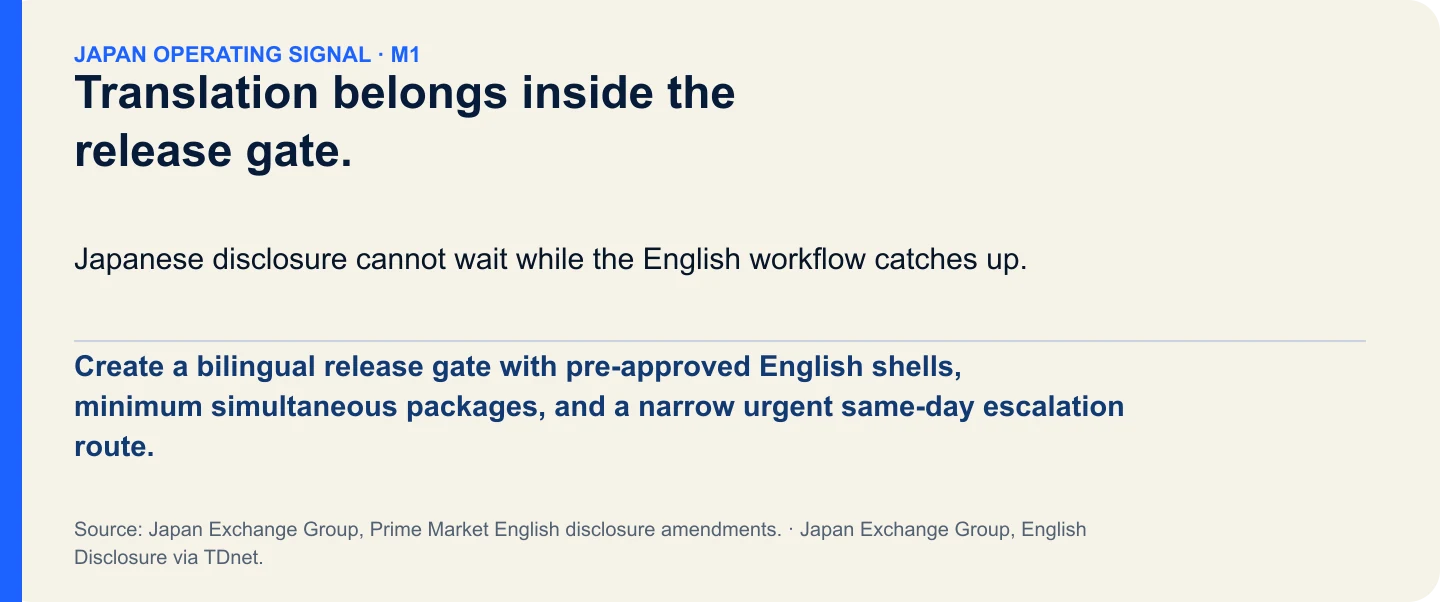
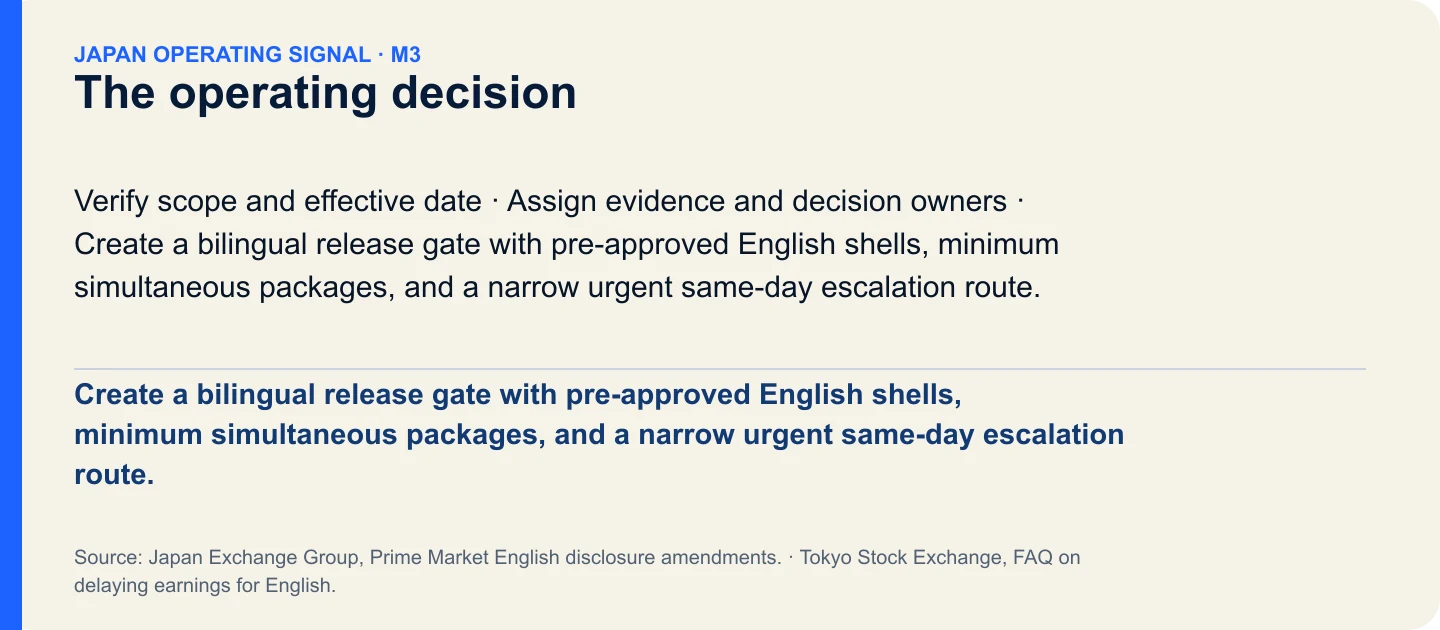
Create a bilingual release gate with five elements: early scope classification, pre-approved English shells, a defined minimum simultaneous package, joint factual approval, and a narrow urgent same-day escalation path.
Measure the process from content determination to both TDnet filings. Track late Japanese changes, translation defects, urgent exceptions, and English corrections. Those indicators reveal whether English is genuinely part of disclosure timing or remains an after-the-fact service.
The objective is not to make every document identical. It is to ensure that language does not determine when investors receive material information.
Evidence
Sources
- Prime Market English disclosure amendmentsJapan Exchange Group · April 1, 2025
- English Disclosure via TDnetJapan Exchange Group
- FAQ on simultaneous timely disclosureTokyo Stock Exchange · October 3, 2025
- FAQ on delaying earnings for EnglishTokyo Stock Exchange · October 7, 2024