Products and Regulation
Circular design is becoming a product system.
By Japan Legible
- Published
- Last checked
- Reading time
- 9 minutes

Japan issued its first certifications for especially advanced plastic product designs on 10 February 2026. Forty-one designs were certified across stationery, PET beverage bottles, household detergent containers, and household cosmetic containers after criteria for those four fields took effect on 25 January. The signal for an overseas product team is not that every package now needs the mark. It is that circularity is becoming a documented product decision.
A sustainability page can describe ambition. A product system has to connect material choice, weight, durability, refill or reuse, separation, collection, recycled content, manufacturing evidence, and the information made public. The new certifications make that distinction visible.
This article is operational guidance, not legal, environmental, or certification advice. Product coverage and eligibility must be checked against current Japanese law, field-specific criteria, and responsible authorities.
The familiar plan starts with the claim
Many overseas launches begin circularity work in communications. The global package already exists. The Japan team translates recycling language, changes a symbol, and prepares a claim about less plastic or better materials. That work matters, but it starts after most environmental outcomes have been fixed.
The February 2026 METI announcement begins earlier. Under the Plastic Resource Circulation Act, Japan has a system through which ministers can certify especially advanced designs for plastic-using products. For the four fields covered by the first certifications, an applicant has to conduct an overall evaluation, publish relevant information, and satisfy the applicable design-certification criteria.
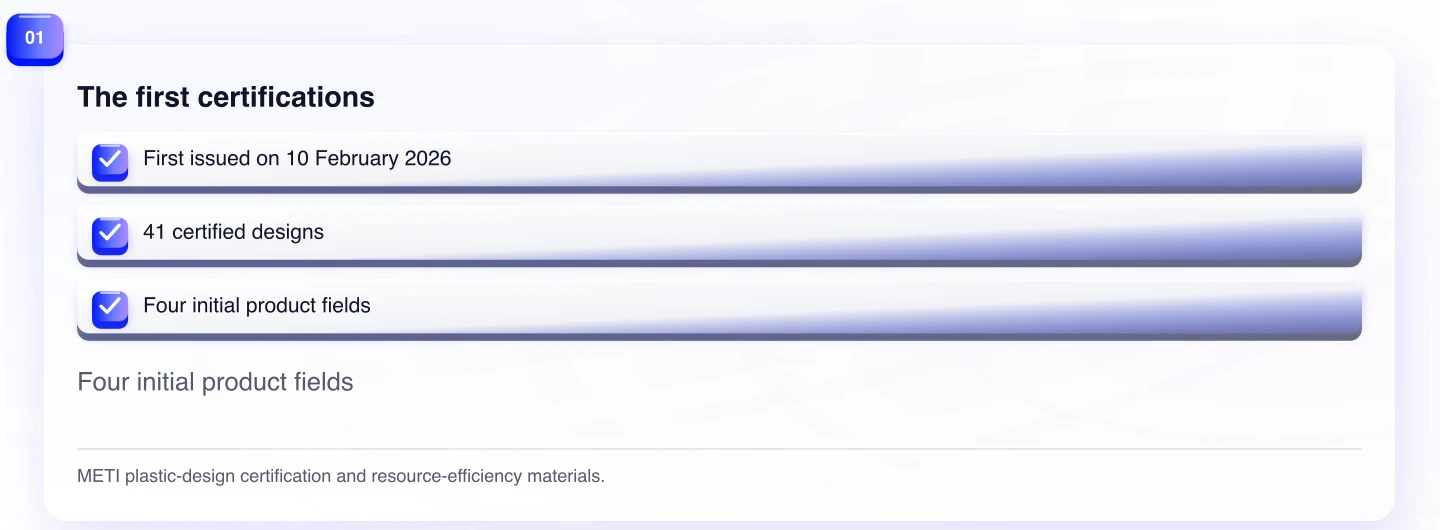
Certification is therefore not created by one marketing sentence. It depends on a product design being evaluated against a field-specific framework and supported by information. The first group included 41 designs, demonstrating that the scheme had moved from abstract policy to actual products.
Four categories are a boundary, not a universal rule
The criteria effective on 25 January 2026 concerned stationery, PET beverage containers, household detergent containers, and household cosmetic containers. The certifications announced on 10 February were the first under those criteria.
This boundary matters. A foreign brand should not infer that every plastic product is currently eligible, that every product in those sectors is certified, or that certification is a universal condition for sale. A field, product, and design have to meet the current framework.
The correct first action is classification. Identify each Japanese SKU, its package and components, product field, materials, manufacturing route, and intended environmental claims. Then verify which statutory design rules, recycling marks, container obligations, voluntary standards, or certification paths actually apply. Do not let a general corporate goal choose the legal category.
Circularity is a sequence of design decisions
METI's policy materials describe a broader direction in which the product life cycle is connected from design and manufacture through sale and use to collection and recycling. The 2025 amendments to the Act on the Promotion of Effective Utilization of Resources were intended to strengthen a circular-economy foundation, including environmentally considerate design, use of recycled resources for designated products, and easier collection and recycling under specified conditions.
The exact duties depend on later designations, thresholds, orders, and detailed rules. The operating implication can still be stated safely: a product team should be able to explain how an early design choice affects the later system.
A darker pigment may complicate sorting. A permanent bond can prevent separation. A refill concept can reduce material per use but add reverse-logistics and hygiene requirements. A thinner wall can reduce material while affecting durability. Recycled content can change appearance or manufacturing control. None of these trade-offs can be resolved by the marketing team alone.
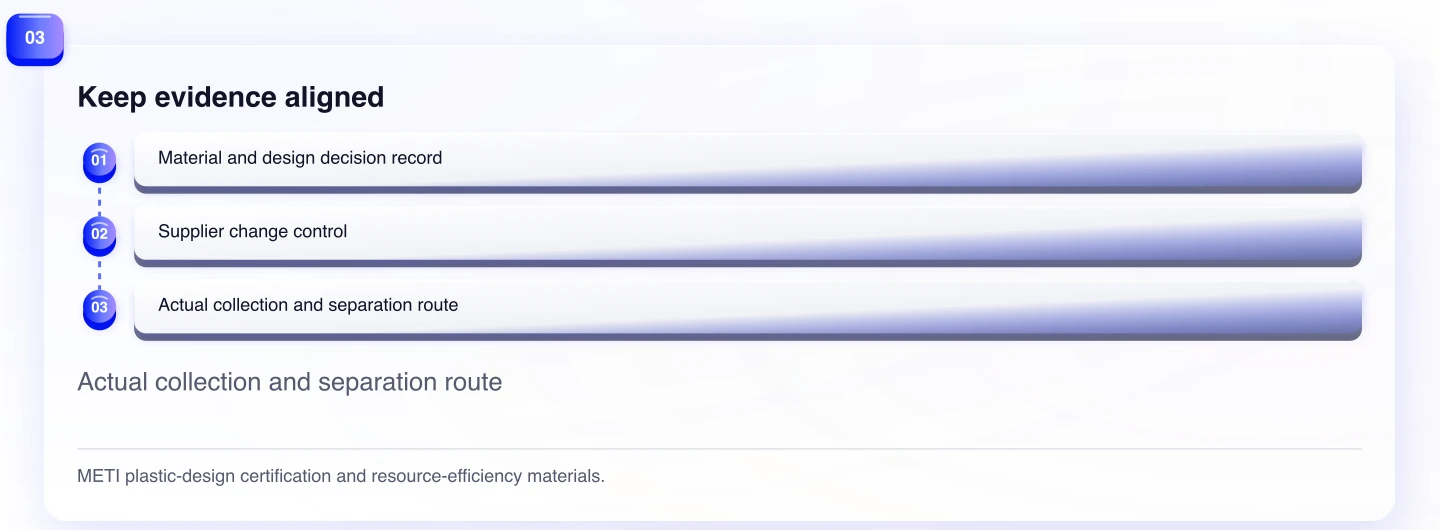
Create a decision record for each material change. Capture the intended benefit, baseline, unit of comparison, product performance, manufacturing tolerance, customer use, separation and collection route, evidence, owner, and claim that may eventually be made. Where a trade-off cannot be measured, mark it as unknown rather than converting it into a broad green promise.
Evidence has to survive the supply chain
An overseas brand may own the design while outsourcing resin, packaging conversion, filling, assembly, and distribution. Each supplier holds part of the evidence. If the Japan team needs to substantiate a material composition or design feature, a final artwork file will not be enough.
The evidence chain can include bills of material, resin specifications, supplier declarations, mass calculations, change-control records, test results, and public information. The exact set depends on the product and claim. The important control is version alignment: the evidence must describe the design and production run actually sold in Japan.
Procurement therefore belongs in circular design. A supplier substitution can change recycled content, color, adhesives, or separability. A cost-down change can weaken the original rationale. Contract terms should require notification of changes that affect the circularity record, and product data should make the current approved specification visible to marketing and compliance teams.
The same control should reach artwork and commerce. A claim approved for one package version should not survive automatically when the bottle, cap, label, refill ratio, or supplier changes. Give every approved statement a product version, market, evidence link, reviewer, and review date. If the evidence expires or the design changes, the claim should return to review before the new inventory reaches a Japanese channel.
A recovery claim needs a recovery route
Design for recycling is not the same as recycling in practice. A product may be technically separable but reach a waste stream that does not separate it. A package can carry a material claim while the local collection route differs by municipality or product category. A take-back program can exist on a page while remaining inaccessible to most customers.
The operator should trace the end-of-use journey as carefully as the purchase journey. What does the customer need to do? Which components must be separated? Where can they be returned or collected? Who receives them? What evidence shows the material is recovered as described? Which geographic or volume limits make the claim less general than it first appears?
Do not promise a circular loop when the team has only designed the first half. A precise claim such as reduced virgin material per package or a field-specific certification can be more credible than an unlimited statement about circularity.
Customer instructions are part of that precision. A technically separable package is less useful if the separation step is invisible, difficult, or inconsistent with local collection. Test the instruction with the actual product in hand and state geographic limits when the route is not nationally uniform.
The objection: certification is not the whole environmental result
There is an important counterargument. Certification can provide a structured signal, but it cannot by itself prove the total environmental superiority of a product in every use. Material reduction, durability, transport, refill behavior, recycling yield, and energy can pull in different directions. A certified design can also be used in a market where recovery rates differ.
That objection is correct. The February announcement says the designs met the applicable certification criteria and describes policy support for certified products. It does not turn the certification into a complete life-cycle comparison with every alternative.
The right conclusion is not to dismiss the mark. It is to place it in an evidence hierarchy. State exactly what was certified, under which field and criteria, for which design version and date. Keep broader environmental claims separate unless they have their own substantiation.
What remains unknown
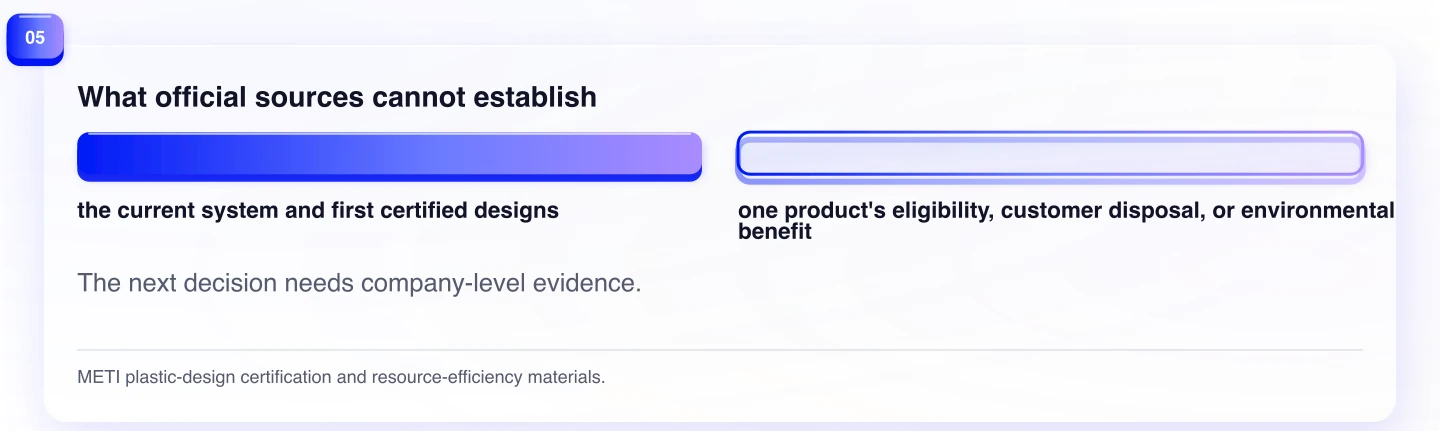
The official announcement does not tell a foreign entrant whether its specific product qualifies, how customers will use or dispose of it, whether a supplier can maintain the design at scale, or what a material change does to cost and performance. It cannot establish the environmental benefit of a hypothetical Japan variant.
Those questions require product-specific work. Select one high-volume SKU and build a life-cycle operating map. List every material and joining method. Record weight and source. Test separation. Identify the applicable Japanese collection path. Trace supplier evidence. Compare the current design with one credible alternative using the same functional unit.
Then hold a review with design, procurement, manufacturing, Japan operations, compliance, and marketing. Approve only claims that the evidence supports. Assign unresolved trade-offs to an owner and a decision date.
Japan's first 41 certifications do not make circular design simple or universal. They make the product-system nature of it harder to avoid. The company that begins with a slogan will discover constraints late. The company that begins with classification, specifications, evidence, and the recovery route can decide what to claim after it has built something it can explain.
Evidence
Sources
- First certifications under the plastic design-certification systemMinistry of Economy, Trade and Industry · February 10, 2026
- Cabinet decision on amendments to the Resource Efficiency ActMinistry of Economy, Trade and Industry · February 25, 2025
- Outline of resource-efficiency and decarbonization design guidelinesMinistry of Economy, Trade and Industry · October 1, 2025