Work and Procurement
A freelancer contract needs an operating clock.
By Japan Legible
- Published
- Last checked
- Reading time
- 9 minutes

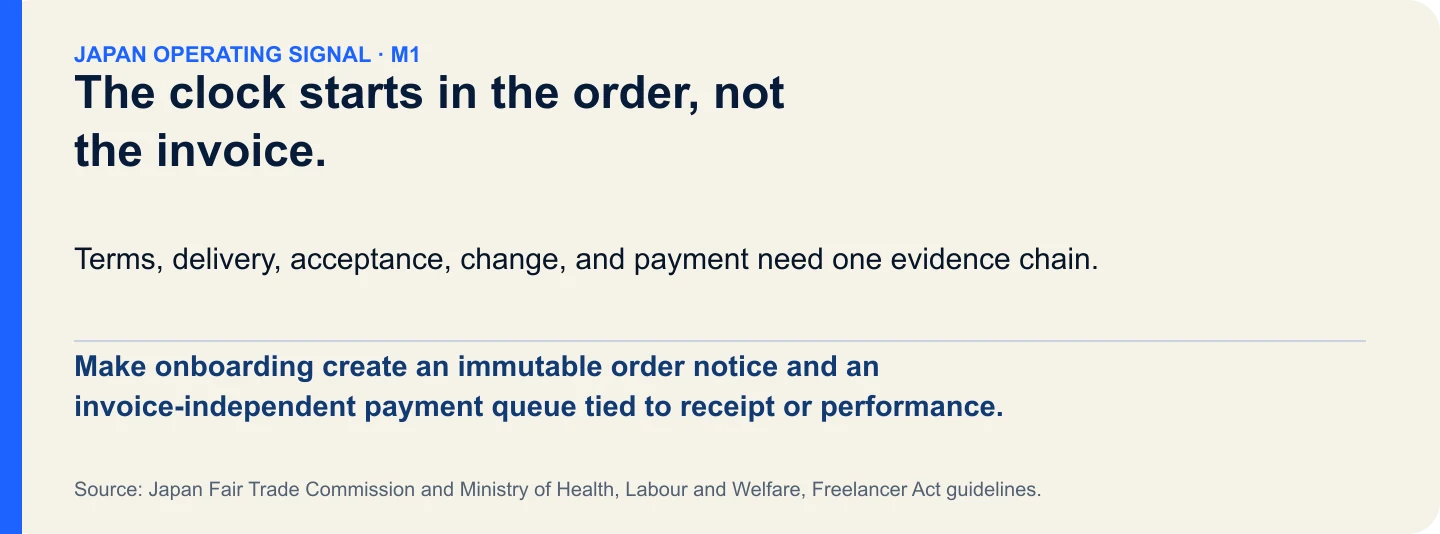
The operating decision is to start freelancer compliance when the work is commissioned, not when an invoice arrives. Japan's Freelancer Act requires transaction terms to be communicated immediately and, for covered commissioning businesses, starts the payment clock from receipt of the deliverable or provision of the service. A signed master agreement can support the process, but it does not by itself control order-level facts, acceptance dates, and payment deadlines.
The Freelancer Act took effect on November 1, 2024. Its transaction rules are now backed by visible enforcement. In fiscal 2025, the Japan Fair Trade Commission reported that disclosure and payment failures dominated the measures it took.
Classification comes before the contract form
The Act uses statutory categories, including specified entrusted business operators and specified entrusted business workers. A party's commercial label is not conclusive. Calling someone a consultant, creator, sole proprietor, or independent contractor does not establish whether the Act applies.
The first control is therefore a classification check. It should record whether the supplier is an individual or qualifying one-person entity, whether it uses employees, who is commissioning the work, and which obligations attach to the transaction duration and the commissioning party's organization.
The check should be proportionate. JFTC says there is no single legally mandated way to verify freelancer status. It also recommends a method that leaves a record without creating excessive burden, such as email or a platform message.
Classification cannot be a one-time permanent flag. A contractor may hire staff, incorporate differently, or change how services are provided. The operating model needs a periodic or event-driven refresh.
Required terms must be sent immediately
JFTC's Freelancer Act special site states that when work is commissioned to a covered freelancer, the transaction terms must be disclosed immediately in writing or electronically. Oral communication alone is not sufficient.
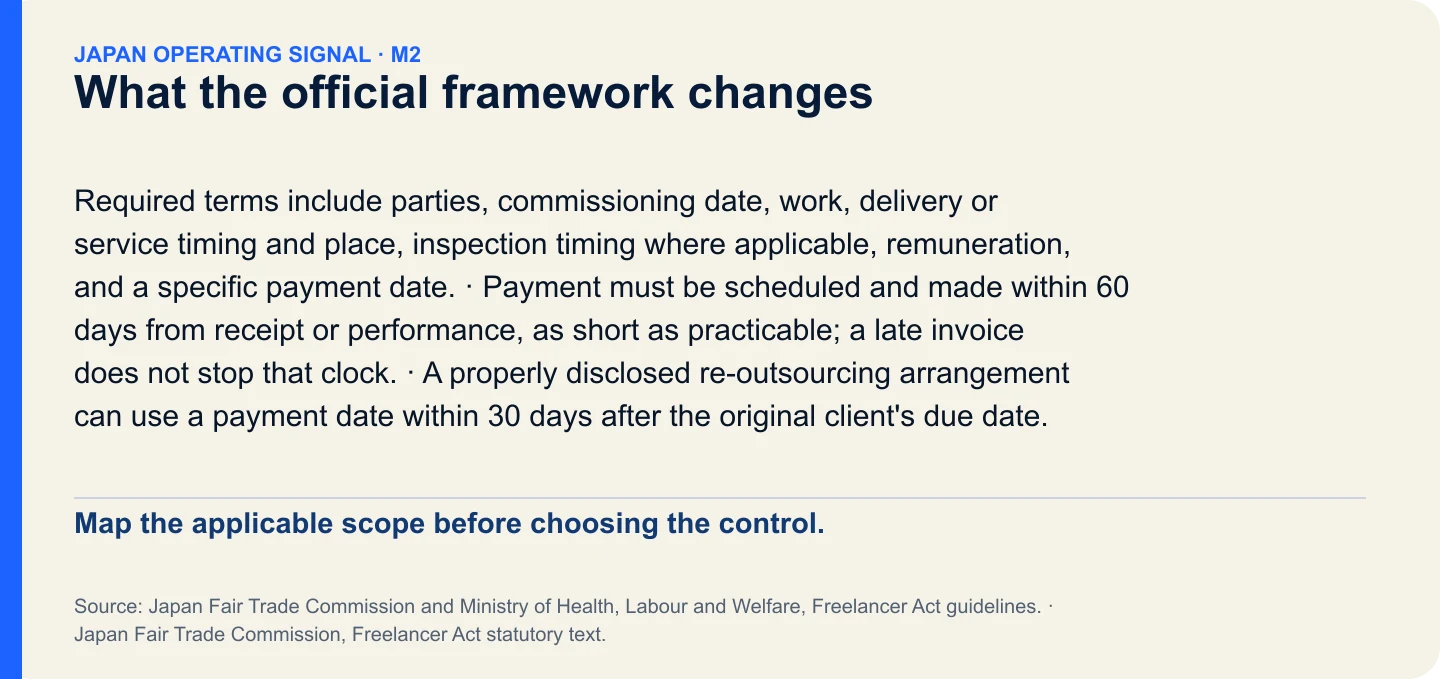
The required items include:
- the identities of the commissioning business and freelancer;
- the date of commissioning;
- the content of the deliverable or service;
- the date of delivery or service;
- the place of delivery or service;
- the inspection completion date, if inspection is used;
- the amount of remuneration and a specific payment date; and
- the payment method where remuneration is non-cash.
The title of the document is not the legal point. A contract, purchase order, email, or platform notice can perform the function if it provides the required information in the permitted form.
The operational risk is fragmentation. A master agreement may contain general conditions, an email may describe the task, and an accounts-payable system may hold the payment term. Unless the freelancer receives a coherent notice and the records can be connected, staff may assume the terms were disclosed when a required field was never communicated.
Unsettled terms need their own follow-up control
JFTC recognizes that a required term may not be determined at commissioning for a legitimate reason. In that case, the initial notice should identify the reason the item is unsettled and the planned determination date. Once the item is determined, it must be disclosed immediately in a supplementary notice, with the relationship between the two notices made clear.
That is an operating clock inside the contracting process. The procurement system should not treat "TBD" as a completed field. It should create an owner and due date for the supplementary notice.
Remuneration is a high-risk example. If the amount depends on a defined calculation, the initial communication should still make the basis clear enough under the current guidance. If the amount is genuinely unsettled, the follow-up cannot disappear into informal negotiation.
The same principle applies to a changed order. Teams need to preserve what the freelancer was told at each stage rather than overwrite the original notice. An immutable sequence makes it possible to understand the agreed task, the later change, and the payment consequence.
Payment runs from performance, not paperwork
For a covered commissioning business, remuneration must be scheduled within 60 days from receipt of the deliverable or provision of the service, and the period should be as short as practicable. The payment date must be specific.
JFTC is explicit that a missing or late invoice does not suspend the obligation to pay by the agreed statutory deadline. "Net 60 from invoice" is therefore an unsafe default description of the rule.
The payment process needs an event that reliably captures receipt or performance. Depending on the work, that may be file delivery, completion in a project system, a service date, publication, attendance, or formal acceptance. If internal acceptance occurs later than legal receipt, accounts payable cannot use the later date automatically.
The system should calculate the outside deadline, compare it with the contractual payment date, and escalate any exception before the deadline. The purpose is not to make accounts payable decide legal scope. It is to ensure that the classification and receipt data received from procurement produce a usable payment queue.
Re-outsourcing has a separate 30-day route
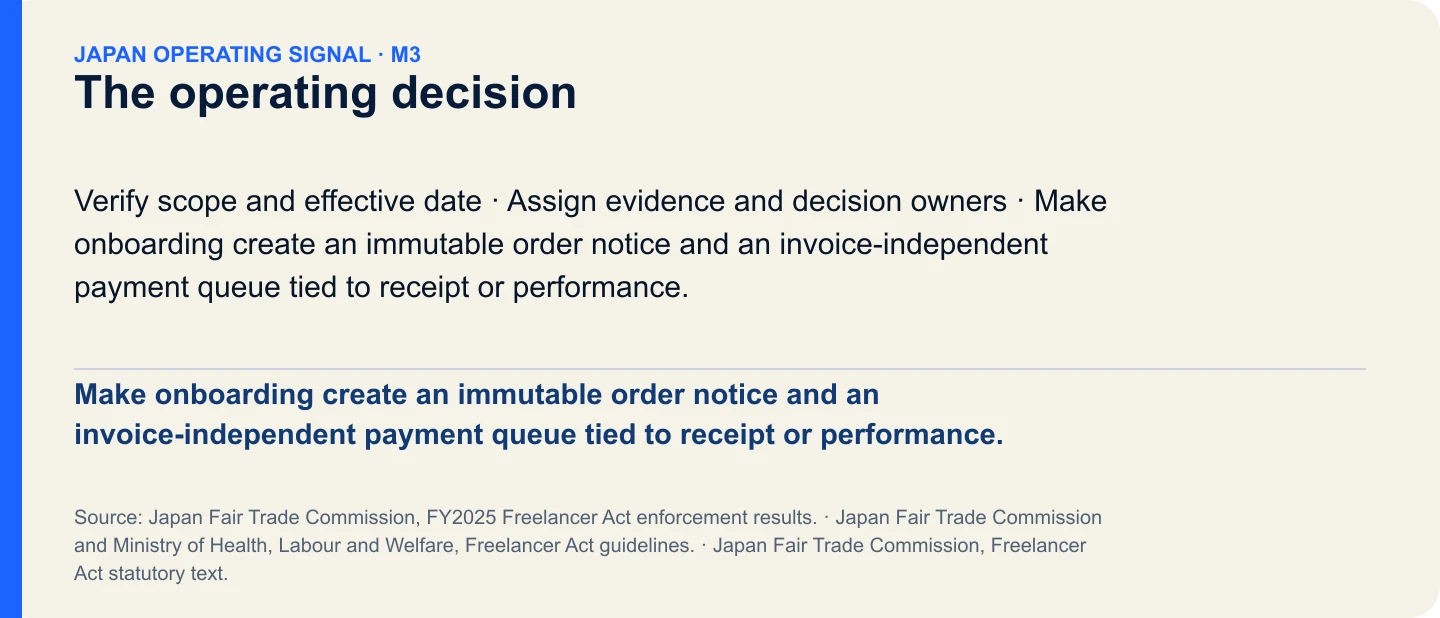
The Act includes a payment-date exception for qualifying re-outsourcing. If a commissioning business passes on work received from an original client, it may set the freelancer's payment date within 30 days after the original client's payment date, as short as practicable.
The exception depends on disclosure. The freelancer must be told that the work is re-outsourced, the original client's identity, and the original engagement's payment date, in addition to the ordinary required terms.
This is not a general permission to pay freelancers when the customer pays. Without the required fields and qualifying circumstances, the normal 60-day rule remains the relevant control. Procurement should therefore make re-outsourcing an explicit order type rather than an informal explanation entered after a late payment.
Fiscal 2025 enforcement shows where operations fail
JFTC's fiscal 2025 enforcement release, published on June 10, 2026, reports 604 allegations submitted by freelancers and 1,626 new suspected-violation cases. It records 10 recommendations and 1,542 guidance actions.
Those totals should be read with their method. A case can contain more than one conduct type, and JFTC says guidance includes conduct considered at risk of violation. The published figures should not be described as final adjudications against every business counted.
The enforcement pattern is nevertheless operationally useful. It shows that the regulator is examining whether terms were communicated and whether payment occurred on the statutory clock. Those are repeatable process questions, not only questions about unusually aggressive contract language.
Duration changes the obligation set
Some protections depend on how long the engagement continues. A series of connected orders or a continuing master arrangement may therefore require careful duration analysis.
The contract system should retain start and end dates and identify renewals rather than treating every purchase order as unrelated by default. It should also signal when a relationship crosses a duration boundary that may change the applicable control set.
This is another reason a static template is insufficient. The relevant duties can depend on who is commissioning the work, who is receiving it, and how the relationship operates over time.
Counterargument: a master agreement can be enough infrastructure
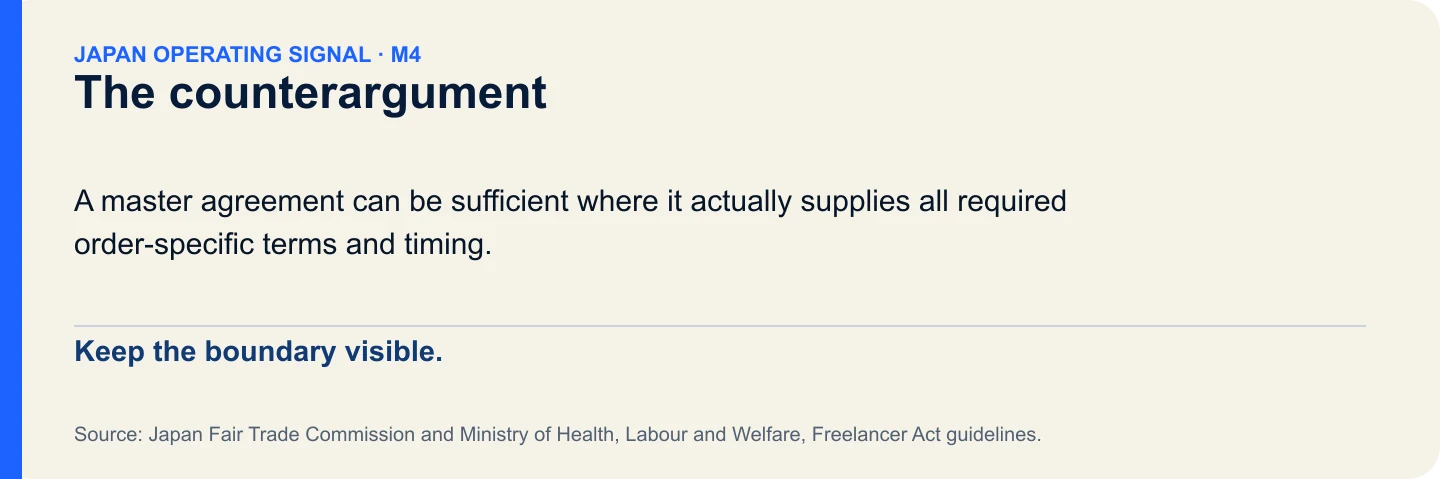
The strongest counterargument is that companies do not need a new contract for every task if a master agreement and existing purchase-order process already contain the required terms.
That is correct. The law focuses on timely disclosure of required information, not on a document with a prescribed title. A well-designed master agreement can carry stable provisions, while an electronic order supplies the task, date, delivery, remuneration, and payment fields.
The weakness appears when teams assume the master agreement contains facts that exist only at order level. A robust design maps every required item to the document or message that communicates it and preserves the link.
Unknowns and source limitation
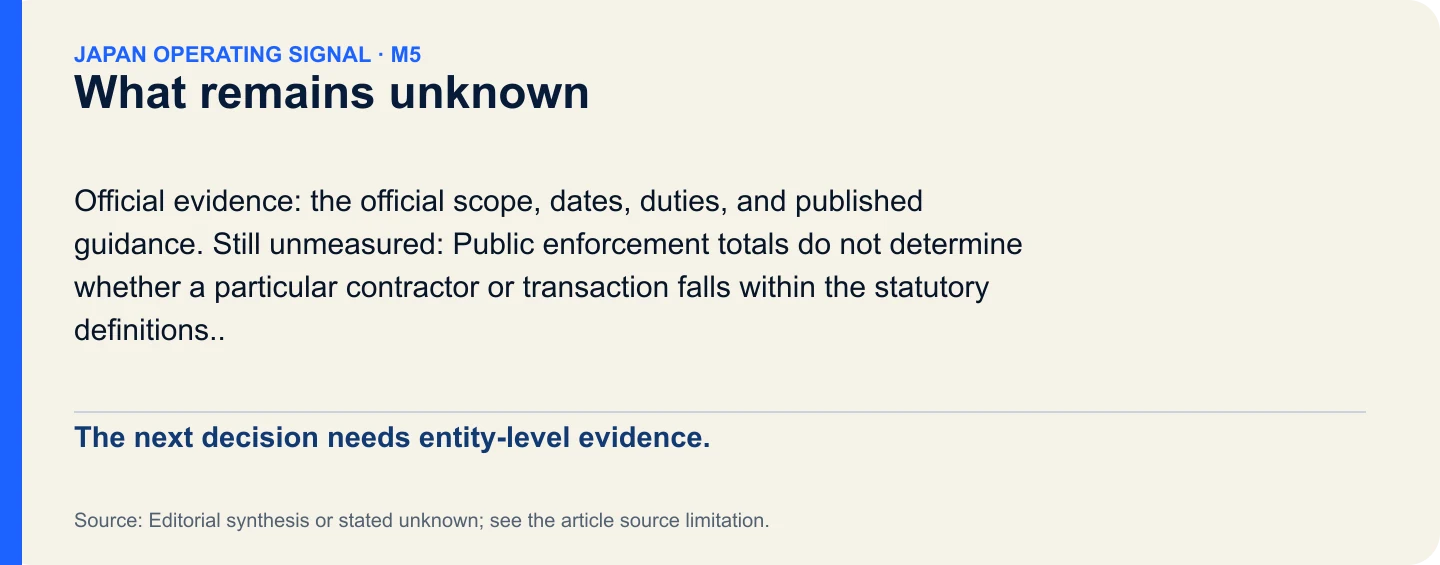
Classification, duration, and receipt can be fact-sensitive. The official materials provide general rules and examples but do not decide every platform, retainer, milestone, or mixed-service arrangement. Public enforcement totals also do not determine whether a particular contractor or transaction falls within the statutory definitions.
There is a one-case discrepancy in official fiscal 2025 summaries. The dedicated enforcement release reports 1,626 new cases, while a recent JFTC activity summary reports 1,625. The dedicated release is the source used here, but the difference should be acknowledged rather than silently harmonized.
Fiscal 2024 covered only the period after the Act took effect on November 1, 2024, through March 31, 2025. Its figures are not a like-for-like annual baseline for fiscal 2025.
Legal and program-scope caution
Not every independent supplier is a statutory freelancer, and not every obligation applies to every commissioning party or duration. The 60-day rule should not be restated as "60 days from invoice." Separate labor-law classification, tax, and sector rules may also apply.
Practical operator decision
Build a freelancer order clock with six linked events: classification, commissioning, immediate notice, receipt or performance, statutory due-date calculation, and payment confirmation.
Require the system to show where each mandatory term was communicated. Make unsettled fields create a follow-up task. Calculate payment independently of invoice receipt. Treat re-outsourcing as a controlled exception with its three additional disclosures. Escalate changes in duration and status.
The key evidence is not merely a signed contract. It is a traceable record showing what was commissioned, what the freelancer was told, when the work was received, and why payment occurred on time.
Evidence
Sources
- FY2025 Freelancer Act enforcement resultsJapan Fair Trade Commission · June 10, 2026
- Freelancer Act special siteJapan Fair Trade Commission
- Freelancer Act guidelinesJapan Fair Trade Commission and Ministry of Health, Labour and Welfare · October 1, 2025
- Freelancer Act statutory textJapan Fair Trade Commission · November 1, 2024